Monday, January 19, 2015

GITA 1.5

GITA 1.5
Many elders have praised this nectar Gita from Sri Krishna. Among the Alwars, the fourth, Sri Tirumazhisai Alwar praises Gita in one of the hymns.
sEyan aNiyan siriyan mihapperiyan
Ayan tuvaraikOnAi ninra mAyan anru
Odiya vAkkadanai kallAr ulahattil
EdilarAm meijnAnamil (71)
This is a wonderful song.The Lord is very near us, as well as very far away from us. He is easily approachable, at the same time He is Almighty. Such a great Person was born as a Cowherd in Ayarpadi (Gokulam) and was easily mingling with others. He hid all His greatness and was born simple. He was King of Dwaraka, in the western coast of India. MAyan = (Such a) Charmer, anru Odiya = on that day told (in Kurukshetra battlefield, in 700 and odd verses), vAkkadanai = that sermon (Gita), kallAr = those who did not study, ulahattil = in this world, EdhilarAm meijnAnamil = will not be able to realise even one reality. Even ordinary knowledge can not be grasped. Then, how can they understand  superior knowledge to know reality? Therefore, if Gita is understood, then unknown things will be known. If we learn so many things but not Gita, then there is no use of all we have learnt. This is what the Alwar tells in this hymn. Sri Nammalwar also tells this : "Arivinaal Kuraivilla agalnyalath avar ariya neri yellam eduthu uraiytha nirai nynathorumoorthi...". That is, againyalath avar = common people like us, should gain superior knowledge about atman and lead a life with equal view of all, neri yellam eduthu uraitha = told us all ways and means, nirai nynathorumoorthi = (the Lord) born with a (divine) body. Let us think of it. Sri Krishna could have remained in Vaikuntam itself.He could have deputed someone else to preach Gita.Or, like Vedas, He could have made Gita available. Instead of any of these, the Lord was born in this world with a beautiful body and sitting as a charioteer preached Arjuna. Therefore, we can imagine how much Sri Krishna was interested to preach Gita,Himself directly. Though it was told to Arjuna, He wanted to tell the whole world, for the common people like us. 
Now we will see what happened from the First sloka of First Chapter. After such a long introduction, everyone would be eager to listen to the Gita slokas. There are 18 Chapters in Gita. This number 18 is closely associated with Mahabharata epic. Mahabharata war was fought for 18 days. The epic is divided into 18 parvas (cantos). Gita, a part of the epic, has also 18 chapters. Let us now start the first sloka
dhrtarastra uvaca:
dharma-ksetre kuru-ksetre
samaveta yuyutsavah /
mamakah pandavas caiva
kim akurvata sanjaya //
Dhrtarastra said: O Sanjaya, after assembling in the place of pilgrimage at Kuruksetra, what did my sons and the sons of Pandu do, being desirous to fight?
Dridarashtra enquires from Sanjaya. Immediately we will have a doubt. In the battlefield, how are these persons present? Gita is about conversation between Sri Krishna and Arjuna, then how Dridarashtra and Sanjaya come into the picture? Dridarashtra is the father of Duryodana and his 99 brothers. He is the elder brother of Pandu. Dridarashtra was blind and Pandu had died at young age. Pandu's sons are Pandavas. Pandu had married Kunti and they had Three children Yudhishtra, Bheema and Arjuna. Pandu had a second wife and from them two sons- Nakula and Sahadeva- were born. Dridharashtra had 100 sons, called Kauravas.Of them Duryodana was the eldest. Due to dispute over kingdom, Pandavas and Kauravas clashed in the battlefield in Kurukshetra. Earlier Yudhishtra lost in a game of gambling and lost his part of Kingdom. Duryodana tried to humiliate Draupadi's (wife of Pandavas) modesty by disrobing her, but she was rescued by Sri Krishna after her surrender. Then Pandavas were exiled for 12 years and then they remained incognito for a year; still, Duryodana refused to part with Pandava's part of the Kingdom; then Sri Krishna went as a messenger and pleaded for at least Five villages for the Pandavas; Kauravas refused to yield and that resulted in the war in Kurukshetra. 
The army of Kauravas, which was bigger was on one side and the smaller army of Pandavas was on the opposite side. Dridarashtra was not in the battlefield but in his palace. Sanjaya was his very old friend. Though blind, Dridarashtra was eager to know what was happening in the battlefield. Sanjaya was blessed by his acharya Vyasa with a divine power to 'see' the battlefield from sitting in the palace and so he assisted Dridarashtra to explain the happenings in the battlefield. Something akin to today's TV technology! Thus Sanjaya tells Dridarashtra the incidents in the battlefield, by the minute and instantly! That is how, these two persons converse in the beginning of Gita. Dridarashtra enquires and Sanjaya replies. After this first sloka, Dridarashtra never speaks again in the entire Gita preaching. But Sanjaya speaks at times to tell Dridarashtra as to what was happening in the war, in all 18 days, till the end of war. 
Let us examine the query of Dridarashtra. Yuyutsavah = with the aim of fighting, samaveta = standing together (on both sides), dharma-ksetre kuru-ksetre = in the righteous place of Kurukshetra (one will follow only righteousness in Kurukshetra), mamakah = my children, pandavas caiva= and the children of Pandu, kim akurvata = what are they doing, sanjaya = O! Sanjaya (please tell). This is a general query from Dridarashtra. "Sanjaya please tell me what happened in the holy Kurukshetra, where my sons and Pandu's sons had gathered to fight each other", enquires Dridarashtra. We are amused at the question. He is asking what are they doing, who had gone with the intention of fighting out. It is like asking, what did he do in the kitchen, with the intention of eating? Why such an obvious question? It means Dridarashtra is concealing something in his mind and enquires Sanjaya. Dridarashtra knows that they were going to fight. But his concealed intention was whether his sons were victorious and Pandavas were defeated. That was his desire. But if he expressed that directly, he was afraid that he would be accused of partisanship. Here Dridarashtra was blind and that was not a real handicap, as blindness is common. Physical handicaps are not necessarily a deficiency. If God's blessings are absent only, one is really handicapped. One may put up with physical blindness; but can one lose intelligence. Here Dridarashtra suffers from such a loss. He knew very well what atrocities were committed by his sons. Still, he sides with his sons. If we do not use properly our influence to correct the mistakes committed by our desired ones, we will only be helping them to fall into hell. As a King, Dridarashtra had all power to easily rectify the blunders committed by his sons. But he did not. When he says Kurukshetra is dharmakshetra, a righteous place, he is hoping that the righteous Yudhishtra now in Kurukshetra, might have changed his mind and might be withdrawing from the battle. Surprised at the question with concealed desire, Sanjaya with both physical eyes wide open and intelligence in sharpness, wants to reply in the same coin! Let us see what and how Sanjaya answered the query.
(continued)




Sunday, January 18, 2015

GITA 1.4

GITA 1.4
"Sarva dharman parityajya mamekam charanam vraja 
ahamtva sarva papeyo mokshayishyami masucha:"
This is a sloka from Sri Krishna's Gita."Surrender unto my feet, I will release you from all papas (sins) and bless you with eternal bliss. Do not worry", spoke Sri Krishna in this sloka.This sloka is the 66th sloka in the last, 18th Chapter of Gita.But before this sloka, the Lord Sri Krishna has given lofty ideas in numerous slokas.We are going to understand each and every sloka separately.Yet, should we not understand this long journey in a summary? Today we will see on the whole what message Gita wanted to convey. Elders have shown this in many ways.We can call it as Gita saram or essence of Gita.Earlier we have seen the story of Sri Alavandar.He has written a compendium called Gitarta Sangraham.In it, he has summarised the messages of Gita in simple language for us to easily memorize. In that work, he has compressed all the 700 slokas into a single sloka:
Svadhârama-Jnâna -VairAgya saadhya-bhakthyEka gOchara:
Nârâyana : Param Brahma GîtasAsthrE Sameeritha: 
This is told in the Gita.What? Sriman Narayana is the Almighty. He will bless us with all our needs.Okay, if it is understood that Sriman Narayana as the entity Supreme God,what will we desire from Him? We can ourselves think of this. For example, we go to an exhibition.Varieties of articles are exhibited.We have selected one as the best. Then we will think whether we can afford to buy it. We will find ways and means to get it.Thus, if we decide on something as best, then we try to find ways and means to attain it. So, we should know which is best and how to attain it.Similarly when we tried to know which is the Supreme entity, the Gita said that Sriman Narayana is the Almighty and Supreme. If this alone is told, then we will not know ways and means to attain It.Once we understand He is Supreme, then we search for ways and means to attain Him.The Gita would explain all those ways and means. So it tells about Sriman Narayana and the ways to attain Him, that is Bhakti (sublime love). As told by Sri Krishna to Arjuna, only through Bhakti we can attain Him.If the entire world is spread with Bhakti and if we get soaked in it, then there is no comparison to the bliss we get. All the Ten Alwars and Acharyas desired to nurture this Bhakti only. Would not the  Bhakti as seed in all minds  germinate into a plant, grow into a tree and then blossom and yield fruits?  Bhakti is the only means to understand Sri Krishna. It is the means to visualize Him and to reach Him.This means of Bhakti was explained in the Gita. Okay, but after all, all of us are Bhaktas and what fresh thing we are going to understand from the Gita? We are Bhaktas and we know the Supreme Being is Lord Sri Krishna. What else we are going to learn?But this is not so. First we should identify Bhakti. What we are doing, is it Bhakti?Are we going on the right track?Are our beliefs correct? Are we ourselves? Unless we know the answers for these, we can not decide whether we have Bhakti or not. For this the Gita came one step down. Bhakti is the means to achieve God, but to possess Bhakti we need to have something. They are Karma yoga and Gyana Yoga. Both are required, Because, if one is asked to perform only pooja (rituals) and meditation - though they alone are not Bhakti-, who is to look after the family, the country and respective jobs?Here only Karma Yoga enters. We should do our karma without fail. Karma denotes the duties and actions. From our childhood we are accustomed to doing many actions from morning till night.But we are not accustomed with Bhakti from childhood.We take food. We play and laugh and cry and sleep away. What is the relationship between Bhakti and these actions? If only by Bhakti we can attain Him, should we sleep or laugh or eat? Should we work to earn? Should we get married to raise families and maintain them? All these are necessary as also Bhakti
The Gita gives you directions to all these and to have Bhakti.This is called Karma Yoga in Gita. All these actions should not be done simply. Then there won't be any difference between a Karma Yogi and an ordinary person. The same actions like bathing, eating or earning, if done with some knowledge, it becomes Karma Yoga.Without that knowledge these action when done would be mechanical. Same action with some thoughts associated would make those actions as superior or, without such thoughts, inferior.Therefore, the Gita first tells Karma Yoga and actions should be done with knowledge. Unintelligent actions will never feed one. We are chanting daily God's names. Should not they be done with some knowledge? Should we not have the knowledge as to why we offer flowers to God? Thus every action should be associated with intelligence or gyana. Karma Yoga is for our daily livelihood.Gyana or knowledge is necessary to associate with these Karma or actions. Gyana is thus required as the next stage. 
Thus we have Three things to learn: Karma Yoga, Gyana Yoga and Bhakti Yoga. Our daily routines done with some knowledge is Karma Yoga. Intelligence, pranayamam, yoga, etc., will come under Gyana Yoga. Then thinking of the Lord, performing pooja and serving Him, will all come under Bhakti Yoga. Lord Sri Krishna tells about all these three in the Gita. If Karma Yoga and Gyana Yoga are performed continuously, Bhakti will emerge. When Bhakti is performed continuously, one can reach the Divine feet of Sri Krishna. By this we have the necessities for this worldly life and also for the Eternal Bliss. That is why the Gita is praised so much. It preaches not mere Bhakti, but all essentials for worldly life. 
But the Gita as preached by Sri Krishna did not start with all these Karma, Gyana and Bhakti Yogas. He told Arjuna to know himself first. Unless we know who we are, we will not know what to do. Unless we know who we are we will not know what to achieve. 
To cite an example, the aspersions of a primary class student would be to come out successfully in the examinations. Whereas, a student in the High school may have his visions of admission in some colleges. A student in a professional colleges may be dreaming about jobs. Thus our objectives will be in the immediate next stage in life. Therefore, we should understand ourselves as to in which stage we are and shape our aspirations and plan our actions. We should understand about ourselves first. That will define our objectives and means to achieve them. Our elders have called these as Tattva, Hita and Purushartham. Tatvam means the Reality. Hita is ways and means to realize the Reality. Purushartham means achievement and consequential benefits. Thus we should know the Reality, how to achieve and the benefits after attainment. All these are given out in the Gita.
On this basis, Sri Krishna first preaches who we are to Arjuna. Whom am "I"? Is it the body or legs or hands? Sri Krishna then tells that none of these were Arjuna and he was the indwelling soul or Atman. These limbs or body are not Arjuna, as they are temporary.These did not exist in his last birth nor would exist in the next birth. That which is constant in every birth was Arjuna and that is soul or Atman. The word "I" denotes atman. Ordinary persons will identify "I" with the body and atman together. But learned Gyanis would identify "I" only with atman. So Arjuna has to learn about the atman first. Arjuna confuses body for atman , and so is afraid of attacking Bheeshma or Drona. Because Arjuna has not understood atman. In turn Arjuna asks what would happen if he knew atman. Sri Krishna replied that then Arjuna would know that all atman were same. This is a basic concept in the Gita called sama darshanam or equality view. All atman in all living beings are same and difference such as male or female, tall or short, white or black, etc., are only manifestations of the body. Thus Gita shastra is that which preaches sama darshanam or equality view. Sri Krishna tells all are equal and there are no differences. So He is with everyone in the same way. Sri Krishna does not look at the differences like intelligent or ignorant, high status or lower status, etc. He is attainable by everyone irrespective of caste or creed. Everyone has equal rights to reach Him. 
To summarize Sri Krishna tells in the Gita, that all are equal and differences appear only on the body or intelligence because of one's past deeds. But if we look everyone at their atman, then there will not be any difference. One should know the atman and consider its superiority and its relationship with Karma Yoga, Gyana Yoga and Bhakti Yoga. Following these one should reach Sri Krishna and attain eternal bliss. In this life one should live honestly and should avoid looking at differences to have enmity or hatred. After preaching, the Lord gave Arjuna vision to view His Divine form.    

Saturday, January 17, 2015

GITA 1.3

GITA 1.3
Sri Krishna gave us the nectar Gita. Gita was preached in Kurukshetra. We can reach this place from Delhi in about 3 or 4 hours travel. Pandavas had Indraprasta as their capital. Kurukshetra was their battlefield. Both Pandavas' and Kauravas' armies were arrayed in Kurukshetra. Sri Krishna's Gita preaching happened in between the two armies. The seven hundred slokas even if recited very fast, could take about 2 hours, or Three hours if recited steadily. That is this duration, if we now decide to recite Gita. But this was not the ambience, when Sri Krishna preached. All the soldiers were ready to fight with their swords drawn. At that time only, Arjuna had the doubt whether the fight was necessary. He saw on both sides his relatives. Within him grew the question, whether it was right to kill so many relatives, to get the Kingdom. He became anxious because he thought that fighting the war was for acquiring Kingdom and enjoyment thereafter, and not for establishing Dharma. So, Arjuna dropped his bow Gandipa and sat down in the chariot refusing to fight. With that determination, he sought the advice of Sri Krishna. Sri Krishna then preached Gita to dispel his fears, to fight to establish dharma and destroy adharma and to bring good to the people. In how much of time Sri Krishna could have advised? This has been the subject of many researchers. Even in Kurukshetra many researches and excavations have been conducted. From Dwaraka and from Kurukshetra we have obtained many evidences. By studying all such publications, one can realize that the war took place in Kurukshetra and that Sri Krishna did preach Gita there. Today, with technology, we are able to see hundreds of pages of documentation are transmitted in seconds to a far off destination. Mobile technology enables us to communicate with anyone in any part of the globe, instantly without any impediments. Therefore, communication between persons is becoming easier. Sri Krishna was not an ordinary human being. He was the incarnation of the Supreme Being. Arjuna also was not an ordinary person, but endowed with gyana and sharp intelligence. So, when Sri Krishna and Arjuna converse, there will not be babble and jabber talk. We have seen that when two intellectuals converse, even facial expressions would convey volumes. Where as ordinary people would take lot of time to understand even some of them. So, it is a higher level of intelligence. It is possible that Sri Krishna would have conveyed so much by mere facial expressions and eye contacts. Matter could have been transferred from brain to brain, without having to speak through the mouth and hear through the ears. It is also said that the lotus eyed Sri Krishna spoke through His lotus like mouth and gave Gita. So, Sri Krishna could have actually spoken. He could have spoken in a fast tempo and Arjuna was intelligent enough to understand them instantly. We find it difficult to understand in the beginning, but by practice, we can also develop understanding the slokas easily. 
We saw Tirukoshtiyur Nambi and Sri Ramanuja. Tirukoshtiyur Nambi had an Acharya and he was Alavandar. There is a story as to how Alavandar got Gita, and that story could be amusing. In the Ninth century there lived Nathamuni, who is considered as the First Acharya in Sri Vaishnava tradition or Guru Parampara. He was born and living in Kattumannar Koil, near Chidambaram, Tamilnadu. Alavandar was his grandson. Alavandar was an infant, when Nathamuni was about to die, So Nathamuni gave all his knowledge in Gita to his disciple Uyyakkondar and requested him to impart that knowledge to Alavandar at appropriate time so that Alavandar was redeemed in life and progressed. Uyyakkondar did not find the opportune moment to impart that knowledge to Alavandar and so he instructed his disciple Manakkal Nambi to take the responsibility. Manakkal Nambi tried to meet Alavandar, who was a ruler of a kingdom, he had acquired through winning a debate. Manakkal Nambi could not meet the very busy ruler. So he devised a method. Manakkal Nambi started supplying a particular type of greens to the ruler's kitchen so that Alavandar daily got the cooked greens. Without enquiring about the source of that dish, the ruler enjoyed the dish. daily. After daily supply for about 6 months, suddenly Manakkal Nambi stopped the supply for about Two or Three days. So, Alavandar was disappointed in not finding the dish in his food and enquired the cook as to why the preparation was not made. When the cook replied that raw greens were brought daily by an old man, and he had not brought them for the last few days. Alavandar asked the cook to bring the old man to him, when he came next time to deliver the greens. Next day, as expected, Manakkal Nambi came with the greens, and the cook promptly produced him before Alavandar. 
Alavandar found Manakkal Nambi to be a great scholar and was puzzled as to why he was supplying greens. Alavandar thought Manakkal Nambi was supplying with some expectation and so asked him what Manakkal Nambi wanted from Alavandar. Manakkal Nambi replied that he did not want anything from Alavandar, instead he wanted to handover a treasure meant for Alavandar. Surprised, Alavandar wanted the treasure, and Manakkal Nambi preached the Gita as told by Alavandar's grandfather Nathamuni. After listening to the exposition, Alavandar surrendered at the feet of Manakkal Nambi and said that after tasting the nectar of Gita, he wanted to see Sri Krishna. Manakkal Nambi took him to Srirangam and got a dharshan of the Lord! Manakkal Nambi prayed the Lord to grace Alavandar and he too,enamoured by Sri Ranganatha, renounced the kingdom and became an ascetic, pursuing God. He later became an Acharya
Therefore, Gita was recognised as a treasure and preserved with reverence. It will be a great opportunity to possess this invaluable treasure and so, we are all assembled. We will see what Gita is all about and what are its teachings, in the days to come. 
                                                                          (continued) 


Friday, January 16, 2015

GITA 1.2

GITA 1.2
paritranaya sadhunam vinasaya ca duskrtam
dharma-samsthapanarthayasambhavami yuge yuge    (Gita 4.8)
This is a beautiful sloka from Sri Krishna. He says that He appears in every yuga (a large division of ages) to protect the good, destroy evil and rescue and establish dharma. Though the Lord has had many Incarnations, we normally glorify Ten Avatars (Dasavatar). Every Avatar is unique and great. But in Sri Krishna Avatar, tenets were preached to improve our lives. Sri Krishna is also known as Sri Gitacharya. He preached Gita by mingling among ordinary people.  Veda Vyasa wrote the epic Mahabharata, which is considered as the Fifth Veda. It has the same superiority as the other Four Vedas - Rig, Yajur. Sama and Atarvana. It has about 125,000 slokas. Compare this with Srimad Ramayana (24,000 slokas) and Srimad Bhagavatam (18,000 slokas). Sage Parashara, father of Vyasa, tells his disciple Maitreya in praise of Vyasa that only Vyasa could compose such a great epic. It is said that what is found in Mahabharata can be found elsewhere also; and, what is not found in Mahabharata can not be found anywhere! With our limited life and knowledge, it is very difficult to study Mahabharata and understand and refine our lives. So, our elders tried to filter the essence of Mahabharata and have prescribed Gita and Vishnu Sahasranamam. With the aid of these two as two eyes, we can refine our life. Gita is what Sri Krishna preached and Sri Vishnu Sahasranamam is about Sri Krishna as told by Bheeshma. Both assist our lives. It is said that Purusha sooktam in Vedas, Manu smriti in smritis, Vishnu Puranam among Puranas and Gita in Mahabharata are most important. Sri Krishna has gifted us Gita incorporating all the essence of all Upanishads. Though there will be many Sanskrit slokas in the lectures, one need not be scared for want of knowledge in Sanskrit, as many scholars have translated them for our benefit. If we are sincere in our attempts we can easily understand all. The Cowherd, Sri Krishna, milked the cows, Upanishads, using Arjuna as a calf, and got us milk, Gita! In fact, Gita is also called Gitopanishad! Since the milk from a cow is not only to its calf but for everyone, Gita was not preached only for Arjuna but for our benefits also. Arjuna was a mere motive for the Lord to deliver Gita. 
Gita was preached to remove Arjuna's anxiety and not to induce him to fight. When one was in predicament as what to do, these tenets came up to do the right and establish dharma. When we are in dilemma, this will be remedy. 
We know how Srimad Ramyana originated. Valmiki was in forest and after a bath in river Tamasa, saw two birds (male and female) on the branch of a tree. Suddenly, one bird was shot down by an arrow by a hunter.  Valmiki was distressed at this sight and out of anger cursed the hunter with all bad things in life. "Manishada pratishtatum samagah sashvatisamah yat krouncha mithunadekam sokam avadhim kama mohitam" are his words. Then he was sitting in his hermitage, when Sri Narada met him. When Narada enquired reason for his sorrow, Valmiki said that he cursed the hunter with words but formed in beautiful poetic metre. But with the blessings of Brahma and Narada, he composed the great Srimad Ramayana. His sorrow (at the sight of the bird being killed) came out as a poem. Sorrow gave birth to a great epic. But here, to dispel the sorrow (of Arjuna), Gita was born!
Keikeyi's maid servant Mantara, went to the balcony and saw the preparations for the coronation of Sri Rama, next day. She was irritated and went to Keikeyi and told that Keikeyi was betrayed by not crowning her son Bharata. For that Keikeyi replied that she did not see any difference between Sri Rama and Bharata. But Mantara slowly changed Keikeyi's mind and so she demanded from Dasarata, coronation for Bharata. Dasarata tried to reason out with Keikeyi, but of no avail. This mind change brought about the entire epic of Ramayana. Similarly, an anxious Arjuna was reluctant ti fight his own kith and kin. If Sri Krishna had agreed we would not have got Gita
How long did Sri Krishna preach? Can it be possible to preach in a battlefield, when both armies had assembled to fight each other? So, how did they converse? Was it oral or mental conversation? 
                                                                   (continued)        


Thursday, January 15, 2015

GITA 1.1

GITA 1.1
LakshmI nAtha samArambhAm nAtha yAmuna madhyamAm |
asmadhAchArya paryanthAm vandhE guruparam parAm ||
yO nithya-machyutha-padaam-buja-yugma-rugma
vyaamOhadas dadhi-tha-raaNi thru-Naaya mEnE
asmath-gurOr bhagavathOsya dhayaika-sindhO:
raamaanujasya saraNau saraNam prapadhyE.
I am standing before you all devotees, with a desire to share the nectar of Gita (Kannanin Aaramudam). We are to drink that nectar to our satisfaction. Most of you to know to some extent Sri Krishna's Gita. Everyone has the desire to know more and more of it. As if to fulfill this desire, great scholars of our country have written many commentaries on the precious points in the text of Gita and made them available for us. We are now assembled to see how we can derive benefits from Gita, using those valuable commentaries as basis and at the same time considering the present times. Sri Krishna's blessings should also be there in listeners' minds, as well. With Sri Krishna's and Acharyas' blessings, I (the lecturer U.Ve. Velukkudi Sri Krishnan Swamy) should also get the power to lecture appropriately. With prayers at His Divine feet, we will start this lecture serial. 
I am presently standing in front of the divya desam (kshetram) Tirukoshtiyur.
There are 108 Divya Desams (sacred temples) according to Sri Vaishnava philosophy. Among them Tirukoshtiyur is important. Alwars' Nalayira Divya Prabhandam (4000 sacred hymns of Alwars) is recited in Sri Vaishnava temples. In that the compilation Tirupallandu and Periyazhwar Tirumozhi, hymns sung by Periyalwar, are recited first. In that the first poem of Periyazhwar Tirumozhi is:
vaNNamaadangkaL suuzh thirukkOttiyuur
kaNNan kEsavan nambipiRanthinil
eNNeysuNNam ethirethir thuuvidak
kaNNanmuRRam kalanththu aLaraayiRRE.
This is sung in praise of the Lord of this place Sri Sowmyanarayana Perumal.
  
This place is also known as Goshtipuram and Tirukkottiyur. This is the place, where Brahma, Vishnu and Siva assembled to discuss how to protect the devotees. Since They assembled as group (Goshti), this place got the name Goshti puram or Tiru Koshtiyur. The Lord of the temple (Moolavar) is gracing in a reclining position. He is gracing as Sri Sowmya Narayana or Sri Sowmya Damodara Perumal or in short Sri Sowmyan. The Lord is also known as Sri Madhavan. Alwar while describing this temple tells, to stimulate our thoughts, that the water drunk and clothes worn by those, who never utter the Divine name of this Lord, as sinful. Can there be better way to express the greatness of this Lord? The Lord graced here for the sage Kadamba as Sri Naraka Nathan, to dispel all miseries. These are greatness of this ancient temple. We may get a doubt as to how this Kshetram and Gita are related? Why Tirukoshtiyur is selected for start of this lecture serial? 
The great Acharyas of our country, Bharat, namely, Adi Sankara, Ramanuja and Madwacharya have written commentaries on Gita. Of these, it was the time when Sri Ramanuja  was living in Srirangam. He was born in 1017 A.D. and lived for 120 years, that is till 1137 A.D. He wanted to learn the significance of Gita. He wanted to understand the 66th sloka of Chapter 18 of Gita, known and renowned as charama sloka by everyone, and Ashtakshara mantra  or Tirumantram (Om namo narayanaya). He learnt that Sri Tirukkottiyur Nambi, a renowned scholar in these subjects, lived in this Kshetram. So, Sri Ramanuja walked all the way from Srirangam to this place (about 46 miles/76 KMs) and enquired here as to where Sri Tirukkottiyur Nambi was living. From that point till Sri Nambi's house Sri Ramanuja went on prostrating at every step. From this we can understand the greatness of the person he was seeking as teacher and of subjects he wanted to learn. Meeting Sri Nambi, Sri Ramanuja requested to teach him Tirumantram and Gita. Sri Nambi did not agree immediately. He advised him to come to him after he became more eligible. Like this Sri Ramanuja was turned away 17 times. But on his 18th mission, Sri Nambi yielded and taught Sri Ramanuja, the significance of Tirumantram and Gita. Sri Ramanuja was told, after he learnt everything, that he should teach others following the same code (and not freely teach everyone without knowing the learner's sincerity and maturity). Though Sri Ramanuja agreed, after leaving Sri Nambi, he came to this temple and prostrated before the Lord. Then he thought that the essence he learnt from Sri Nambi was such a great treasure that could uplift those who learnt and followed, and so ne thought that it should not remain a secret, known only for very few, but to be propagated to a larger audience. So, Sri Ramanuja selected some of the people who had some knowledge and taught them what he learnt from Sri Nambi. Enraged on hearing that Sri Ramanuja was teaching others, Sri Nambi came to Sri Ramanuja and questioned as to why he flouted his instructions on teaching others. Sri Nambi also warned Sri Ramanuja that disobeying guru's instructions would push Sri Ramanuja into Naraka (Hell). After prostrating Sri Nambi and apologising, Sri Ramanuja told that he was aware that disobedience of guru's instructions would push him into naraka, but he would welcome Naraka for himself, if all those people he taught would get salvation and get Moksham.  Immediately, Sri Nambi realised the greatness and the compassion Sri Ramanuja had and embraced him and conferred the title 'Emperumanar'. We are now at the sannidhi of Sri Emperumanar.
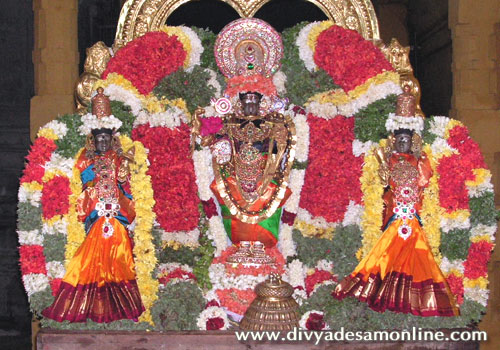
Next to this, is the sannidhi of Sri Ramanuja's Acharya Sri Tirukoshtiyur Nambi:
Moolavar                              and               Utsavar:

It is customary in this temple to first worship these Acharyas before worshiping the Lord. 
After looking at both Acharya and Disciple, we can appreciate the connection between this place and Gita. The exposition of Gita and the charama sloka was done in this Kshetram. Therfore, it is God's blessings that the starting lecture of this serial is from this place. Thus, what was preached as Gita by Sri Krishna is available with valuable commentaries by Acharyas and we enjoy them. From now on we will meet daily to understand Gita and its greatness. The Lord has appeared on this Earth in many avatars (incarnations). However, Sri Krishna Avatar is considered special, becauseHe preached Gita. Gita is part of the epic Mahabharata. It has 18 Chapters and 700 slokas. Gita was born to clear doubts in a confused Arjuna. Therefore, Gita will benefit all those who are in turmoil. In our life we face daily some dilemma or the other. Many difficulties crop up. To get relieved from all these, Gita will standby to assist. Like for Arjuna, everyone can benefit from Gita and be happy. Therefore, it is essential that Gita lectures are listened to by all in all families. 
                                                                                    (continued) 


Wednesday, January 14, 2015

INTRODUCTION

INTRODUCTION

श्रीमते  श्री लक्ष्मीनृसिंह परब्रह्मणे नम:  
श्री मट्टपल्लीनाथम प्रणतोस्मि नित्यं नम :  
Sri UVe Velukkudi Krishnan SWamy needs no introduction to Tamil people all over the World for his powerful lectures on Sri Vaishnavam of Sri Ramanuja Siddhanta. He lectured on Srimad Bhagavdgita on the Doordarshan Poigai Tamil TV channel daily on all working days for nearly 750 days. This used to be telecast as 'kannanin aaramudhu' in the morning from 6:30 to 6:45 AM (a repeat telecast in the evening from 6:30 to 6:45 PM) in Tamil starting from January, 2007. Since this was the first time I was listening to Gita in such a detail, I first thought of translating the gist in the form of a mail to my children living abroad. Then on the advice of my son, I created a blog and started writing the lectures in English. Earlier I used to scribble the lecture on paper and then translated it. But since speed of writing was very much limited and with my own limitations in listening and writing simultaneously, I recorded the lectures on audio cassette tapes and then translated by replaying with pausing and reverse and forward techniques. Thus I could try verbatim translation, only limited by my English knowledge. But this started after the lectures had progressed to some extent. I also started this adventure after skipping the first few lectures.
Now in 2015, I perused those writings and felt that I could rewrite the lectures from the beginning resorting to the recordings available in the website maransdog.net and youtube, and editing whatever was already written so that a full compilation could be presented. Also in my earlier translation work, I had missed a few lectures due to variety of reasons. I thought in the present blog I could get those missed lectures also translated. I have also used the Internet to get more visual aids to make the reading interesting.
Before I venture I prostrate at the Divine feet of the Divine Couple Sri Rajya Lakshmi sametha Sri Mattapalli Yogananda Lakshminrusimha Swamy, at the lotus feet of my Acharyas of Sri Ahobila Mutt and at the lotus feet of UVe Mukkur Sri Lakshminarasimhachariyar. The last mentioned is fondly remembered by our group, as Sri Mukkur Swamy. Though I had listened to his lectures in the 1970's, I came into intimate contact with him in 1987, in New Delhi, when at our request he decided to perform the 90th Sri Maha Narasimha Maha Mantra yagnam in New Delhi. My family and I were so much blessed to be fortunate to host him and his family whenever they came to Delhi.We, like many others, regard him as the incarnation of Sri Nrusimha and hold him in very high esteem and respect.
I also prostrate at the lotus feet of Sri Velukkudi Swamy for the honey soaked lectures in which he has explained the subject very clearly and lucidly. I was fortunate to listen to a seven day lecture on Srimad Ramayana by his illustrious and famous father Sri Velukkudi Varadacharya Swamy.  I take this opportunity to thank Doordarshan for arranging the lectures and telecasting them and to maransdog.net and youtube for archiving the original lectures in Tamil and making them available for the public.