Thursday, September 1, 2016

GITA 11.5

GITA 11.5
Considered as the Leader of Alwars, Nammalwar composed Thiruvaimozhi, equivalent to Sama Veda. Of the 1102 pasurams, the First pasuram is Uyarvara uyar nalamudaiyavan.[உயர்வர உயர் நலம் உடையவன்].The Lord is with supreme auspicious qualities and without any blemish. Alwar says that He blessed him with knowledge and devotion [gyana and Bhakti] without any further doubts [mayarvara madhinalam arulinan -மயர்வற மதிநலம் அருளினன்]. That is Bhakti embedded Gyana was granted to the Alwar. [Ayarvarum amarargal adipati -அயர்வறும் அமரர்கள் அதிபதி ] Leader of Devas and Nithyasuris, blessed Alwar. He is Sri Devaraja. [Thuyar aru sudaradi thozhudhen maname - துயர் அறு சுடரடி தொழுதென் மனனே]. Worship the Divine feet of that Lord, says Alwar. By doing so our miseries are cut off. Thus Alwar advises his mind. Why, instead of advising others, Alwar advises himself? To know the reason, we have to come to the sannidhi of Nammalwar, situated in the Alwar tiruchutru [corridor for Alwar procession -ஆழ்வார் திருச் சுற்று] in the temple.
PART OF AZHWAR TIRUCHUTRU

 We can figuratively see the pasuram in idol form. We enter the sannidhi consisting of large maha mandapam and Ardha Mandapam. Then is the garbha gruham, where Alwar is gracing. Whenever the Lord Sri Devadiraja, comes in procession on Garuda vahanam, it is in this corridor only the Lord begins, after, first blessing Alwar in his sannidhi, the Lord proceeds further. Sri Devaraja observes Garuda vahanam in the months Vaikasi, Aani and AadiVaikasi Garuda sevai is well known; when, during Brahmotsavam, on the Third day the Lord is in procession on Garuda.
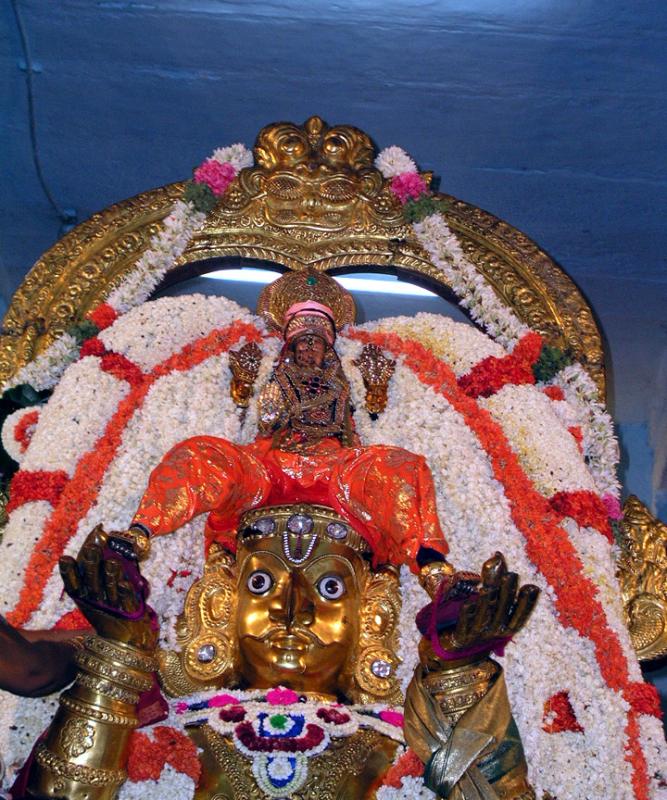
THE LORD ON GARUDA
Again in Aani, on Swathi, the birthday of Perialwar, the Lord is on Garuda. This is the replica of the Lord appearing to Perialwar on the streets of Madurai.
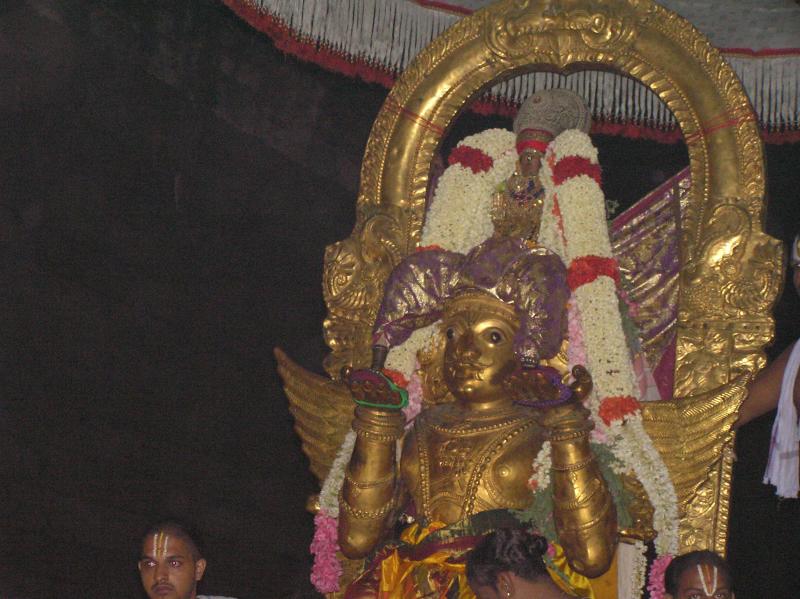
THE LORD ON GARUDA IN THE MONTH OF AANI
Then, in Aadi Pournami, to enact the incident of Gajendra Moksham, the Lord is on Garuda.
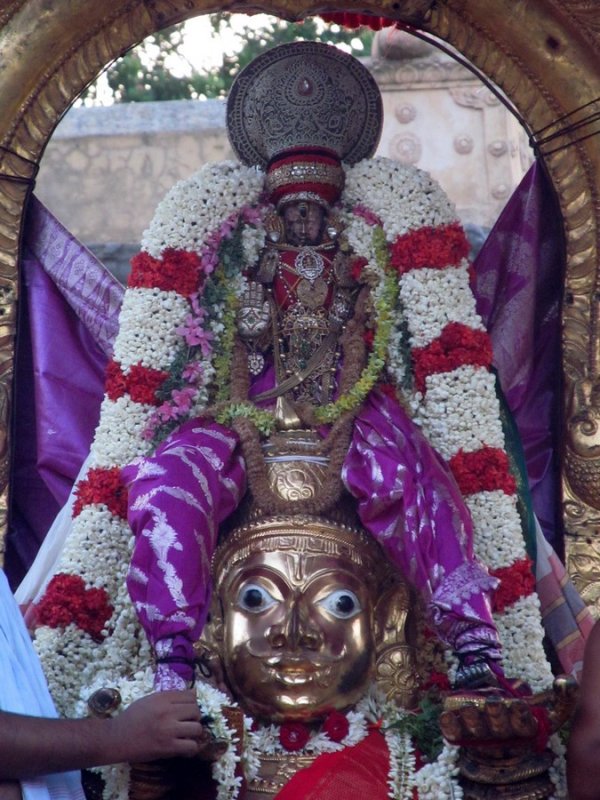
THE LORD ON GARUDA IN THE MONTH OF AADI

 All these Three Garuda sevai, are started with a visit to Nammalwar sannidhi. What is the connection between Alwar and the Lord on Garuda? Swami Vedanta Desika says that in the very First pasuram of Tiruvaimozhi, the Alwar mentions Sri Varadaraja. Amarargal adhipathi - Leader of Devas, indicates Sri Devaraja! Again in Nammalwar's Tiruviruttham [திருவிருத்தம்], the First pasuram starts with poi ninra gyanamum polla ozhukkum[பொய் நின்ற ஞானமும் பொல்லா ஒழுக்கமும்].In that, he says Imayor thalaiva [இமையோர் தலைவா], which means again, Leader of Devas or Sri Devaraja! Thus Alwar has an intimate devotion to the Lord of this temple. We will see another pasuram in Tiruvaimozhi. We can remember this in Arjuna's request in the sloka 4 of Chapter 11. We can see the similarity of both. Alwar assumes the heroine [நாயிகா பாவம்] form and languishes to see 'her' Hero, the Lord. 'She' sends emissaries to the Lord. 'She' sends a message that the Lord had totally forgotten 'her' and so, He should come in the street where 'she' is living and show Himself. In the pasuram the words to this effect are arulazhi put kadaveer [அருளாழி புட் கடவீர்]. 'She' wants the Lord to come on Garuda and show Himself to 'her' so that 'she' does not wither away longing to see Him. The Lord fulfils the request of His devotee. That too, if the devotee happens to be like Nammalwar, then the Lord takes it as an important responsibility. Therefore, whenever the Lord takes a ride on Garuda, He does not miss first to grace the Alwar, before He proceeded further. We have seen Alwar in many Kshetrams. In all those places Alwar would be either in Anjali [folded hands] mudra or in upadesa [ teaching] mudraBut here, the Alwar's right arm is touching his heart, in upadesa mudra. That is, he is advising his mind!
SWAMY NAMMALWAR

 It seems that when the Alwar's idol was being crafted in the usual way, it was not possible and this pose only could be moulded. Thus his pasuram is figuratively displayed. To the right of Alwar is Madurakavi Alwar and to his left, Swami Nathamuni, are gracing.
NAMMALWAR WITH MADURAKAVI ALWAR (L) AND SWAMY NATHAMUNI (R)

 Nammalwar is alwauys with Sri Madurakavi Alwar to his right and Swamy Nathamuni to his left.For the satthumurai [சாற்றுமுறை], the finale of festivals, of all the Three mentioned above, the Lord arrives at this sannidhi.That is on Vaikasi Vishaka - it is possible that is also the Garuda sevai day. Madurakavi Alwar was the direct disciple of Alwar, while Swami Nathamuni, who appeared much later, is also a disciple of the Alwar, by Swami Nathamuni's yogic powers. For every festival of the Lord, mruth sngrahanam [ம்ருத் சங்க்ரஹணம்] - collecting mud from the ground- is performed in this sannidhi only from a maadam (மாடம்).
MRUTYU SANGRAHANA MAADAM

 By this procedure, symbolically, we can say, Alwar conducts the festivals.
 Part of the sloka 4, we are to see today [2nd October 2008 ] has been seen in Alwar's pasuram. We saw that Arjuna mentioned whatever he learnt in Chapters 1 to 6, in one sloka, and whatever he learnt of Chapters 7 to 10, in another sloka. Then he told that believing all told by the Lord as true, he desired to see His wealth. Expressing desire is one thing, but to really see Viswaroopam is another matter. So in sloka 4, he expresses this:

manyase yadi tac chakyam
maya drastum iti prabho
yogeshvara tato me tvam
darsayatmanam avyayam

"If You think that I am able to behold Your cosmic form, O my Lord, O master of all mystic power, then kindly show me that unlimited universal Self."

Manyase = if it is thought so, Prabho = Lord [Sri Krishna], yadi = this [Arjuna's desire], chakyam = possible, maya drastum = could be seen by me [Arjuna], then, atmanam = Your [Sri Krishna's] image, avyayam = limitless, me = to me [Arjuna], darsaya = show, yogeshvara = repository of auspicious qualities. Arjuna says that if the Lord thought that Arjuna could see that limitless image of the Lord [Viswaroopam], then He might show Arjuna. Arjuna expresses a doubt in seeing the Lord's infinite image [Viswaroopam] with the normal eyes. We can see the Lord in temples with our eyes. But Viswaroopam involves showing His image with entire Universe as His body. Our eyes have limitations. Prabho also means capable of doing anything. Arjuna cleverly uses this word. Since he is doubtful of seeing the Viswaroopam with the normal eyes, the Lord, capable of doing anything, should make Arjuna see by providing special powers. It is similar to the request Alwar made to the Lord to come on Garuda to the street, where Alwar lived. Swami Koorathalwan says that our eyes with limitations could only see objects with limitations; but, the Lord has infinite qualities and so our eyes can not see as such. Nammalwar desired to see the Lord as Fire, Water, Wind, etc. The Lord agreed that he could see. But what Alwar desired was he should see in these the Lord holding discus and conch. Thus the Lord yields to the request of His devotees and so He is Sri Varadaraja!
                                                                                             (continued)


GITA 11.4

GITA 11.4
WEST SIDE RAJA GOPURAM

Srinidhim nidhimaparamarthinam
artitarthaparidana dikshitam |
Sarva bhutasuhrutam dayanidhim
devarajamadhirajam asraye ||
This sloka is in the beginning of Sri Varadaraja Sthavam, by Swami Kooratthalwan. The Lord is nidhi [wealth] for Sri Maha Lakshmi or Sri Perundevi Thayar, capable of granting wealth of Sri to Universe and He is Sri Varadaraja, capable of granting whatever one yearns for. The Lord is gracing in Kanchipuram. He is the best Nidhi or wealth. This 'Wealth' has been preserved carefully, by Alwars and Acharyas, and preserved atop Hasthigiri. To worship the Lord of Hasthigiri we are entering the temple. Tall Raja gopuram welcomes us. This is the Western gate. The Lord observes all processions via this gate only. After crossing this we see two Four pillared mandapams. Every time the Lord arrives after a procession, He is welcomed with honours such as argyam, padhyam and achamaniyam in these mandapams; thereafter, thiruvandhikappu [திருவந்திக் காப்பு] is performed inside. When this lecture was being recorded, an important function was celebrated. Adi [ஆடி] Pooram [பூரம்] is Sri Andal's birthday. So, Sri Andal and the Lord exchanged garlands as part of Kalyanotsavam [கல்யாணோத்சவம்] and entered the temple. It is a beautiful sight.

TIRUVANDHIKKAAPPU
EXCHANGING GARLANDS
THE DIVINE COUPLE
Sri Devaraja has captivating beauty and it is said that Swami Ramanuja was totally attracted by His shoulders. King Krishnadevaraya and Pallava Kings have done many contributory works for this temple. We now arrive at Dwajasthambam and Bali Peetam. On the left of Dwajasthambam is the vahana mandapam or hall where all vahanams [vehicles] are stored.

VAHANA MANDAPAM
 In this mandapam, Swami Vedanta Desika and Swami Thatha Desika or Swami Thathacharya [தாதசார்யா] are gracing. After worshipping these Acharyas, we enter the temple. Lord Brahma arrived at Satyavratha Kshetram [Kanchi] to perform yagna. He got constructed the homa kund [where the sacred fire is lit] Uttharavedi [உத்தரவேதி], by Viswakarma. He started the yagna alone, without his consort Sri Saraswati. Angered by this negligence, Saraswati decided to stop the yagna. First, she put the entire world in darkness. The Lord appeared as Sri Deepaprakasa [ஸ்ரீ தீப பிரகாசர் ] in Chitra Revati [சித்திரை ரேவதி].
SRI DEEPAPRAKASA PERUMAL

 Darkness was driven out. Again when lord Brahma wanted to start the yagna, Saraswati sent a demon with bird and beast features to stop the yagna. Immediately, the Lord appeared with Eight arms -Sri Ashtabuja Perumal [ஸ்ரீ அட்டபுயகர பெருமாள்].

SRI ASHTABHUJA PERUMAL
 Both these are separate Kshetrams within Kanchipuram. This happened in Chitra Rohini [சித்திரை ரோகிணி]. The demon was driven away and lord Brahma started the yagna. Not to rely on others to stop the yagna, Saraswati then decided to stop the yagna herself and took the form of a rushing river - Vegavati [வேகவதி]. The Lord now took the reclining pose and as a bridge stopped the flow of the river. This happened in Vekkha [திரு வெஃகா ] and the Lord is Sri Yatoktakari [ஸ்ரீ யதோக்தகாரி / ஸ்ரீ சொன்ன வண்ணம் செய்யும் பெருமாள்].
SRI YATOKTAKARI PERUMAL AT VEKKHA


 This happened in Chitra Punarvasu [சித்திரை புனர்வசு]. Thus the Lord appeared in Three forms in the month of Chitra in Revati, Rohini and Punarvasu as Sri Deepaprakasa, Sri Ashtabuja Perumal and Sri Yatoktakari. Lord Brahma was able to complete the yagna and from the homa kund Utharavedi, the Lord arose. Swami Vedanta Desika has composed a stothram Sri Varadaraja Panchasat. He says that lord Brahma was able to see, the otherwise invisible Lord, the Supreme Cause- Sriman Narayana, coming out of the homa kund. We can see even now that the Lord's has marks of fire on His Face. That is why the Lord is also called Sri Tyagaraja [ஸ்ரீ தியாகராஜா] and the mandapam is called Tyaga mandapam [தியாக மண்டபம்]. In Srirangam, the Lord is enjoying and so it is Bhoga [pleasure] mandapam. Tirumala is called Pushpa [flower] mandapam. Here it is Tyaga mandapam and the Lord is Sri Tyagesa or Sri Tyagaraja. When the Lord appeared from the homa kund, He came along with the Vimanam [canopy] and it is called Punyakoti vimanam[புண்ய கோடி விமானம்]. We might not be able to do koti [10 Million] Punya; but certainly, we can view this vimanam and get the benefit. The Lord has many names like Sri Devarajan, Sri Varadarajan, Sri Devadirajan, Sri Perarulalan [ஸ்ரீ பேரருளாளன் ], and so on.
 We will now see sloka 3 of Chapter 11. Lord Brahma saw the Lord as He appeared from the homa kund. Arjuna also prays to see the Lord:

evam etad yathattha tvam
atmanam paramesvara
drastum icchami te rupam
aishvaram purushottama

"O greatest of all personalities, O supreme form, though I see You here before me in Your actual position, as You have described Yourself, I wish to see how You have entered into this cosmic manifestation. I want to see that form of Yours."

He addresses the Lord as Parameswara and Purushottama and desires to see the Lord with His wealth. It is not wrong to pray to see the Lord. We may like to see Him with these ordinary eyes we have. That is why the Lord is standing on the Hasthigiri so that millions of devotees could see Him. Te rupam = Your [Sri Krishna's] enchanting beautiful image, drastum = to see, icchami = [I, Arjuna, am] desiring. But a precondition is to be satisfied. We should believe what all He told. If we believe all things He told in Chapters 1 to 10, then we should realize that He is the One and Only God. That He is the Prime Cause for everything in this Universe. If we believe in this, then the Lord also would agree to be visible. This is Sri Krishna's opinion. Yata = whatever, tvam = You [Sri Krishna], atmanam = about Yourself [Sri Krishna], atta = explained, etad = let that be [as truth]. Here, Arjuna is not saying that he is permitting the Lord to say so; but Arjuna is fully accepting all those told by the Lord. We should accept all things told about the Lord and believe in them. It is not that we are to believe, even if they were false; but, they are all true and so we have to believe. He addresses the Lord as Parameswara. Paramam means Super most or the most Supreme, with none equal or superior. Iswara means Leader, Who commands and controls everyone. Arjuna feels that the Lord would not have cheated him by any of the explanations He made in all the slokas so far because He is his Iswara. The Lord has all the knowledge, as He is Iswara. The Lord possesses all auspicious qualities, as He is Iswara. Being Iswara, He is the repository of all good qualities, He would not misdirect Arjuna and would not utter lies. The Lord is close to Arjuna and so he believed as truth or Satyam whatever the Lord told. Paramaswara indicates all the eminence of the Lord. This feeling we will get when we have darshan of the Lord Sri Varadaraja, standing with broad shoulders. In fact, we may submit a decree proclaiming our eternal slavery to the Lord! Once agreed, Arjuna desires to see the Lord. Aishvaram = wealth, commanding powers, entire property. Earlier the Lord told that lord Brahma, this Universe, all living beings such as birds, snakes, Asuras, etc., were all His property. When we own something, say, a car, we just own it; but we are not the car. But in the case of the Lord, all His property are His body. Everything is a microscopic part of His body. Arjuna wants to see that body. He wants to see Viswaroopam. Viswam, that is this Universe, is His body. Then Arjuna addresses the Lord as Purushottama. Purushas [all atman in all living beings] can be adama = low type, living at the cost of others; or, madyama = middle type, living and letting others also to live; or, utthama, supreme or best, destroying or lowering oneself to let others live. The Lord, to fulfil lord Brahma's desire, immersed Himself in the Holy fire and then came out; so, He is Sri Purushotthama. Purusha also means he who grants whatever is demanded. That is why Arjuna asked Him. Because He is granting, the Lord is called Sri Varada [varam dadadi - granting demands]. He wants all living beings should live happily. He is the embodiment of mercy. So we have to surrender unto Him only, as told by Swami Kooratthalwan. By mentioning Parameswara and Purushotthama, Arjuna is implying Lord Sri Varadaraja.
                                                                                                (continued)

GITA 11.3

GITA 11.3
Srirangam Karisailam Anjanagirim Tharkshyadri Simhachalau
SriKoormam Purushtthamam cha BadariNarayanam Naimisam
Seimad Dwaravati Prayaga Mathura Ayodhya Gaya Pushkaram
Salagrama girim nishevya ramate Ramanujoyam muni:
This sloka tells the places Swami Ramanuja visited and served to do good for the people. Though he visited many Kshetrams, he was born in Sriperumbuthur and for learning various skills he lived in Kanchipuram. We are now in Kanchipuram. It is praised as nagareshu kanchi that is, among cities Kanchipuram is topmost. Kanchi is well planned with straight roads and beautiful buildings and temples. Kanchi incorporates many Kshetrams. But we are in the main temple of Sri Varadaraja or Sri Devaraja Perumal [ஸ்ரீ தேவராஜ பெருமாள்/ ஸ்ரீ தேவப்பெருமாள் ].
Srirangamangalanidhim karuna nivasam
Sri Venkatadri shikaralaya kalamakam
Sri Hasthisaila shikarotjvala parijatam
Srisam namami sirasa Yadhusaila deepam. 
This sloka salutes Srirangam, Tirumala, Kanchipuram and TiruNarayanapuram. We note these Four important Kshetrams. The First Three are famous as koil, tirumalai and perumal koil [கோயில், திருமலை, பெருமாள் கோயில்]. Perumal koil indicates Kanchipuram, which is also known as Vishnu Kanchi. It is known as Satyavrata Kshetram. This place got the name Kanchi because 'ka' indicates lord Brahma, 'anchitam' means worship. So it is the Kshetram worshipped by lord Brahma. Lord Brahma performed Yagam here. The Lord Sri Devaraja was worshipped by lord Brahma. Thus this place got the name Kanchi. It is called Satyavrata Kshetram because the Lord pledged to appear here to lord Brahma. He appears as the embodiment of Satyam or Truth, and so it is Satyavrata Kshetram. We are now entering the temple of Sri Devadiraja [ஸ்ரீ தேவாதி ராஜ] Perumal.


SRI VARADARAJA PERUMAL TEMPLE, KANCHIPURAM
The Lord is facing the West. So we enter the temple from the West gopuram. A very large temple.As we enter, on the left we notice the Nootrukkal [100 pillared] mandapam [நூற்ற்க்கால் மண்டபம்], built by many Kings and devotees. Many of the sculptures in this mandapam belong to Pallava period. Pallava Kings who ruled in the 7th and 8th Centuries have done enormous works in this temple. We now come to the Pushkarini behind the Nootrukkal mandapam. This pushkarini is called Anantha Pushkarini or Anantha Saras. Anantha means endless; so, a very large pushkarini. Anantha is also the name of Adisesha. So, this pushkarini is named after Adisesha, who worshipped the Lord here. This pushkarini has a unique feature not found in other pushkarinis. Here, the Lord is inside the pushkarini. We might have heard of Sri Atthi Varada [ஸ்ரீ அத்தி வரதர்]. 
SRI ATTHI VARADAR

The Lord of this Kshetram was once upon a time made of wood. In Srirangam, the Lord is made of sudha [சுதை]. In Tirumala, He is of sila [சிலா] idol. Here, the idol of the Lord is dharu [தாரு or दारु ], which means wood. But the Lord desired to feel cool in water and wanted the devotees to worship His sila roopam. So, He ordained His devotees to place Him in Ananthasaras; and, further ordered that a new and large sila [stone] idol be prepared for worship. For this, He directed to procure granite from Pazhaya [old] Seevaram [பழைய சீவரம்] village nearby. This happened so many centuries back. Even now, once in every Forty years, Sri Atthi Vardar is brought out of the pond and placed outside, for devotees' worship for one mandalam of 48 days. This happened last in 1979; and, the next such viewing will happen in 2019. Sri Atthi Vardar is placed in a well like construction in the mandapam in the pushkarini. He is guarded by many serpents. This pushkarini has thus a privilege of holding the Lord. There is yet another importance for the pushkarini. When Swami Ramanuja decided to renunciate all worldly relations [துறவறம் மேற்க்கொள்ளல்], he cast away the white robes peculiar for Grahastasrama [those in household affairs] and took on saffron robes intended for ascetics or sanyasi. He also took the tridandam. This incident took place in the sannidhi of Lord Sri Varaha, on the shore of this pushkarini. On another side of the pushkarini is the sannidhi of Sri Chakkarathazhvar [ஸ்ரீ சக்கரத்தாழ்வார்]. On another side, is the beautiful Dasavatara mandapam [தசாவதார மண்டபம்]. Opposite Sri Varaha sannidhi, is Sri Ranganatha sannidhi. Among cities, Kanchi has a reputation. Among hillocks, Hasthigiri [elephant hill] has a reputation.
 We are going to study Gita in this temple for next few days. We will now see sloka 2 of Chapter 11:

bhavapyayau hi bhutanam
srutau vistaraso maya
tvattah kamala-patraksha
mahatmyam api cavyayam

"O lotus-eyed one, I have heard from You in detail about the appearance and disappearance of every living entity and have realized Your inexhaustible glories."

Arjuna tells that He learnt about the eminence of the Lord, from Himself. He believed in all. All the worlds are created, sustained and destroyed by Him. Agreeing with what the Lord told, Arjuna speaks. In the sloka 1, Arjuna told that the Lord did him a great favour by explaining matters regarding atman and thereby deleted Arjuna's illusion and confusion. We can ignore Chapter 1, as it was Arjuna's lament and his decision not to kill his kith and kin. From sloka 12 of Chapter 2 till the end of Chapter 6, Sri Krishna told about Karma yoga and Gyana yoga. By understanding all those, Arjuna's confusion was removed. In sloka 2 of Chapter 11, Arjuna tells Sri Krishna that what all He told in Chapters 7,8,9 and 10, were understood by Arjuna. Thus by the sloka 1, Arjuna tells he had understood Gita Chapters 1 to 6; and, by sloka 2, he had understood Chapters 7 to 10. By Chapters 7.8 and 9, Arjuna understood Sri Krishna's natural Majesty and grandeur. This way he understood Bhakti yoga was the best and learnt how to do. In Chapter 10, Arjuna got a glimpse of the Lord's property listing. He learnt that everything and everybody were under His Command and Control. Bhutanam = all living beings', bhava = [both] origin, appyaya = disappearance, srutau = was heard, vistarasa = in detail, maya = by me [Arjuna], tvatta = by You [Sri Krishna] Yourself. Kamala patraksha = Lotus-eyed [Sri Krishna], avyaya = infinite, mahatmyam = eminence. Arjuna tells that everything in this world emanated from Him or get created by Him; and, everything got destroyed by Him or merged with Him. This he learnt from Him; thereby he learnt the limitless eminence of the Lord. In Chapter 7, Sri Krishna told that the Universe originates from Him and ends up in Him. Arjuna addresses the Lord as the Lotus-eyed while talking of creating and destroying. There is a sentence in Upanishad: He is the Creator of the world, Who has Lotus eyes [kapyasam pundarikamakshinau..] and meditate on Him. Thus Lotus like eyes are an important identity for the Lord. Thus Sri Krishna is the Creator, we search for. The Lord told about His infinite eminence. All the worlds are strung by Him, like a thread strings various pearls. Remembering all these words, Arjuna tells that he is aware of His boundless eminence. Arjuna confirms whatever he heard in Chapters 7,8,9 and 10. We are also at Anantha Saras -endless pond! 
                                                                                               (continued)

GITA 11.2

GITA 11.2
In the Sri Vaishnava parampara, the last Acharya is Swami Manavala Mamunigal. He was born in an Aippasi [ஐப்பசி ] month, Moola [மூலம்] star. Swami Nampillai wrote a detailed commentary Eedu Muppathi Arayirappadi [ஈடு முப்பத்தி ஆராயிரப் படி], on Nammalwar's Thiruvalmozhi. Swami Manavala Mamunigal had the privilege of explaining in deatail the interpretation of this commentary, in the temple of Srirangam. Thus, Swami Manavala Mamunigal is praised as Acharya of Sri Ranganatha. Swami Manavala Mamunigal is glorified as the Avatar of Adisesha. Adisesha was born earlier as Lakshmana; then as Sri Balarama; then as Swami Ramanuja and, as Swami Manavala Mamunigal. His greatness can not be easily told. Upadesa Rathnamala, Thiruvaimozhi Nootrandhadi, Yatiraja vimsati, Arthiprabhandam,etc., are the works of him. Apart from these, he also wrote commentaries for Swami Pillai Lokacharya's Sri Vachana Bhooshanam, Tatva trayam, Acharya Hrudayam and Mumukshupadi. This Acharya was born in the same place as Nammalwar - Alwar Thirunagari. He grew up and lived in Srirangam. He was blessed with Sesha Peetam by Sri Ranganatha. This is important information. Swami Manavala Mamunigal was always seated in the Sesha Peetam, wherever he was. We came to enjoy thr glory of Adisesha, in Thiruvahindrapuram. We completed the worship of Lord Sri Devanatha. Outside the temple, in the North mada street, in a private temple is gracing Swami Manavala Mamunigal. Today's [29th September 2008] lecture is from that sannidhi.
With folded hands, he is gracing. We can see the Sesha Peetam also. The luminiscence of Adisesha is reflected in the idol of Swami Manavala Mamunigal. His fame is that he was Acharya of Sri Ranganatha and preached Him Eeedu and the interpretations of Thiruvaimozhi. He was an ascetic or sanyasi and remained detached from worldly affairs. He lived to serve. We can say Aippasi Moolam was glorified by him. In Aani Moolam [ஆனி மூலம்], he completed his lectures on Thiruvaimozhi. We are previleged to worship him. Compared to the Lord, we are negligible. We are fortunate to have Sanskrit and Tamil as two eyes for us to understand the Shastras. He has taught us to have faithful devotion to Alwars and Acharyas. In his Upadesa Rathnamala, he tells that we should seek the Divine feet of the Lord. But even before that we should seek the feet of Acharyas. The Lord is percievable easily, if we approach with the help of an Acharya. Without devotion to Acharya, any amount of devotion to the Lord, will not reach us to Moksham; in other words, devotion to Acharyas is enough to get anything. He says that by adhering to an Acharya well versed in Gyana and Anushtanam [ knowledge and practice], the Lord would grant anything we seek. There are astika, nastika and astika-nastika [ theist, atheist and theist-atheist]. Atheists could be identified and we can avoid them. We can also identify theists and associate with them. But in astika-nastika, it is difficult. They may agree with existance of God and also deny. They will talk one thing outside and another inside. He says that we should never follow nastika and astika-nastika. We should follow only astika. We should have that astika's quality. It means we should believe in His existence; His glory and eminence are true and what He preached are true. In Sanskrit asti means is or existing; and. from that, the word astika got derived. We should believe in His existence; in His greatness. He only protects us. He sustains us. In the path shown by Swami Manavala Mamunigal, we will see sloka 1 in Chapter 11:

arjuna uvaca
mad-anugrahaya paramam
guhyam adhyatma-samjnitam
yat tvayoktam vacas tena
moho ’yam vigato mama

"Arjuna said: By my hearing the instructions You have kindly given me about these most confidential spiritual subjects, my illusion has now been dispelled."

By three slokas Arjuna claims he was a devotee of Lord Sri Krishna, an Astika and faithful to Sri Krishna. Arjuna says gratefully, that his illusion was dispelled. Mad anugrahaya = to bless me [Arjuna], paramam = top most, guhyam = secret [that is not easily understandable or not easily instructible]. Adhyatma = about atman, samjitam = embedded, vaca = teachings. That is, the Lord has blessed Arjuna with important secrets incorporating atmanTvayoktam = told by You [Sri Krishna], mama = my [Arjuna's], ayam = that [regarding atman], moha = illusion, vigata = dispelled. Arjuna tells that by the words of Sri Krishna on atman, all his illusion and confusion on atman were resolved. This sloka is not about Chapters 9 and 10. Arjuna starts to convey his gratitude for all teachings the Lord made right from the beginning. Now, Arjuna has reached a stage [to which he is transformed]. By conveying his devotion to the Lord, he proclaims he is an astika or theist, who believes in the existence of God and that He would do only good. Astika leads to Bhakti, which after maturing, reaches one to Moksham. We saw earlier that Bhakti was the only requirement to understand, see and reach the Lord. The desire to see Viswaroopam emanated from Bhakti, which is based on astika, which is based on belief. We have to be grateful to all good done. What is the good the Lord did to Arjuna? We have to start from Chapter 2. Arjuna says that in order to bless him [mad anugrahaya], the Lord had taken efforts. What type of Arjuna he was? He was totally confused. With no idea about soul, Arjuna was thinking that atman and body were one and the same. Swami Desika says that when Arjuna says that the Lord had blessed him [anugrahaya], it is evident that Arjuna is not talking about the War. It was incidental, to induce him in war; the main purpose was to dispel his confusion about atman. While showing the right path of Dharma, Arjuna was made to realize that fighting was his duty. Arjuna prayed to the Lord to consider him as His disciple and tell all about atman. Sometimes we are confused in some matters. At least if we realize we are in illusion, we could avoid sufferigs. But we do not realize and so we suffer. We take good people for bad and vice versa. But we never realize our confusion. Arjuna wanted to run away and avoid fight. But Sri Krishna, diagnosed Arjuna's proplem and starting from the sloka 12 of Chapter 2, the Lord told that atman was eternal, body might be born and get destroyed, but not atman; Karma yoga was important; Karma yoga itself would get atman sakshatkaram. So, Arjuna should become an Yogi; and the Lord taught how to practice Yoga, in detail. Sri Krishna sincerely and affectionately taught Arjuna. It was like teaching a child in school. Therefore, Arjuna felt that the Lord was kind enough to bless him with all such important teachings. All these, the Lord did, because Arjuna was His cousin. Was it not due to this reason, He agreed to be his charioteer? By listening to the very important teachings of Sri Krishna, Arjuna's illusion was dispelled. What did he learn? That atman and body were different, That, atman was the property of the Lord; that, atman was ruled and commanded by the Lord; that, atman behaved as decided by the Lord; that, atman existence was under the control of the Lord; that, origin, sustenance and destruction were all under His control; that, the Lord had atman as His body. So much Arjuna had learnt! We also have to repeatedly listen to Gita to reform ourselves. Arjuna is going to further pray the Lord to show him, His Divine Form - Viswaroopam. We should follow such astikas or theists. We will take leave of Swami Manavala Mamunigal. Recently, samprokshanam was performed. 
                                                                                                              (contnued)