Thursday, September 1, 2016

GITA 11.1

GITA 11.1
In the programme of lectures on Gita in Kannanin Aramudu [கண்ணனின் ஆரமுது], we are now in Thiruvahindrapuram Kshetram of Nadu nadu. Today's [26th September 2008] lecture is from the sannidhi of Sri Thayar.
ayindhai

We are fortunate to worship Sri Thayar and the Lord. Ahindrapuram is the Kshetram built and worshiped by Adisesha. We will see the connection between the servant [சேஷ] Adisesha and this place. From the sthala purana, it is evident that the Lord appeared to sage Markandeya and Sri Bhudevi. The Lord here has many names: Sri Devanatha, Sri Trimurthi, Sri Dasa Sathya, Sri Adiyavarku Meyyan [ஸ்ரீ அடியவர்க்கு மெய்யன்] and Sri Achyuta. Thirumangai Alwar has praised this Kshetram in Ten poems. Once a war broke out between Devas and Asuras. As advised by lord Brahma, Devas approached the Lord Sri Maha Vishnu for help. The Lord helped and destroyed Asuras and so He is called Sri Devanatha. Thirumangai Alwar, while praising, has considered Him as the Trinity (Periya Tirumozhi 3.1.10). So, the Lord has incorporated, the Trinity in Him. Nammalwar also has said 'eralum iraiyonum, thisaimuganum, thirumagalum, kooralum thani udamban..' [ஏராளும் இறையோனும், திசை முகனும், திருமகளும், கூறாளும் தனி உடம்பன்- Tiruvaimozhi 4.8.1]. Thus He is called Sri Trimurthi. During the war, Devas felt thirsty. The Lord also wanted water. Garuda went in one direction to fetch water from Viraja river near Vaikuntam. But Adisesha knew this place thoroughly and so by a blow of his tail on the ground created a water source. It is now called Sesha Theertham [சேஷ தீர்த்தம்]. Adisesha gave water to the Lord. Soon, Garuda also returned with Viraja water and requested the Lord to accept that also. That water is flowing now as Garuda nadhi [கருட நதி]. Today the name has mutilated to Gedila nadhi [கெடில நதி]. We can worship Sesha theertham in the temple itself.
SESHA TEERTHAM

 It is in the form of a well. Devotees pray for all happiness and curing of their ailments; and, drop salt, jaggery and pepper in this well. We can also see Adisesha in a serpent form. Indra once started to kill Vrittarasura. But he could not succeed. He came to Aushadagiri, on top of which Sri Hayagriva is gracing, and hid himself in the stem of a lotus flower in the pond there. The Lord taking pity on Indra, presented weapon Vajra, made from the back bone of His devotee, sage Dadichi. Indra was able to vanquish the enemy. We will now worship the Lord.
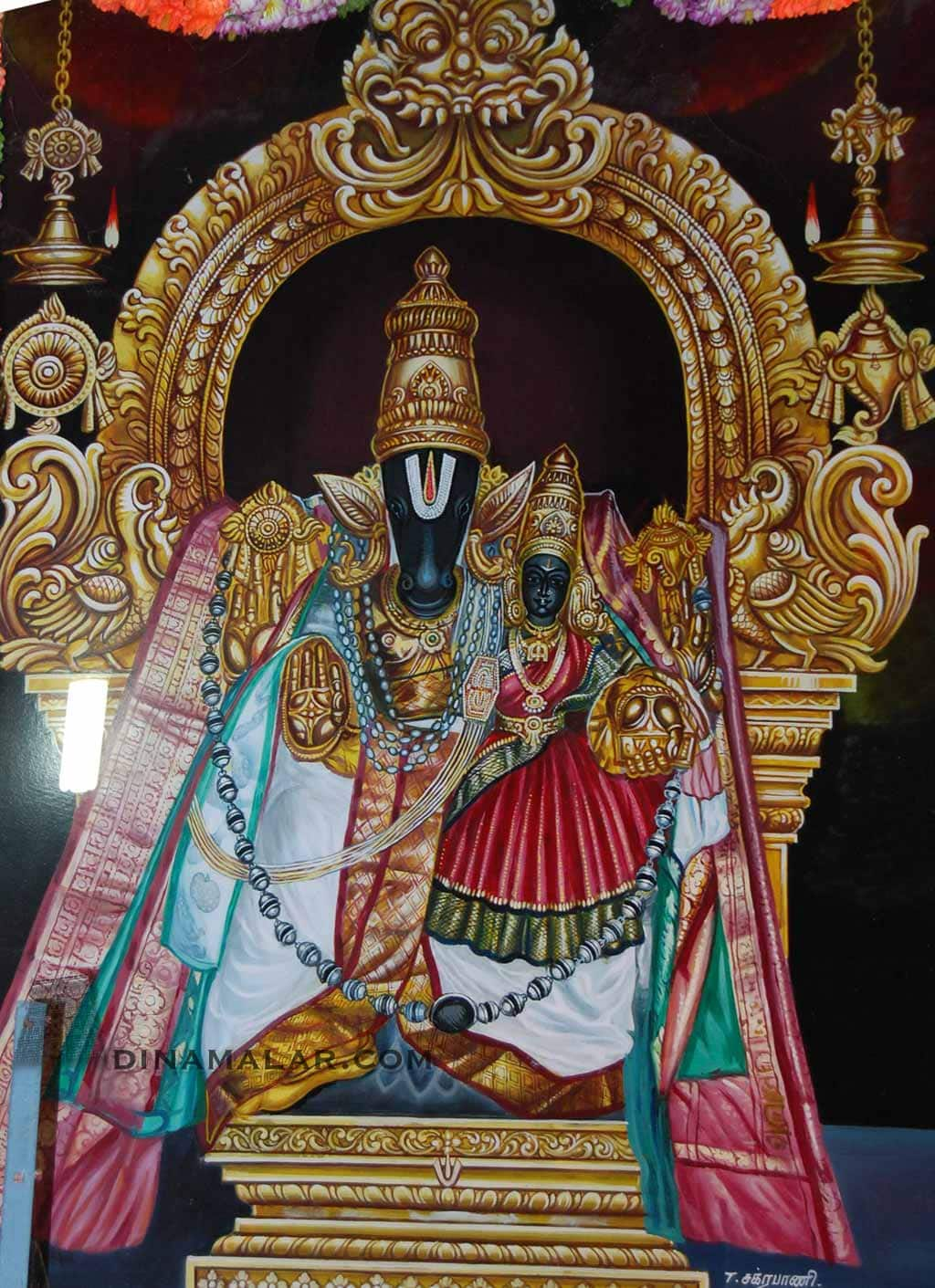
LORD SRI HAYAGREEVA
SRI DESIKA WITH LORD SRI HAYAGREEVA

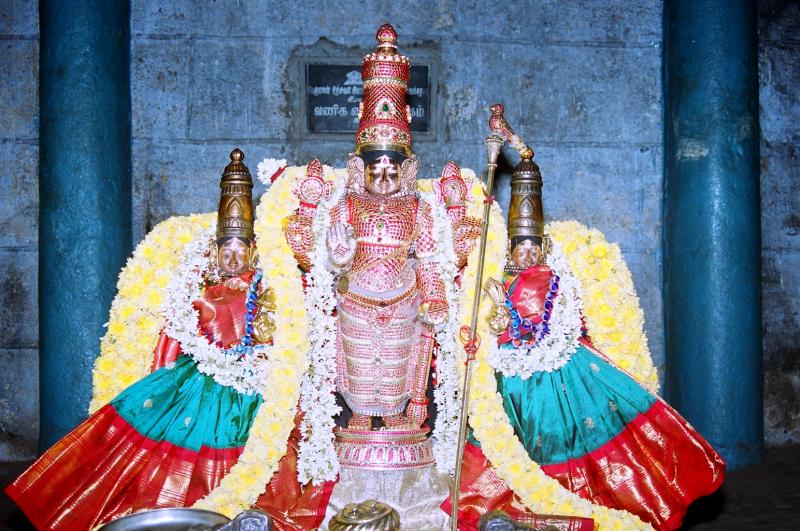
SRI UTSAVAR WITH UBHAYA NACCHIYAR;

Moolavar is large and is in standing pose, with upper arms holding discus and conch, lower right arm in abhaya mudra and left arm on His lap. Utasavar displays abhaya and holds the mace and is accompanied by Sri Ubhaya Nachiyars. Every Saturday the Lord is in procession; and every Friday, Sri Thayar is in procession. Swami Vedanta Desika has praised the Lord's every organ like the face, the Divine feet, the Crown, etc. While praising the Crown, he says that the radiance of the Crown, which is like a billion Suns' luminescence, should remove the darkness of ignorance in his heart. Sri Thayar is Sri Senkamalavalli, aka Sri Hemabjanayaki. Her Divine grace will remove all our sins. Sri Thayar is also known as Sri Bhargavi. Sage Brighu, meditated for long and prayed that Sri Thayar should be his daughter, and so She is called Sri Bhargavi. Thirumangai Alwar addresses the Lord as Sri Adiyavarku Meyyan [ஸ்ரீ அடியவர்க்கு மெய்யன்]. In Sanskrit this is called Sri Dasa Satya. He is always supporting the devotees.
 We will now see the introduction to Chapter 11. In Chapters 7, 8 and 9 Bhakti yoga was explained. To answer what stimulates Bhakti, the Lord explained His eminence and His wealth. In his Gitartha Sangraha, Swami Alavandar gives the essence of Chapter 11:
ek¯ada´se sva y¯ath¯atmya s¯aks.¯atk¯ar¯avalokanam |
dattamuktamvidipr¯aptyoh.bhaktyekop¯ayat¯a tath¯a || [15]

Ekadase = in Chapter 11, sva yathatmya = the Lord's eminence and magnificence, His wealth and auspicious qualities, sakshatkara avalokanam = to understand it as it is and properly. Here, the word avalokanam means not scene but eyesight. In order to see properly the Lord's greatness, Dattam uktam = [Arjuna was] blessed (with divine eyes) appropriately. Arjuna was blessed with the Divine power to see for himself the Lord's grandeur. What is the necessity to grant Arjuna this power? Was he not seeing Sri Krishna with his ordinary eyes? Uktam means it was stated. That is Divine eyesight given was stated. Because, Arjuna did not possess the superior eyesight to view the Lord's real form; the eyes he had could see only earthly ordinary things. This new superior eyesight was needed to see all the great things he heard from the Lord in Chapter 10.
When normal humans tell about their wealth, we might like to verify by seeing them. But if a King boasts of his enormous wealth and troops, one would be eager to have a glimpse of it. Like this Arjuna had the eagerness to see the wealth of the Lord. He wanted to see Adityas, the stars, the Vedas, etc., as part of the Lord. His normal eyes would only reveal the Lord's human form as Sri Krishna. Our eyes have limitation. But to view the Lord in His true perspective, superior eyes were needed. After granting, Arjuna could see the mammoth form of the Lord - -the Viswaroopa. Arjuna had seen the Lord as a Cowherd, as teaser of Gopikas, as the mischivous Boy of Gokulam, etc; but what he saw after the Divine power of sight was granted, was something one could not imagine. Sanjaya, who was narrating the battlefield happenings to Dhridarashtra, also got this power to see, with the blessings of his Acharya, Vyasa. Vidi praptya = knowledge [about the Lord] obtained [it is also called gyana darsana parapti, or understanding the Lord, seeing the Lord and reaching Him - para bhakti, para gyana and parama bhakti stages]. Bhakty = devotion, eka = only, upayata = means. To understand, to see and to reach Him, Bhakti is the only means. Thus in Chapter 11, Arjuna got the divine vision to see the Lord with all the wealth and auspiciou qualities, and further, he was told that Bhakti alone was the only means to understand, to see and to reach Him. We will now take leave of the Kshetram.

                                                                                                      (continued)

Monday, August 15, 2016

GITA 10.43

GITA 10.43
Sriman venkatanatharya Kavitarkkika keasri |

Vedantacharya varyome sannidattam sadahrudi ||

Today's [25th September 2008] lecture is from the sannidhi of Swami Vedanta Desika, in Sri Devanatha Perumal temple. After crossing the dwajasthambam, we arrive at Swami Desika sannidhi. There is intimate connection between him and this temple. He lived in this Kshetram for more than 40 years and worshiped the Lord.
He was confered with the title 'sarvatantra swatantrar' [ஸர்வ தந்த்ர ஸ்வதந்த்ரர்] , meaning he can do anything and knows past, present and future. Some wanted to test this power in him. That time he built a well himself, in which water never dried up.
WELL CONSTRUCTED BY SRI DESIKA

Can a person skillful in Vedanta, build a well? Everyone was astonished. Like donating wealth to others, building ponds, wells and temples, are also important social service. People realized he was skillful in everything. We can see the well built by Swami Desika. We now worship Swami Desika. By one hand he is preaching and in the other hand he is holding book (palm leaves). This idol was approved by Swami Desika himself. Like the idols of Thirumangai Alwar and Swami Ramanuja in Sriperumbuthur are famous, this idol in Thiruvahindrapuram is very famous. Swami Desika every year arrives at the top of Aushada giri to worship the Lord Sri Hayagriva, on his birthday Purattasi - Shravanam. That day, he is decorated with diamond studded kavacham. Swami Desika imagined himself to be the sweet heart of Lord Sri Devanatha and composed Achyuta sathakam. It is in parakruta language. It is a derivative of Sanskrit, minus harsh sounds, and suitable for ladies. He also composed another sthotra Devanayaka Panchasat. We can worship Lord Sri Rama in the temple.
 Swami Desika composed Raghuvira gadhyam on the Lord. Similarly on Sri Krishna here, Swami Desika composed Gopala vimsati. In his 28 stotras, he has praised this Kshetram in 6.
 Our lecture is connected with Swami Desika. He composed a detailed commentary Tatparya Chandrika. First Swami Alavandar wrote Gitartha sangraham in 32 slokas. Next Swami Ramanuja wrote a commentary Gita bhashyam, on Bhagavad Gita. Tatparya Chandrika further explained Gita Bhashyam. Like the Moon reflecting Sun's light, we can enjoy Swami Ramanuja's Gita Bhashyam in Tatparya Chandrika. For the past one and half years or so, our lectures are based on Tatparya Chandrika. We will now see the completion of Chapter 10. 
We have seen the last sloka also. Gitartha sangarha gave a summary of Chapter 10. 
svakalyaaNaguNaanantyakR^itsnasvaadhiinataamatiH . 
bhaktyutpattivivR^iddhayarthaa vistiirNaa dashamoditaa .. (14)
The Lord's auspicious qualities, His command over everything and His infinite property, were all listed in all the slokas. Why should anyone know His wealth or His greatness? Then only devotion or Bhakti will evolve and develop in us. Therefore, to practice Bhakti yoga we should know about the Lord. Sri Krishna tells Arjuna that in Arjuna's interest, the Lord again and again was going to mention about His greatness. Arjuna was eager to know His wealth. He wanted in detail. The Lord started telling from sloka 19 and mentioned some important groups in which He was the more important. From that what Arjuna and we should learn? In all those groups all of them and the more important mentioned, were all deriving their eminence from Sri Krishna. In the last Three slokas, the Lord concluded saying that those, mentioned and not mentioned, micro and macro matters, born and unborn, with life and lifeless, movable and stationary, everything without exception, were all in His command and control. The entire Universe was but a micro fraction of Him and was supported in creation, sustaining and destruction. This sermon should stimulate us to reach the Lord. At the end of each Chapter we have been seeing the conversation between Parvati and lord Shiva, on the magnificence of that Chapter. Sri Parvati asked what was great about Chapter 10?, and, lord Shiva narrates what Sri Narayana told Sri Maha Lakshmi. There lived one Dhirati. He was helping many devotees of the Lord. Lord Shiva told that there was a swan and it was reborn as Dhirati. Once there lived a Brahmin, who learnt everything from his master. Once, he tripped on the leg of his master who was sleeping; but, he did not express apology and so the master got angry and cursed him to be born as a swan. This swan was travelling many places. Swan came acrossa a pond in which five lotus flowers had blossomed. When the Swan wanted to fly over the pond, it could not. And, it fell down helplessly. The white Swan turned black. When the Swan was perplexed, a female voice was heard and it said that it would tell the reason. All the Five lotus flowers in the female voice spoke. That she was called Padmini and lived a happy life; but she had a bad habit of caging birds. Her husband never approved it and once he cursed her to become a bird. This bird was a pet of some children of sages. Those children used to chant the Chapter 10 daily and the bird was listening and it got a divine woman form. She was bathing in a pond without any clothes  [We should never bathe without any clothes, according to shastras]. Seeing this Durvasa cursed her to become flowers and she existed in this pond. Swan was asked to take those flowers and offer to lord Shiva and pray. Lord Shiva got their [lotus and swan] curses removed. That Swan was now born as Dhirati and now worshiping the Lord and His devotees. Thus the greatness of Chapter 10 was explained. 
                                                                                                   (continued)

GITA 10.42

GITA 10.42
LORD SRI HAYAGRIVA


Gyananada mayam devam nirmala spatikakrutim |
Adaram sarvavidyanam hayagrivam upasmahe ||
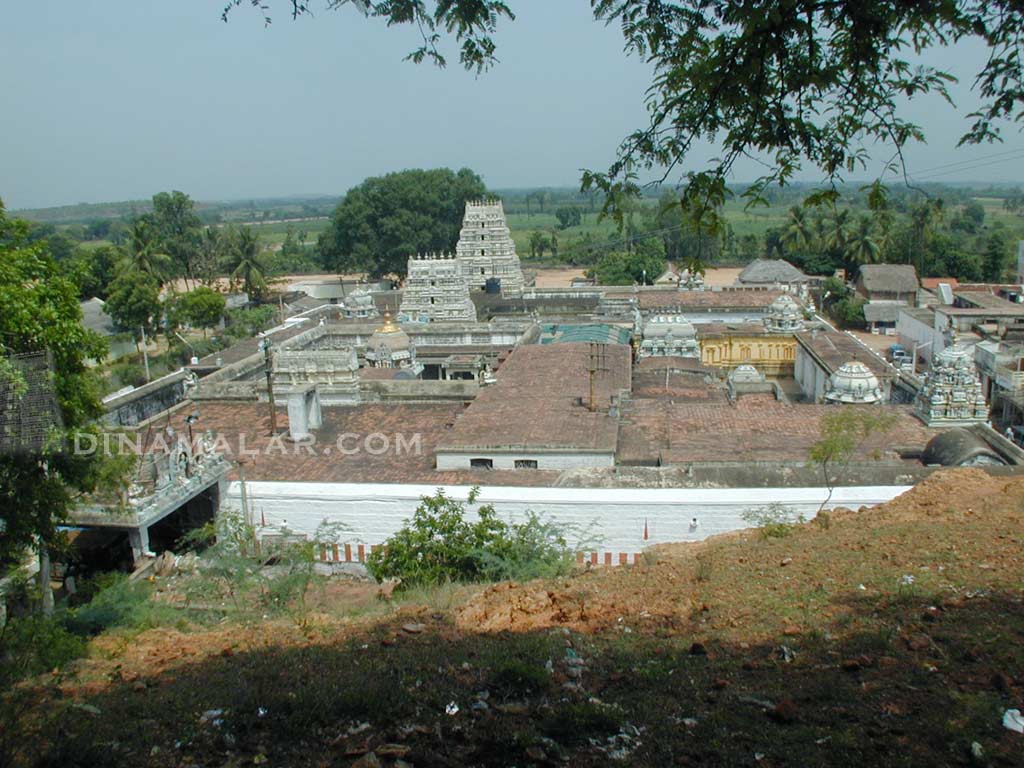
This sloka was composed by Swami Vedanta Desika. This sloka tells the glory of Sri Hayagriva, the Lord of all Vidya [knowledge]. Sri Hayagriva is Horse faced and He reclaimed the lost Vedas and taught lord Brahma. Whether we want to know the Brahman or other worldly matters, Sri Hayagriva is the Lord of such knowledge. We need not go far off in search of Him. He is available in the mid-region of Tamilnadu. Kshetrams of Nadu Nadu (நடு நாடு)  are Two. Of these, we have already visited Tirukkovalur. Now, we have arrived at Tiruvahindrapuram [திருவஹீந்தர புரம்], to worship Sri Hayagriva, Sri Devanatha and Sri Thayar Hemabjavalli , with the blessings of Swami Vedanta Desika. It is called Thiru + Ahindra puram. Ahi means serpent, and ahindra indicates the leader of all serpents- Adisesha. Ahindrapuram means the Kshetram built by Adisesha and the abode of the Lord, requisitioned by Adisesha. Tiru suggests the association of Sri Thayar always with this place. Sri Devanatha is at the bottom of a hill, Aushdagiri [ஔஷத கிரி]. On top of the hill, the Lord Sri Hayagriva graces. Surroundings of the hill are very beautiful and give an appearance of about to rain, always. Many springs are seen. We climb 74 steps to reach the top of the hill.
STEPS LEADING TO THE TOP

This is like the 74 Simhasanathipathis. We now reach Sri Hayagriva sannidhi.


We will first worship Sri Hayagriva.
MOOLAVAR SRI LAKSHMI HAYAGRIVA

The Lord is Sri Lakshmi Hayagriva. He is seated with the Right lower arm in Upadesa mudra, Left lower arm holding a book and the upper arms holding discus and conch. Sri Maha Lakshmi is seated on His Left lap. His foot is on the lotus. Near the Moolavar is Sri Venugopala. On the left Garuda is there. Utsavar is seated like MoolavarSwami Vedanta Desika has described the Lord in his Sri Hayagriva sthothram. In the last sloka, vyakya mudram..., Swami Desika says, the Lord as the Leader of speech, Sri Hayagriva should appear in his heart. He appears as though He is teaching all the Vedas and other religious books. Palms resemble the lotus. Like the whiteness of a freshly broken white marble, the Lord Sri Hayagriva appears. Seated on a lotus, the Lord should grace us to ward off the heat of samsaram. Swami Vedanta Desika meditated on this hill.
PLACE WHERE VEDANTA DESIKA MEDITATED

 Garuda appeared to him. He praised Garuda and Garuda taught him Garuda mantram and Sri Hayagriva mantram.
GARUDA PREACHING DESIKA
 He also gifted Swami Vedanta Desika, a small idol of Sri Hayagriva. 
SRI YOGA HAYAGRIVA GIFTED TO DESIKA BY GARUDA

That Lord is called Sri Yoga Hayagriva and is in the sannidhi of Sri Devanatha. In all Swami Desika composed 28 sthotras, of which many are in praise of this Kshetram.
 With the blessings of Sri Hayagriva, we will see the last sloka of Chapter 10:


atha va bahunaitena
kim jnatena tavarjuna
vistabhyaham idam krtsnam
ekamsena sthito jagat

"But what need is there, Arjuna, for all this detailed knowledge? With a single fragment of Myself, I pervade and support this entire universe."

Athava = therefore. That is after explaining by the previous slokas that He was everything, micro or macro, movable or stationary, animate or inanimate, and everything was His property. He controls evertything. Bahunaitena = listening to all, kim = what, jnatena = additional knowledge, tavarjuna = to you, Arjuna? The Lord asks what benefit is to Arjuna by listening to more. What is implied is, He has given examples of His eminence in 18 slokas. By saying more in another 100 or 1000 slokas, Arjuna is not going to understand the finality of the property of the Lord. Arjuna can not derive the benefit that he has understood all His properties. What He told was a glimpse and that was enough for Arjuna. Idam = the perceptible, jagat =Universe, krstnam = without an exception all, aham = I [Sri Krishna], ekamsena = by a miniature fraction of, vishtabhya = supporting. Without any exception, whatever was perceived in this Universe, are all supported by a microscopic fraction of Him. For the word entire, Swami Ramanuja gives an explanation. It is all movable and non-moving, chetanam and achetanam, differing by appearance, magnitude, etc. What is supporting? Especially, when the Lord says He supports all, what we perceive in this Universe and other invisible worlds. How is it possible? When we lift a book, we can clearly see the hand supporting the book. But the Lord is supporting from inside, as antharatman. He is inside and at the same time surrounds - antar bahischa tad sarvam vyapya narayana sthitha:. It is not mere holding, but by supporting it is meant that the Lord is the cause of our origin, presence and destruction. Every action like being born or living or dying, are all in His domain and control. All atman - baddha, Mukta and Nithya - and all achetanam or lifeless matter are all under His control. Summarising the Lord says all actions of everything without exception, are in His control. He supports everything by a fraction of Him. In Vishnu Purana, Parashara says that He prostrates to the Lord, whose millionth fraction of a millionth fraction supports this Universe. The Lord wants Arjuna to realise the eminence of the Lord. In the entire Chapter, the Lord tells what His greatness is. There is no use in further telling this. Now Arjuna should realise the glory of the Lord. We should also realise that every action of ours is in His control. To get this knowledge we should worship Lord Sri Hayagriva, as mentioned in the beginning. 
                                                                                                   (continued)

GITA 10.41

GITA 10.41
AN OVERVIEW OF THE TEMPLE 

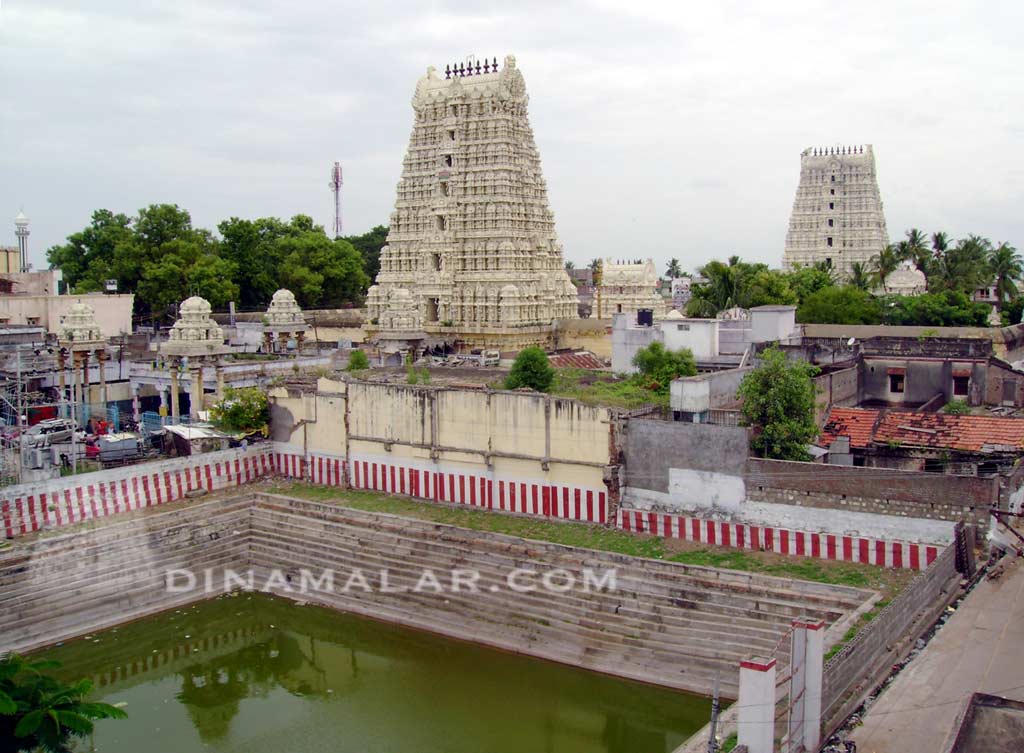
Tiruvenkatam [Tiirumala] and Tirukkovalur are closely connected. That connection, not only is in Alwar's pasurams, but even now continues. Today's [23rd September 2008] lecture is from H.H. Emperumanar Jeer mutt in the sannidhi street. At the end of the long street, is the tall Raja gopuram. As if competing with Sri Trivikrama, the gopuram is tall with 11 tiers. The Emperumanar Jeer mutt is near the gopuram. This mutt was established some 500 years back. In Sri Vaishnava sampradaya, Swami Ramanuja is the prime Acharya. It is an unshakable faith that all his predecessors and his successors reach Moksham because of their association with him. Swami Ramanuja formed 74 Simhasanathipatis. In that list, there was one Swami Tirukkovalur Alwan. He had many disciples and was serving in the temple. There was a village Munpadir, north of Tirupathi in Andhra Pradesh. There, a Vaishnava couple lived and had no children. Once they prayed to Sri Venkatachalapathi to bless them with a child and that they would engage the child in His service. Their wish was to transfer their bhakti and gyana to the child. The Lord blessed them and in the year 1452, in Thei [தை] month and in Mrigasirsha star, a child was born and was christened Ilayazhvar [இளையாழ்வார்], one of the names of Swami Ramanuja. The child grew and learnt all good things. There was the Periya Jeer mutt, established by Swami Ramanuja nearly 1000 years back, in Tirumala. At that time the Jeer was H.H. Yettur Sundaracharya Swami. Swami Ilayazhvar approached the Jeer and learnt everything in sampradaya, Shastras, Prabhandam, etc. By a peculiar design, the Jeer died. The Lord ordained on all those present, to appoint Swami Ilayazhvar as the next Jeer. Accordingly, Swami Ilayazhvar was Jeer for 16 years and served the Lord of Tirumala. Meanwhile, in Tirukkovalur, a stone wall was erected to hide Sri Trivikrama and a Shiva Linga and Nandi were erected; and, it was widely publicised that the temple was a Shiva temple. There was no Sri Vaishnava and it was regarded as a Shiva sthala. In the dreams of Swami Tirukkovalur Alwan, the Lord ordered him to go and stay at Srirangam and return only when the Kshetram became Vaishnava Kshetram. At the same time, Lord Sri Venkatesa ordered the Jeer to visit Tirukkovalur. The Jeer tried to argue with people in Tirukkovalur, to return the temple to Sri Vaishnavas, but in vain. Then, he thought that arguments might not yield results and wanted to prove by some other action. He asked people to construct a lime kiln and challenged that he would enter the burning kiln and meditate inside. If he came out alive, it should be proof that the Lord inside the temple was Sri Vishnu. He accordingly went in and remained there for a long time. The Jeer came out alive. By that time the King who hated Sri Vaishnavas was succeeded by another King, who was not so cruel. The King saw the Jeer coming out radiant with success. All people agreed that the Jeer was divine and with his supervision, all the idols of other gods were respectfully returned to their original places and the stone wall was opened to find Sri Trivikrama. One was reminded of the pasuram tirukkanden, ponmeni kanden,... of Peyalwar! But in spite of efforts, the Nandi could not be displaced. When others reported this, Jeer came to the spot. After observing, he ordered for green grass and when the Jeer displayed it in front of the Nandi, it got up to eat the grass. The Jeer requested Nandi to go to its Master lord Shiva. Nandi told that it wanted to meet the Jeer and then walked its way to the temple where lord Shiva was. From that day all the old [Sri Vaishnava agamapoojas were resumed. The Jeer from there went to Tirukkannamangai and did service to the Lord. Then he served in Sri Mushnam. He also visited Nava Tirupathi and did many notable services. He also visited Srirangam. Again he visited Tirukkovalur, to ensure all pooja were in proper order and then decided to return to Tirumala, where his mutt was. But the Lord appeared in everybody's dreams and ordained that the Jeer should stay, henceforth, in Tirukkovalur as the Head of Sri Emperumanar mutt. A new Jeer was appointed in Tirumala. We are in Sri Emprumanar mutt. The Lord here is Sri Bhogaraja. He is considered to be the reincarnation of the Lord of Thirukkannamangai. We can also worship the First Jeer [Sri Ramanuja (Ilayazhvar) Jeer] in a sannidhi here. This mutt was established in 1521. Now the 25th Jeer is the Head of this Mutt. 
Thirukkovalur jeeyar
THE 25TH JEER

About 10.000 disciples are there. By performing Pancha samskaram, he is establishing the association wit Swami Ramanuja. Only being a servant of the Lord is important and not his caste or creed. He has performed samasrayanam to about 3,000 tirukkulathars [திருக்குலத்தார்]. Jeer of Sri Emperumanar Mutt, Tirukkovalur says:
Sri Krishna preached Bhagavat Gita to Arjuna in the previous yug. In this yug, the greatness of Gita has been told by great elders. In that order, lecturing on Sri Krishna's Gita in this Krishnaranya Kshetram by Sri Krishnan Swami [sri Velukkudi Swami] is very appropriate. This temple has been praised by Four Alwars. This Mutt is being administered by Jeer for the past 500 years. I pray the Substance of Gita, the Lord Sri Ayanar, to bless all with prosperity. 
Now, we will see sloka 41:


yad yad vibhutimat sattvam
srimad urjitam eva va
tat tad evavagaccha tvam
mama tejo-’msa-sambhavam

"Know that all opulent, beautiful and glorious creations spring from but a spark of My splendour."

The Lord tells Arjuna that by now he would have understood all were His wealth. None of them could remain without Him. Yad yad sattvam = those which are [existing in this Universe], vibhutimat = every one of them might be under the control of some. That is the control of some over all the existing entities in this Universe. Srimad = those which are having radiance or prosperity, urjitam = resoluteness [in all efforts], tad tad eva = all such things, mama = My [Sri Krishna's], tejo = eminence, amsa = fraction, sambhavam = originate, tvam = you [Arjuna], avagaccha = know. So, the prosperity, wealthiness and resolution are all a mere fraction of the eminence of the Lord. Parents order children. King orders subjects. Teacher orders students. All these ordering power of all emanate from a spark of His eminence. That is, when He said He is Vishnu among Adityas, Vishnu or Adityas have some ruling power over people. This controlling power has originated from a fraction of His power. The eminence of Margasirsha [Margazhi] month, is a part of the eminence of the Lord. He mentioned that among luminous entities, He is Sun. This luminance is a fraction of the Lord's luminance. Like this everyone's eminence, determination, wealth, etc., are all but a fraction of the Lord's qualities. We will now take leave of this Kshetram.
                                                                                        (continued)