Tuesday, December 1, 2015

GITA 8.30

GITA 8.30
TIRUMAZHISAI ALWAR

Among the Alwars, Thirumazhisai Alwar is Fourth and is considered as the incarnation of Sudarshana, the discus of the Lord, and appeared in the Kshetram Thirumazhisai [near Chennai] in the Tamil month Thei [தை ] in the star Makha. He had visited many Divya Desams. He composed many works, but we have only two with us now: Thirucchandha viruttham and Nanmugan Thiruvandhadhi. Today's [6th june 2008] lecture is from his sannidhi in Kumbakonam. It is outside the Sri Sarngapani temple and is managed privately. Here, many thousand years back Thirumazhisai Alwar was in yoga. It is reported that this Alwar lived in this world for 4,700 years. He spent his last 700 years in Thirukkudanthai and he departed this world while in yoga from this place. We can find the connection between the Alwar and the conclusion of 8th Chapter and the introduction of Chapter 9. While all Alwars are addressed as Alwar, only this Alwar is addressed as Thirumazhisai Piran [திருமழிசைப் பிரான்]. Similarly, while the Lord is addressed as Piran in every temple, only Sri Aravamudhan is addressed as Sri Aravamudha Azhvar [ஸ்ரீ ஆராவமுத ஆழ்வார்]. There appears to be an exchange of the titles between the Lord and the devotee, we may wonder. But there is a reason. This Alwar and the Lord here have been very intimate, and exchanging their clothes and food were quite common. Once Alwar came to this temple and in worshiping the Lord, Alwar went around the sannidhi [pradhikshanam]. Eager to see His great devotee, the Lord's head turned to Alwar as he went around the sannidhi, like a flower turning to the movement of Sun. This caused great surprise to other devotees and temple servants. The Alwar is called Bhaktisaran, meaning he is the essence of devotees or he showed the devotion in its essence. After going round the sannidhi, the Alwar entered the sannidhi. Some devotees felt Alwar was to be given the prime honours; while many others opposed it. A great devotee Perumpuliyur Adigal, wanted the Alwar to be given proper honours but it was rejected. Seeing this the Alwar requested the Lord to come out of his heart to show who he was. The Lord did accordingly, to the surprise of all. Then the Alwar went near the Lord in the garbhagruha. Alwar thought the Lord would get up and converse with him. Alwar thought the Lord must be tired very much and this he expressed in his poems - nadandha kaalgal nondhavo.....At the end of the pasuram the Alwar said ezhundirundhu pesu vazhi kesane [எழுந்திருந்து பேசு வாழி கேசனே! Tiruchanda Viruttam 61]. He asked the Lord whether He was tired because as Sri Rama, He walked all the way to Lanka? Or, because He had to rescue Mother Earth from the Demon? Or, He had to measure the entire Universe when He was Sri Trivikrama? Accepting the command of the devotee, the Lord also tried to get up from His bed. We can notice that Sri Aravamudhan(Moolavar) is not lying flatly but His head is slightly raised.
SRI MOOLAVAR (in sketch)

 Repenting for his request, the Alwar immediately requested the Lord not to get up. This demonstrates the power of unwavering and concentrated devotion [bhakti], and this is the essence of Chapter 9 we are to see in the coming days. In this temple, the Moolavar is Sri Varantharum Perumal and the Uthsavar is Sri Bhaktisaara Varadan. Thayar is Sri Padmasani. 
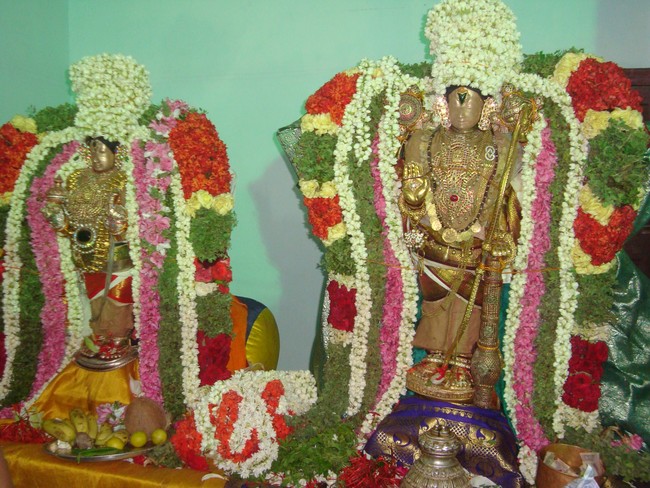
UTSAVAR SRI BAKTISARA VARADAN AND SRI PADMASANI THAYAR

We can also see Nammalwar, Swami Nathamuni, Swami Ramanuja and Swami Manavala Mamunigal.  We will see the greatness of Chapter 8 as told to Parvati by lord Paramasiva. Bhava Sarma was a brahmin, living with all bad habits. He never did any of his prescribed duties. In the death bed, he remembered the palm trees which yielded liquor and so after death, he was born as a palm tree [as mentioned in the Chapter 8, one attains the same thoughts in the last moments, in the next birth]. Under this tree there lived a brahmarakshas couple Kusubalan and Sumati. Before death, the wife out of greed, forced her husband to beg for chairities indiscriminately, resulting in getting this brahmarakshas appearance after death. One day, while the couple sitting under the palm tree, she asked her husband the means to get rid of the brahmarakshas form. The husband, who was well learned, explained that they should realise Brahman. She inadvarently repeated the 1st sloka of Chapter 8, where the Lord is explained as Sri Purushottama. Instantly, listening to this, the palm tree with a blast broke up and Bhava Sarma appeared. The brahmarakshas couple also regained their earlier forms. Such is the greatness of one- here, the first- sloka of Chapter 8. All the three, later on, after refining their lives attained better worlds.
                                                                                                     (continued)

GITA 8.29

GITA 8.29
We are studying Chapter 8 of Bhagavad Gita from the sannidhi of Sri Aravamudhan in Thirukkudanthai (Kumbakonam). We are to see the last sloka of this Chapter, in which Sri Krishna tells His glory, and person understanding this gets all the comforts in this universe and also in the other worlds. But we are awestruck. The Lord is so great and is at a place beyond Indra loka and Satya loka, and where even great souls are not able to reach easily. But Nammalwar allays our bewilderment. Nammalwar performs the total surrender [saranagathi - சரணாகதி] five times, as indicated in Tiruvaimozhi. By surrendering, that is clinging to His Divine feet, we can reach Him or travel by archiradhi marg. In the pasuram on Vanamamalai [5.7], he starts his first saranagathi. Again at the feet of the Lord here [5.8], he did the second saranagathi.
SRI NAMMALWAR

 The idol of Nammalwar here portrays him keeping his hand near the heart, as he says when he chants the name Sri Aravamudha, it sweetens his heart. If we are enjoying Nalayira Divya Prabhandam, it is because of the Lord here. Swami Nathamuni was living in Kattumannar koil, near Chidambaram. Some Sri Vaishnavites met him and recited the pasurams on this Kshetram, starting with Aravamudhe [ஆராவமுதே..5.8.1]. Swami Nathamuni lived in the 9th and 10th centuries. Nammalwar lived Thousands of years earlier. In the intervening period, Nalayira Divya prabhandam went out of usage and was lost. Therefore, it was the sankalpam or determination of the Lord, to revive Nalayira Divya Prabhandam and make it popular by Swami Nathamuni. In the last pasuram, it was stated by Nammalwar that these 10 pasurams out of 1000 [ஓராயிரத்துள் இவை பத்தும்] in that pasuram, and this caught the attention of Swami Nathamuni. So, he inquired about the remaining 990 pasurams, and the Srivaishnavas replied they were not aware. Swami Nathamuni then found that these were composed by Kurugur Satagopan and so he took up a journey to Kurugur or the present Alwar Thirunagari, near Tirunelveli. It was his luck that there was one Parankusa Nambi living and who hailed in the family of Madhurakavi Alwar, a disciple of Nammalwar. When enquired, Parankusa Nambi also replied of his ignorance of the 1000 pasurams of Nammalwar; but, he was knowing the 11 pasuramKanninun chiruththambu of Madurakavi Alwar. He suggested that if Swami Nathamuni could recite these under the tamarind tree, where Nammalwar was reported to have been dwelling when he was alive in this world, for 12,000 times and meditate, perhaps Swami Nathamuni might succeed in getting help. Swami Nathamuni did likewise and Nammalwar appeared before him in yoga and taught Nathamuni entire Nalayira Divya Prabhandam. From Swami Nathamuni we thus got this invaluable treasure. Like a small seed is the cause for a gigantic tree, the 10 pasurams on the Lord here were responsible for us to get and enjoy this great treasure. It is because of Sri Aravamudhan we have inherited this great literature. That is why in the namavali archana [recitation of Divine names] of the Lord here, one name is mentioned: Dravida sruthi darsakaya nama: Dravida sruthi implies Tamil Vedas, which is Nalayira Divya Prabhandam. The Lord is praised by both Tamil and Sanskrit Vedas.
 Understanding that nothing else we need other than worshiping the Lord, is the essence of the last sloka of Chapter 8, we are to see. He advises Arjuna not to set his eyes on dhoomadhi marg and inferior pleasures:

vedesu yajnesu tapahsu caiva
danesu yat punya-phalam pradistam
atyeti tat sarvam idam viditva
yogi param sthanam upaiti cadyam


" A person by understanding all these reaches beyond what by performing yagna, tapas and chairity as stipulated in Vedas, could yield noble results; he reaches the highest and most ancient place."

Vedesu = in Vedas, yagnesu = yagnas, yat punya phalam = whatever punya results, pradhishtam = will be received. Similarly, tapasu = meditations, danesu = charities. That is in accordance with the stipulations of Vedas by performing Yagnas, meditations and gifts, whatever punya results would accrue, atyeti = stands beyond them. Who stands beyond all the good results achieved by yagna, meditation and loftiness? Idam sarvam = all these, viditva = having learnt, tat = that person. Whatever we learnt in the Chapters 7 and 8 is here mentioned by the Lord as all these. In Chapter 7, He told He is also the means. He is the Cause of the Universe. All souls are His body. He is the support of all. He is pervading in and out of all and the entire Universe. All are ruled by Him. Such a great, He was learnt in Chapter 7. This was to explain the 4 types of devotees and only one type wanted the Lord alone and nothing else - Bhagavallabharti. For him, everything is He only and considers Sri Vasudeva for everything. Such persons are rare also was told by the Lord. In Chapter 8, what each type of these devotees should know and follow was explained. The routes and destinations were all explained. His greatness was also detailed. So after learning all these, the best course would have been learnt as saranagathi or clinging to His feet. Yogi = person now desirous of reaching the Lord, thinking always about archiradhi marg, param sthanam = highest place [ Vaikuntam], adyam sthanam = very ancient place [Vaikuntam], upaiti = reaches. Such a person reaches the place which has no equals or superiors, where happiness only is there, where there is no hatred or enmity, where there is no hunger or thirst or old age, that is Vaikuntam and the Lord confirms it here. So He is the goal and to reach Him we should have archiradhi marg in mind always and for that also He alone can help. We should be doing all good things as long as we live here and never even think of harming anybody. This ensures happiness here and paves the path for archiradhi marg.
                                                                                                            (continued)

GITA 8.28

GITA 8.28

tiruvezhukUtrirukkai - Rathachitrabhandam


The last among Alwars, Thirumangai Alwar had composed Thiruvezhukottrirukkai [திருவெழு கூற்றிருக்கை] on the Lord of Thirukkudanthai, Sri Aravamudhalwan. It is an artful poem in that the poem when written will appear as a picture. Alwar had composed this to appear as a chariot. Chariot and Thirukkudanthai are closely connected. The Lord appeared in a chariot to marry Sri Komalavalli ThayarGarbhagruha is a stone chariot. In the Tamil month Chithirai and in star Chitra, the Lord appears in procession on a chariot. That chariot is of wood. What we see now is chitra roopa [image][சித்திரம்] of Alwar's poem, depicting a chariot. The design of a chariot is, at the bottom it is narrow and expands to the seat of the Lord and then again from the ceiling of the seat it narrows to the top. Alwar's poem starts with numbers. At the bottom most it is 1,2,1. Next level of the chariot base is 1,2,3,2,1 and then 1,2,3,4,3,2,1, etc. At the seat it is 1,2,3,4,5,6,7,6,5,4,3,2,1.
A sample is shown below:
orupE runthi yirumalarth thavisil,
orumuRai ayanai yeenRanai, orumuRai
irusudar meethini liyangaa, mummathiL
ilangai yirukaal vaLaiya, orusilai
onRiya IreyiR Razhalvaay vaaLiyil
attanai, moovadi naanilam vEndi,
muppuri noolodu maanuri yilangum.
maarvinil, irupiRap porumaa Naagi,
orumuRai yeeradi,moovula kaLandhaanai,
In the first line oru perunthi = one great navel [of the Lord, in which lord Brahma emerged], yiru = [though by reading, number 2 is indicative, actually it means ] glorious, malarth thavisil = in the petals of [lotus] flower, oru murai = once, ayanai = lord Brahma, yeenranai = was created [by You, the Lord]. Note the numbers 1, 2 and 1. Similarly all other lines of the poem. One interesting feature is that the only Lord, Who appears in Thirumangai Alwar's all Six compilations, is Sri Aravamudhalvan. In the slokas 24, 25 and 26 of Chapter 8, we have to observe that we should seek refuge in Him and wait with eagerness to reach archiradhi marg. Like the Alwar, we should concentrate only on that. Thirunedunthandakam [திருநெடுந்தாண்டகம்] was his last [6th] compilation. In this, in the end, he mentions the Lord of Thirukkudanthai and it is said that after this only the Alwar departed his life in this world. It is to be mentioned that the wooden chariot used in the procession was presented by this Alwar. The chariot like poem also was presented by the Alwar and it is called the chariot of gyana. In the pasuram kudanthaimeya [குடந்தைமேய] in Thirukkurunthandakam [திருக் குறுந்தாண்டகம் ], he says that a gold basket of precious stones will be nothing before the Lord of Kudanthai. The Lord is the repository of all literature, raw honey and pure gold.
 We will now see the 27th sloka:

naite srti partha janan
yogi muhyati kascana
tasmat sarveshu kaleshu
yoga-yukto bhavarjuna

"Although the devotees know these two paths, O Arjuna, they are never bewildered. Therefore be always fixed in devotion."

Arjuna = Arjuna, tasmat = therefore, sarveshu kaleshu = at all times and always, yoga-yukta = associated with yoga, bhava = be. Here yoga does not mean either Karma yoga or Gyana yoga, nor Bhakti yoga, but it means one should always be thinking of archiradhi marg. So, archiradhi marg should be our objective and we should do all to travel by that route. Kascana yogi = any yogi, ete = these two, sriti = krishna and shukla routes, janan = knowledgeable, na muhyati = will not be worried. By knowing the two routes and their destinations, any yogi will never worry. He will know which is to be preferred. We have seen the Lord in more than 40 kshetrams and we would have realised what value it is and the inferiority of all the pleasures of the world. We will, therefore, choose shukla or archiradhi marg and reject the dark or krishna marg. Once we decide the greatness of archiradhi marg, we can pray the Lord for good health and with thoughts on Him at the time of death, our souls will depart by that 101st nerve [sushumna nadi] and the Lord will lead us in His light along the archiradhi marg. We will travel and see all the 12 places mentioned and everywhere we will be welcomed as the servants of the Lord and honoured. Then after taking a bath in the Viraja river, we will go to the other side of the river. There 500 apsaras women will decorate us with garlands, beautiful robes, sandal paste, precious ornaments, etc. We reach Thirumamani mandapam and from a distance we will have the view of the Lord seated on the serpent Adisesha, along with His consorts Sri Sridevi, Sri Bhudevi and Sri Neeladevi. We will be brought forward near the Lord. We have travelled a journey and will never have to return to the sufferings of this world. The Lord with affection will lift us up and get us seated on His Lap [as a child on its father's lap] and with a hug and kiss on our forehead, would enquire where we had gone all these days. In this great moment of happiness, we will find difficult to express and narrate. With a form similar to the Lord's, we will then be introduced and joined in the company of other Mukthas to have everlasting happiness. So this should be the only thought of any devotee always.
                                                                                                  (continued)

GITA 8.27

GITA 8.27
MOOLAVAR SRI ARAVAMUDAN

A North Indian pundit said that between the names of the Lord, Sri Aparyamrutham and Sri Aravamudan, he found the latter was sweeter to pronounce and so, he decided to settle in South. We can also feel the taste of that name. So, the Lord as Sri Aravamudhan, graces as devotees gather to chant His name heartily. The Lord is reclining with the feet in North direction and head in the South. Sri Sridevi and Sri Bhudevi are seated by His feet and head. All devas are at His feet and worshiping Him. As we come around the prakaram [corridor], we can see the sannidhi of Sri Andal. We have heard of the garland used by Sri Andal, being offered to the Lord in other temples. In Her Nachiyar Thirumozhi pasuram 'kolal [கோலால்]...', She asks to decorate Her with the Tulasi garland used by the Lord of Kudanthai [Kumbakonam]. This is unique for this kshetram. There is a long corridor in front of this sannidhi, which has been mentioned by Perialwar in his pasuram ' thoonila mutrathe..'(தூநிலா முற்றத்தே). 
THOONILA MUTRAM

Alwar praises the long corridor of this temple. Alwar assumes the role of Yasoda and in chappani paruvam [சப்பாணிப் பருவம்], which is the stage when the mother and child sit facing each other and clapping hands, move the body front and back.
 In sloka 24, Archiradhi marg [utharayanam] and in sloka 25 Dhoomadhi marg [dakshinayanam] were explained. Atman travelling by Archiradhi route never returns to this Universe and reaches Vaikuntam; while by dhoomadhi route, the atman returns back after reaching pithru loka or chandra loka. In sloka 26, summarisng both, the Lord explains:

sukla-krsne gati hy ete
jagatah sasvate mate
ekaya yaty anavrttim
anyayavartate punah

"According to Vedic opinion, there are two ways of passing from this world—one in light and one in darkness. When one passes in light, he does not come back; but when one passes in darkness, he returns."

By one, atman reaches a never-to-return place and by the other, atman reaches places from where a return to Universe, is a must. Sukla = white, krsna =dark, gati = routes, hyete =these, jagata = here Swami Vedanta Desika in his Tatparya Chandrika says that, we can not take the routine meaning of world, but it means the Gyani or devotee who has the aim of reaching the God alone and other yogis who perform Punya karma to obtain higher strata of life in pithru lok or swarg or chandra lokSasvate = permanent, mate = is told. That is for Gyani and for other yogis or punyatman, these two routes and the destinations are permanent as told in Vedas. Ekaya = [of these two] in one [that is sukla or archiradhi marg],yati = reaches, anavrittim = no-return place, anyaya = [while] by the other different route [by Krishna marg], avartate = returns, puna = again. So. by krishna marg one returns back to the Universe and by the white or shukla marg atman never returns back. White marg because it has light and dark or krishna marg because it has smoke. Or, white symbolises satva quality and dark symbolises rajo and tamo qualities. That is those with satva quality will travel by archiradhi marg and others travel by dhoomadhi marg. Or, it is possible that the atman comes across worlds of gods of satva qualities who welcome and offer all good things, while in dhoomadhi marg, gods with rajo and tamo qualities are encountered. Thus this sloka summarises what was told in the earlier slokas. We have to note some interesting points here. Those who travel by archiradhi marg do not return. But the converse, that is those who do not return travel by archiradhi marg, is not true. Brahma is in satya lok . After his tenure he also reaches Vaikuntam. Satya loka is in the archiradhi marg and there is no necessity for lord Brahma to come down again all the way and then reach Vaikuntam like a Gyani. He got satya loka but to reach Vaikuntam he need not travel by archiradhi marg. Similarly, kaivalyarti also reaches a place from where there is no return to earth. In fact, Shastras do not mention by what route kaivalyarti reaches his destination, as the Lord is never pleased with such persons. Similarly, those travelling by dhoomadhi marg return back and here also the converse is not true. All persons returning back are not necessarily to travel by dhoomadhi marg. Persons reaching naraka loka return back, but he does not travel by dhoomadhi marg. So we have to have our sight on archiradhi marg, resembling the thoonila mutram.
                                                                                             (continued)

GITA 8.26

GTA 8.26
SRI KOMALAVALLI THAYAR

We are now at the Dakshinayana gate of Sri Sarngapani Perumal Sannidhi. Dakshinayanam is from Tamil month Aadi to Margazhi (mid-July to mid-January). The Lord is reclining with His Divine Head on this side. Opposite this gate is the Sannidhi of Sri ThayarSri Komalavalli Thayar is waiting to grace all devotees, on the banks of Potramarai kuLam. Komalavalli means very soft creeper. Creeper has to be on a tree. Sri Sarngapani Perumal is gracing as the tree for this Creeper. 
SRI ARAVAMUDAN

The right lower arm is in Abhaya mudra and left lower arm is holding the mace. Upper arms are holding the discus and conch. As told, many Alwars have sung in praise of this Lord. The Dakshinayana gate and the 25th sloka have similarities. In Nammalwar's pasuram, ' kalaivai thunbam [களைவாய் துன்பம்...Truvaimozhi 5.8.8]' he says that as a person is in his death bed, the body is out of control, the mind is tired, the eyesight is blurred, the speech is ineligible, etc. Atman is to depart the body. All sense organs have to subside. Where is that atman to go? If that person has done the required things for reaching Vaikuntam, with the Lord's blessings, that atman departs as mentioned in sloka 24. This meaning is brought in by Alwar. He says,"You should remove my miseries. Others do not have the capacity to do so. In case You decide not to help me, none can help me. You, the great Mystic in Thirukkudanthai! Always holding discus..." We have seen that Sri Chakrapani temple and Sri Sarngapani temple are separately located. But during the 10 day festival of Sri Sarngapani, Sri Chakrapani arrives at this sannidhi and remains here all the ten days. Everyday, both grace the procession together. It is a feast to the eyes we should never miss.
SRI SARNGAPANI AND SRI CHAKRAPANI

 Alwar says further: " At that time I do not want to cause trouble for anyone. You should bless me to have unwavering faith in You and hold on to Your feet". We are seeing the same current of ideas in Gita. One atman departed via the Archiradhi marg and reached the Vaikuntam, and never returns. Another atman might have departed via the dhoomadhi marg to reach heaven or pithru lok or chandra lok. These are going to be explained in sloka 25 and we will see those from the Dakshinayana gate. On this side of this Chariot here, we can see Sri Narasimha in four forms.

SRI NARASIMHA

 In one, He comes out of the pillar. In another, He runs after Hiranyakasipu. He then places him on His lap and kills by tearing his body. Finally, He appears as Sri Yoga Narasimha. These are on the South side of the chariot. Further, we can see the sculpture of Meivasal udayar [மெய் வாசல் உடையார்].
MEIVASAL UDAYAR

 This great man brought out the Lord in this temple to public view. When alien forces invaded this place, this person who had hundreds of cattle, hid the entire sannidhi by husks. He is honoured in every festival for his noble deed. We can also see the idol of Swami Lakshmi Narayana.
SWAMI LAKSHMINARAYANA

 His parents did not have any issue for long and prayed to the Lord here. As promised after the child was born they left the child for the service of the Lord. After serving the Lord, one day his soul departed. Sri Rama had performed the last rites to vulture Jatayu and Sri Krishna to Vidhura and Dharmaputhra. The Lord here, similarly, performed the last rites for Swami LakshmiNarayana. The Lord with wet clothes, just like any son would perform, did the apara karma. This incident is even now followed here.
 Now sloka 25:
dhumo ratris tatha krsnah
san-masa daksinayanam
tatra candramasam jyotir
yogi prapya nivartate

"The mystic who passes away from this world during the smoke, the night, the moonlight fortnight, or in the six months when the sun passes to the south, or who reaches the moon planet, again comes back."

By this sloka, dhoomadhi marg is explained. Those travelling by this route, return back to the samsaram. That is, this route leads to other worlds from where the atman will have to return. This is not the route for Naraka or hell, also. It takes the atman to worlds in higher planes. We saw archiradi marg has light in the beginning. Dhooma means smoke. So this route has smoke and darkness in the beginning. First palce is, therefore, darkness and smoke. Second place is night. Third place is the krishna paksh or wanining period of the moon. Fourth is Dakshinayanam, the Six months when the Sun travels from Tropic of Cancer to Tropic of Capricon. These are all opposite of what we saw in the last sloka. [As mentioned in Upanishads] The Fifth place is Pithru loka [world of deceased ancestors]. Sixth place is Akash or space. Seventh place would be chandra loka. Here also, the Lord says yogi reaches Chandraloka. But the yogi mentioned in the last sloka is the one who had realised the Brahmam, or Gyani. But here, the yogi mentioned has performed lots of good deeds and wants to reach worlds of higher planes. He would have performed good deeds like building temples, creating ponds for public welfare, etc. Yogi = person who has performed such noble deeds, prapya = after reaching Chandra Lokanivartate = returns back to this karma bhoomi [Universe]. 
There are some called Ahivahikas [आही वाहिका]. These details could be seen in Chandokya Upanishad. Nammalwar's Thiruvaimozhi is considered to be equvalent of Chandokya. In 10-9 decade, soozh visumbin [சூழ் விசும்பின்], he says how the atman travels in Archiradi marg and how at each place the atman is welcomed and honoured. One person called Amanava [அமானவன்] will be accompanying this atman through out the journey. He will accompany upto Viraja river and after getting the atman bathed, he will hand over to the other side of the river. He will wait for the next jeevatman to come in this Archiradi marg. This is the arrangement the Lord has established so that such atman are very courteously treated and brought up to Him.
                                                                                             (continued)