Saturday, February 14, 2015

GITA 1.29

GITA 1.29


"vede pourushamdharma shastre manavampurane vaishnavam,  bharathe bhagavat gita"

So goes a saying which means that of the so many branches and mantras in Vedas, it is Sri Purushsooktham the most important and similarly, in various Dharma shastras,it is Sri Manu shastra, in the 18 puranas it is Sri Vishnu Puranam and in the 125,000 slokaand 18 parvas with number of chapters in Mahabharatha, it is Bhagavat Gita ,  most important.
We are at the scene where Arjuna is worried at the sight of his relatives to fight. A compassionate Arjuna is worried to kill his kin in the battle. Arjuna laments that on seeing the relatives, his skin was burning and developed goose-bumps. Arjuna says that he saw bad omens. So far we have seen upto the First half of sloka 31. Today's lecture is the second half of sloka 31.:
na ca sreyo ’nupasyami

hatva sva-janam ahave

I do not see how any good can come from killing my own kinsmen in this battle

Ahave = in the battle, hatva = by killing, sva-janam = my own people, anupasyami = do not see, sreya = good. Arjuna continues : Hey Keshava! I do not see any good coming by killing my own relatives. Here he addresses Sri Krishna as KeshavaKeshava is an important name of the Lord Sriman Narayana. Mere utterance of this name will abolish all the sins one had accumulated. In a pasuram in Tiruvaimozhi, while adoring Sri Padmanabhaswamy of Thiruvananthapuram[Trivandrum], Sri Nammalwar says 'kesava ena kedum idarellam..'.In this temple the Lord is reclining on Anantha, the serpent. It is unique here that the garba graha -sanctus sanctorum- has three doors. From the first we can worship His Face, from the middle one, we can worship His stomach with the Lotus and from the third gate we can worship His feet. All our sins will be destroyed by mere chanting of His name Keshava. According to Alwar, one time mention of Keshava, will destroy all our sins. How can, by mentioning once Keshava, all sins are destroyed? It is like the darkness in a den for hundreds of years, is driven out at the instant, a lamp is lit! It should not be misunderstood, here, that we continue with our sinful activities, and utter the name Keshava, every time! It means that while uttering the name Keshava, we do it with sincerity and love and resolve not to repeat the sins. 
In Vishnu Purana, Sage Parashara says about a jeevetma, going after committing many sins. Tirumangai Alwar in a hymn praises the name Keshava, saying it will wipe out all the sins accumulated over so many births. For each type of sin a particular hell or Narakh is indicated and the Alwar says that his sins entitled him to all the types. But Yama, mere sight of whom is so dreadful, comes and puts his hands on the shoulder of the Alwar and says could he not mention even once the name of Sri Kesava and avoided these punishments. That is Keshava means, in Sanskrit, that which annihilates klesha or sorrow.
Tondaradipodi Alwar says that it was very sweet for him to mention His names like Achyuta or the Toddler in Ayarpadi (Gokulam), and he did not want even Vaikuntam, if only he could remain in Srirangam and chant those sweet names! We should chant Sri Vishnu Sahasranamam and derive benefits. We need not worry if we do not know the meaning of each of those names. But benefits will accrue. It is like a child touching fire and getting hurt. Fire has the nature to burn whatever touches fire, irrespective of whether the person touching it knows about nature of fire or not. 
Keshava also means the person having curly, black and thick locks of hair on the head.
It also means He Who killed the demon Keshi who came in the disguise of a horse to kill Sri BalaKrishna.
Lord Parama Siva says Sri Narayana commands Bramha[ka] and Iswara, that is himself [Isa] and so He is Keshava [ka+isa +va].
By addressing Sri Krishna as Sri Keshava, Arjuna, indirectly, is praying to end his present distress.
                                               (continued)

Friday, February 13, 2015

GITA 1.28

GITA 1;28

Kara-Aravindena Pada-Aravindam
Mukha-Aravinde Vi-Niveshay-Antam |
Vattasya Patrasya Putte Shayaanam
Baalam Mukundam Manasaa Smaaraami ||


This sloka pictures Him as lying on a tender banyan tree leaf, as a small child holding the feet by His hands and the mouth tasting the toe. His feet are like lotus, His hands are lotus and His face and Mouth are lotus. Such a Bunch of lotus is delivering the Gita to Arjuna.
Today the First half of sloka 31 was explained:
nimittani ca pasyami
viparitani keshava


I foresee only evil, O killer of the Kesi demon.
Kesava = Hey! Sri Krishna!, nimittani ca psyami = I see omens. viparitani = bad ones.
Here, Arjuna further tells: Oh! Keshava, i see all bad omens.
Seeing that his dear ones have all assembled to fight, Arjuna feels that it is mistrust [in Tamil it is nambikkai droham] and so his mind swirls and body trembles. Normally, if someone betrays us, we get angry and would like to take revenge. But here, Arjuna feels sorry at the sight of his relatives and friends ready to fight him. Filled with mercy, Arjuna feels distress in seeing his relatives joining Duryodana to fight with Arjuna. Instead of taking revenge at the betrayal, Arjuna wanted to abandon fight out of distress. This happens to all when something contrary to our belief happens. He notices some bad omens or signs occurring, heralding bad things.
Unusual howling of fox or anticlockwise circling by birds are all to be noticed to be bad omens. Animals and birds observe nature closely and predict. In the recent tsunami havoc also, animals were able to know the disaster earlier and they escaped to safer places while human beings failed to notice those indications, as we are going away from nature.  This does not mean one should lead a beast's life, but we should try to respect mother nature and preserve for our own benefits. 
It may be thought that Arjuna feared defeat and so he felt bad omens. But Arjuna is ever victorious and with Sri Krishna as his Associate, where is the question of defeat for him?
 In Ramayana, Vibheeshana cautions Ravana saying that right from the time Ravana abducted Sri Sita and imprisoned Her in Ashoka forest, he saw lots of ill omen indicating annihilation of the Rakshasa community and advises his brother to release Sri Sita back to Sri Rama. So noticing nature for such messages is good. 
The lecturer emphasised the difference between noticing natural indications and irrational beliefs [mooda nambikkai].If a lady becomes a widow, we should not treat her so badly. We should understand that it was not her fault that she lost her husband and she like any sanyasin lives a secluded life and so she should be given the same respects as we give to sanyasins. They also should be invited to functions like anyone else. To observe omens, dose not mean we resort to everything for such indications. Also resorting to astrology for everything is bad. Astrology is a great science and is regarded as Vedas' auxiliary.  Our ancestors have developed that as a science and we are able to know eclipse etc accurately But referring to that for every small thing is irrational.  We tend to reject some stars as not auspicious. How can in God's creations such discrimination be possible? So all 27 nakshathrams are good and all the seven days of the week are good.
                                                            (continued)

Thursday, February 12, 2015

GITA 1.27

GITA 1.27
Today's sloka is latter half of 29th and first half of sloka 30:
gandivam sramsate hastat

tvak caiva paridahyate
na ca saknomy avasthatum
bhramativa ca me manah 
My bow Gandiva is slipping from my hand, and my skin is burning.I am now unable to stand here any longer. I am forgetting myself, and my mind is reeling.
Today's lecture is from the Thousand Pillar Mantapam. This is the place where Raapathu (Nights Ten) or Tiruvaimozhi Tirunal festival is celebrated annually. Here, Lord Sri Namperumal listens to Tiruvaimozhi of Nammalwar, with all Alwars in attendance. This festival has been conducted for so many centuries that each pillar can tell so many stories. We will continue with Gita lecture from here.
The First Chapter details Arjuna's sorrow. In the last lecture we saw Arjuna was so much distressed to see his relatives assembled to fight, that his body trembled and face dried up. These are Natural for many persons. But what we are going to see today, is something unusual for Arjuna. Gandivam sramsate hastat = (Arjuna's bow) Gandivam slips from hand, tvak caiva paridahyate = skin is burning, na ca saknomy avasthitum = unable to stand, bhramativa ca me manah = my (Arjuna's) mind is reeling.   
Arjuna continues: My bow Gandeevam is slipping and my skin is burning . I am unable to remain in this chariot and my mind is reeling. If we know who Arjuna was, we can realize how serious was his state of mind and body.
When one thinks of bow or archery, immediately  the names of Sri Rama, Sri Parasurama,BheeshmaDronacharya, Arjuna and Karna come to mind, as they were all great archers. Such a hero feels that his bow is slipping. Gandeevam comes from the word Gand which means knot. The bow had many knots for grip and so in spite of it, with such a troubled state of mind, the bow was slipping from his hands. During his student days, Arjuna was practicing his archery skills, in the forest, in the night, with none near him. Seeing his dedication and fearlessness, his teacher Drona blessed him to become best archer on the Earth.
The bow of Arjuna is not an ordinary one . It was gifted by Soma Deva  to Varuna who gifted it to Agni from whom Arjuna got it while helping Agni in burning down the Kandava  forest . Normally, no warrior would that easily leave grip of his bow. In the Ramayana war, Sri Rama destroys the chariot and horses of Ravana and when Ravana stands only with a bow and arrows , Sri Rama breaks the bow and Ravana feels highly humiliated. Similarly, Sri Parashurama is humbled and He gifts away His Vishnu Dhanus to Sri Rama in acknowledgement of defeat. Arjuna has a name Savyasachi, which means he can hold the bow in either hand and fight. Such a person was unable to hold the bow.Much earlier, Drona calls his sishyas AswattamaDuryodana , Arjuna etc. when they were boys learning archery from Drona, and asks them to aim a bird sitting on a tree. Duryodana first comes and when he was about to shoot, Drona stops and asks whether he saw the tree, Duryodana says yes, and further says he saw the bird, its feet etc. Drona asks him to keep away and asks others, one by one, what they saw when aiming. Everyone replied they saw only the bird and its feet etc. Drona asks them also to keep away and finally comes to Arjuna and asks him what he saw while aiming. Arjuna says he saw only the eye of the bird and nothing else and Drona pats him as the superior hero as he fully concentrates on the object and nothing else distracts. Such was the prowess of Arjuna.
Much before the war began, Arjuna in some context makes a vow that he might tolerate anyone if Arjuna was ridiculed but never if his Gandeevam was made fun of and he would kill such a person whoever he might be. After the war started and after a couple of days when the Pandava army was destroyed by the other side, Yudhishtra was very much annoyed and blamed Arjuna that he was not up to mark and ridiculed Gandeevam. Arjuna became very furious and as per his vow he wanted to kill his elder brother for making remarks about his bow. Sri Krishna saw this and wanting to end the feud amicably, asked Arjuna to address his elder brother with disrespect [like tum instead of aap in Hindi] and told it was equivalent to killing. This is a sookshma [subtle] Dharma that by disrespecting elders and great persons, one almost kills them.
                                                    (continued)

Wednesday, February 11, 2015

GITA 1.27

GITA 1.27
srimAn vEnkatanATHArya kavithArkika kesari |
vEdhAnthAchArya varyOmE sanniDHaththAm sadhAhrudi ||


Sri Vedanta Desikan's real name was Sri Venkata Nathan. He has written Tatparya Chandrika, a commentary on Gita. On the basis of this we have been studying Gita. He lived in Srirangam.
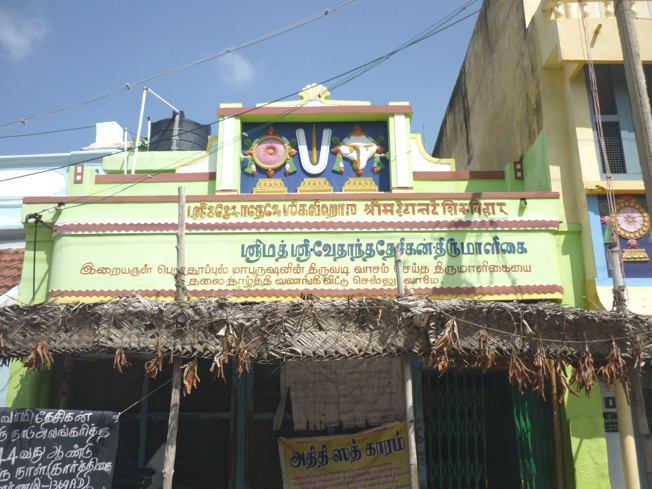
From the house of Sri Vedantha Desika in North Uttira street, today's lecture was given. Desika was born in 1267 and lived for 100 years. He made 28 sthothrams on various deities besides drama, kavya and a number of works on sidhantha. His work on Gita is called Tatparya Chandrika and forms basis for these lectures.While living in this house, Sri Desika used to observe unchavrutti  that is he used to get alms from houses and use them as food for living. This was the way great people lived in those days. They never used to stock, but got the necessities for that day's living from others. One day while he was going for alms, some people with either to test him or to endow him with some wealth, offered gold along with the grains. But back in his house, he asked his wife, to throw away those 'unwanted' gold as though they were worms in the grains! Such was his detachment to worldly matters.  Paying our respects to that great Acharya we continue.

Today's sloka is the latter half of sloka 28 and full sloka 29:
arjuna uvaca

drstvemam sva-janam krishna
yuyutsum samupasthitam
sidanti mama gatrani
mukham ca parisusyati
vepathus ca sarire me
roma-harsas ca jayate
Arjuna said: My dear Krsna, seeing my friends and relatives present before me in such a fighting spirit, I feel the limbs of my body quivering and my mouth drying up.My whole body is trembling, and my hair is standing on end. 
Arjuna now speaks: Krishna = Hey! Krishna, imam = here, samupasthitam = where all have assembled, sva-janam = my relatives, drstva = (I am) seeing, yuyutsum = eager to fight.
Arjuna finds all his relatives and friends assembled. Normally such assembly will be for some happy occasion and people will be glad to be among the gathering. But here they have assembled to fight with each other and so he is saddened.
He addresses as Krishna and not by any other name now. Krishna in Sanskrit ,by splitting the word Krishi+ na, means person who pleases earth. Krishi is farming or ploughing. By doing this, we harvest and live happily. So also Krishna makes those living on this earth happy. So, He should dispel the worries of Arjuna and make him happy. Krishna also means dark blue or black which was the complexion of Sri Krishna. Andal says in her Nachiyar Thirumozhi ' Kannan ennum karundeivam..' Since He was not appearing before Her, out of disgust, she says she wanted to forget Him but she is unable to forget the black colour.
Black is considered beautiful. A black cloud brings happiness as it will rain and after exhausting its water content it turns white. So normally a person with good compassion and sympathy is likened to a rain bearing black cloud. Such a cloud does not rain for a particular section or persons, but for the entire area without any discrimination. So also good people do not discriminate on the basis of caste or creed. So also God is. Sri Krishna is always black, because He has compassion always for us. 

Sidanti mama gatrani = (on seeing his relatives assembled to fight, Arjuna's) body is paining, mukham ca parisusyati = face is gloomy, vepathus ca sarire me = my (Arjuna's) body is trembling, roma-harsas ca jayate = (Arjuna) has goose-bumps (horripilation). Arjuna is a brave warrior and he fears none to tremble. He has control over sleep. So, something more powerful is making him to tremble. That is his compassion. That has agitated his mind, on seeing his relatives assembled to fight. 
Child Bhakta, Prahalada was sent to the school on the first day; but refused to go on second day. Thinking it was the usual habit of children, his father asked him, why Prahalada did not want to go to school. Prahalada replied that on the First day, they taught in the school, to hate Devas and love Asuras. He said that he did not find it acceptable to hate anyone. All were dear to him. Thinking some people are not belonging to us, is limiting ourselves.Because of this Universal feeling only, Arjuna is worried, in spite of many atrocities of Duryodana.
                                              (continued)  


Tuesday, February 10, 2015

GITA 1.26

GITA 1.26
Today it is the 27th sloka of Chapter1:
tan samiksya sa kaunteyah

sarvan bandhun avasthitan
kripaya parayavisto
visidann idam abravit
When the son of Kunti, Arjuna, saw all these different grades of friends and relatives, he became overwhelmed with compassion and spoke thus:
Sa = that, kaunteyah = Kunti's son (here, Arjuna), bandhun avasthitan = assembled relatives, samiksya = fully saw. Why that Arjuna? Here it means that Arjuna, full of compassion and mercy! Those with compassion are always great people. Karuna, daya, krupa, etc., are all synonyms. Paraya = overwhelming, kripaya = with mercy, avista = full of, visidann = suffering (trembling), idam abravit = told this. Thus, seeing relatives on both armies, Arjuna was suffering mentally and body trembled. Was Arjuna, a very bold archer, capable of taking on anyone, gift of Indra and favourite of Sri Krishna, trembling? He was well versed with wielding all weapons. But his great quality was compassion. .Today's lecture was delivered from the Sri Ramanuja Matham in the North Uthira [ul +thiru] street. Now it is occupied by H.H.Sri Sriranga Jeer, who accepts all the rituals gifted to Sri Bhashyakarar[Sri Ramanuja].In this place only Ramanuja lived in Srirangam and administered the entire SriVaishnava community. He was born in the star Arudra also known as Ardra. In Sanskrit, ardra means wet or water soaked. Normally those with compassion or sympathy are referred to in Tamil [as also in other languages] as with a wet mind [ as opposed to dry mind or heart]. This is a very essential quality. Without this the importance of other qualities will be nil. For example, we refer to God as all knowing and all powerful. His knowledge is boundless and He knows all and everyone. His power also is limitless and He can tackle everyone anywhere and always. On the other side, we are all mortal humans with limited capabilities and we commit endless mistakes knowingly and otherwise also. This God knows and He has the full authority to punish. So if only He did not have that quality of mercy we can not imagine what will happen to us. So it is the quality of mercy makes us all approach Him and get what we want for our welfare,[TGS:in a sloka in Daya sathakam, by Swamy Sri Desikan says,"Hey! Mother Mercy! But for you all other qualities of Him will be dangerous for us"]. God also expects us to have compassion for others.We are all children of God and what use is there if we can not help each other in distress. Just as, if one hand gets help from another hand because all belong to same body, we should help each other. This will happen only when there is the quality of mercy 
During Ramanuja's time there was another sanyasin disciple called Sri Embar. His original name was Sri Govinda and was the cousin of Sri Ramanuja. Once he bathed in Cauvery and came out and on the bank he saw a snake struggling because of a thorn stuck in its tongue. Embar, out of pity, removed the thorn carefully and again took bath and returned to the math.
His sishyas asked as to why did he remove the thorn from the deadly snake and enabled it to start biting people and killing them. For this his reply was: Did the snake put the poison on its teeth or is it God's creation? Did it have the option to take birth as snake? It is the nature of snakes and we can not see it suffering.
Though Arjuna was a great warrior and his prowess in archery was famous , yet because he had that quality of mercy in him he was overwhelmed with compassion at the sight of the relatives and friends in the battlefield.

                                                         (continued)

Monday, February 9, 2015

GITA 1.25

GITA 1.25

pAdukE yati-rAjasya kathayanti yad-AkhyayA
tasya dASarathE: pAadav SirasA dhArayAam yaham
This is a sloka on the greatness of one of Sri Ramanuja's disciples, with real name Sri Dasarathi, but more famous as Sri Mudaliyandan. He was considered as Sri Ramanuja's paduka (sandals). Already we saw one other disciple of Sri Ramanuja - Sri Koorattalwan. Today's lecture was given from the house[thiru maligai] of Sri Mudaliyandan. His name was Dasarathi and was the son of Ramanuja's sister ie nephew. This house also is in East Chittirai street. Thousand years back Ramanuja got the authority to administer the temple and he devised the rituals, uthsavams and other functions to be carried out which are followed even today. Ramanuja wanted participation of all . He put Mudaliyandan in charge of administration and the nephew also did the job sincerely.
In the last sloka, we saw Sri Krishna parking the chariot in between the armies and Sri Krishna asking Arjuna to look at the members of the Kuru clan assembled to fight. 
Today the 26th sloka:
tatrapasyat sthitan parthah

pitrn atha pitamahan
acaryan matulan bhratrn
putran pautran sakhims tatha
svasuran suhridas caiva
senayor ubhayor api
There Arjuna could see, within the midst of the armies of both parties, his fathers, grandfathers, teachers, maternal uncles, brothers, sons, grandsons, friends, and also his father-in-law and well-wishers--all present there.
When we see the list of people assembled, in the sloka, we may be wondering how even such close relatives have gathered to fight with each other. Pitrn = (In both sides Arjuna saw) fathers, pitamahan = grandfathers, acaryan = teachers, matulan = (maternal) uncles, bhratrn = brothers, putran = sons, pautran = grandsons, sakhims = friends, tatha svasuran = and fathers-in-law, suhidas caiva = also well wishers, seneyor ubhayor api = in both armies, tatra pasyat = saw there , parthah = Arjuna. 
Did not Arjuna know before start, who were likely to fight from both the sides? Yes, to some extent Arjuna was aware as to who were all going to be in the war. Bur Arjuna might not have known who were all invited by Duryodana to help him in the battle. But seeing so many relatives assembled, is the start of confusion in Arjuna. Fighting known enemies is not difficult, but fighting friends who have joined the enemy group might be difficult.  
Here it is not important to know who were fathers, or sons etc. but it should be noted that those whom normally we consider as mutual help have all come to fight. This is the start of confusion Arjuna is going to have. In our life, normally we regard friends and close relatives as those who will always standby us. But it is practical that this does not happen and we are shocked to find when they do not support us.
Here an incidence in Srimad Valmiki Ramayana is to be remembered. When Sri Rama decides to fulfill His father's promise to Kaikeyi and goes to forest, He, accompanied by Sri Sita and Sri Lakshmana, is driven in the chariot by the king's one of the ministers Sumanthra. At the banks of Ganga river Sri Rama and the accompanying two are to board the boat brought by Sri Guha and the time for taking leave by Sumanthra comes. With a heavy heart Sumanthra takes leave of Sri Rama and asks what was the message for His father, Dasaratha.Sri Rama replies that His heart was filled with sorrow and wants Sumanthra to tell His father that He would complete the 14 years exile period like 14 days and so Dasaratha should not feel sorry. He further asks Sumanthra to take care of His father. Next Sumanthra goes to Sri Sita and asks for any message. She, being a lady with more tender heart by nature, is unable to say anything. When it is the turn of Sri Lakshmana, Sumanthra asks him as what the message to his father. Sri Lakshmana says the question itself was wrong. Puzzled, Sumanthra replies that he had asked correctly only. Lakshmana said that his message is only to the King Dasaratha. He regarded Dasarath no longer as his father nor did he regard Sumithra as his mother but for him all such close relations was Sri Rama alone.
Sumanthra, after taking leave, arrives at Ayodhya and reports to the king Dasaratha that Sri Rama had entered the forests. Dasaratha enquires what were the messages from them and Sumanthra tells what happened. But Dasaratha on hearing Sri Lakshmana's message that he did not regard Dasaratha as father but Sri Rama as father, is overjoyed and embraces Sumanthra.
Here we should understand that all so called close relatives and friends are neither dependable nor permanent and everyone should regard God as the true relative and friend. This way one can avoid unhappiness if a relative or a friend turned against oneself In fact it should be our endeavour not to expect anything from them so that disappointment never occurs. We should have relations like water on lotus leaf. Absence of this attitude made Arjuna worried, when he saw his relatives and well wishers in the battlefield/
                                                 (continued)


Sunday, February 8, 2015

GITA 1.24.

GITA 1.24
The Gita by Sri Gitacharya is very important for every one's life. Our life will be uplifted, if we follow every tenets of Gita. Peace will prevail and we will know how to live mutually helpful to others. We are studying slokas 24 and 25 of Chapter 1 of Gita. As required by Arjuna, Sri Krishna parked the chariot in between the two armies, in front of Bheeshma and Drona, without caring for others, who were watching. Sri Krishna then told Arjuna to look at the Kuru clan members assembled to fight.  Thus Sri Krishna obeyed the order of Arjuna. Here a noble quality of the Lord is exhibited, which we, as devotees, should realise. 
A subordinate can work for a proprietor, but it is impossible for the proprietor to obey the orders of his own employee. But in the case of the Lord, that situation also can be realised. If we approach Sri Krishna with bhakti and love, He will treat us as His equal and after sometime, even place us above Him!  
We should remember we are lecturing from the house, where Sri Periya Nambi lived.  Here an anecdote is narrated.  Peria Nambi, who was still in the grahasthasramam had Sri Alavandar, a sanyasin, as his guru and Sri Ramanuja, another sanyasin, as his disciple. Once Ramanuja, who had about 700 sanyasins and about 12,000 grahasthas as sishyas ,was coming around the temple streets. At one place Periya Nambi, his guru appeared and suddenly, prostrated to Ramanuja, his sishya, when all Ramanuja's sishyas were watching. One would have expected Ramanuja to hurriedly rush towards his acharya and stopped Periya Nambi or Ramanuja also should have returned by prostrating to his guru, Periya Nambi. Ramanuja did neither and moved as usual and reached his ashram. Some sishyas were aghast at seeing this scene and asked Ramanuja why he did not do either of the possibilities and turned a blind eye. Ramanuja explained that if he had acted either way it would have shown that he ha recognised the falling at his feet by the Acharya and actually he never wanted such an action. So he was indifferent to that action.The same sishyas went to Periya Nambi and questioned as to why he fell at the feet of his own disciple. Came immediately the reply from Periya Nambi: to him Ramanuja appeared as his guru Sri Alawandar! So, great persons do not mind offering respects, when they see very noble persons, even if they are juniors to them.
In Srimad Bhagavatham, Sri Ambareesha tale is told. Ambareesha observes ekadasi vratham and on next day dwadasi, after performing pooja he completes the vratham by taking food. Once on such an occasion, on the dwadasi day as Ambareesha was performing pooja, sage Durwasa arrived and after offering swagatham, Ambareesha, the Ikshwaku king requested him to take food with him and help him to complete the vratham. Durwasa agreed and said he would finish his bath and come for food. But the sage wantonly delayed to test the king. The king waited and seeing that the sage had not come and also noting that in the next very few minutes dwadasi thithi would end and if he did not take food before that all the ekadasi vratha efforts would go in vain, Ambareesha consulted the pundits and took water, though that was not a food yet it satisfied the conditions for the vratha.  Durwasa was waiting for this and he immediately arrived at the spot and accused the King of inviting a guest and taking food before his arrival.The king's explanation went unheeded and Durvasa as usual in his anger cursed and he created a demon to devour the King, who respectfully, with folded hands, accepted the punishment. But earlier Sri Vishnu in appreciation of His devotee's sincerity, had placed His Sri Sudarsana Chakra [Discus] in the custody of Ambareesha for protection. Now when the Durwasa created Demon was coming near the king, Sudarsana could not remain idle at the injustice and so the Chakra reduced the demon to ashes and started chasing Durwasa. Scared , the sage went all over to Sri Paramasiva and Sri Bramha for help and all expressed their inability. Finally, he went to Sri MahaVishnu reclining on the Serpent mattress and wit Sri MahaLakshmi seated by Him, and appealed to withdraw His Chakra. For this Sri Vishnu replied that He could not do anything and it was better Durwasa surrendered to Ambaresha for redress. At that time He said," I am Bhaktha paradheena", meaning He is bound by the wishes and orders of His devotees. Durwasa went back to Ambareesha and fell at his feet and he was saved. Here, in Bhagavatham it is told that just like a husband is enslaved by a dutiful Pathivratha wife, so is the God, a slave to His devotees. Therefore, anyone can control others by sheer love. 
This is what Sri Krishna also did. 
                                                         (continued)