Tuesday, February 10, 2015

GITA 1.26

GITA 1.26
Today it is the 27th sloka of Chapter1:
tan samiksya sa kaunteyah

sarvan bandhun avasthitan
kripaya parayavisto
visidann idam abravit
When the son of Kunti, Arjuna, saw all these different grades of friends and relatives, he became overwhelmed with compassion and spoke thus:
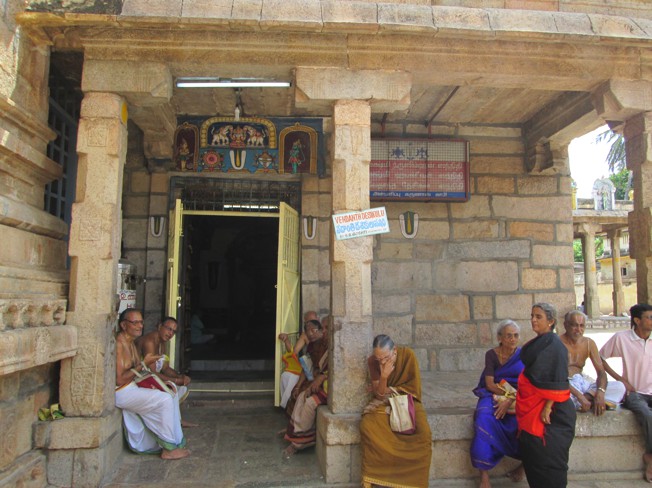
Sa = that, kaunteyah = Kunti's son (here, Arjuna), bandhun avasthitan = assembled relatives, samiksya = fully saw. Why that Arjuna? Here it means that Arjuna, full of compassion and mercy! Those with compassion are always great people. Karuna, daya, krupa, etc., are all synonyms. Paraya = overwhelming, kripaya = with mercy, avista = full of, visidann = suffering (trembling), idam abravit = told this. Thus, seeing relatives on both armies, Arjuna was suffering mentally and body trembled. Was Arjuna, a very bold archer, capable of taking on anyone, gift of Indra and favourite of Sri Krishna, trembling? He was well versed with wielding all weapons. But his great quality was compassion. .Today's lecture was delivered from the Sri Ramanuja Matham in the North Uthira [ul +thiru] street. Now it is occupied by H.H.Sri Sriranga Jeer, who accepts all the rituals gifted to Sri Bhashyakarar[Sri Ramanuja].In this place only Ramanuja lived in Srirangam and administered the entire SriVaishnava community. He was born in the star Arudra also known as Ardra. In Sanskrit, ardra means wet or water soaked. Normally those with compassion or sympathy are referred to in Tamil [as also in other languages] as with a wet mind [ as opposed to dry mind or heart]. This is a very essential quality. Without this the importance of other qualities will be nil. For example, we refer to God as all knowing and all powerful. His knowledge is boundless and He knows all and everyone. His power also is limitless and He can tackle everyone anywhere and always. On the other side, we are all mortal humans with limited capabilities and we commit endless mistakes knowingly and otherwise also. This God knows and He has the full authority to punish. So if only He did not have that quality of mercy we can not imagine what will happen to us. So it is the quality of mercy makes us all approach Him and get what we want for our welfare,[TGS:in a sloka in Daya sathakam, by Swamy Sri Desikan says,"Hey! Mother Mercy! But for you all other qualities of Him will be dangerous for us"]. God also expects us to have compassion for others.We are all children of God and what use is there if we can not help each other in distress. Just as, if one hand gets help from another hand because all belong to same body, we should help each other. This will happen only when there is the quality of mercy 
During Ramanuja's time there was another sanyasin disciple called Sri Embar. His original name was Sri Govinda and was the cousin of Sri Ramanuja. Once he bathed in Cauvery and came out and on the bank he saw a snake struggling because of a thorn stuck in its tongue. Embar, out of pity, removed the thorn carefully and again took bath and returned to the math.
His sishyas asked as to why did he remove the thorn from the deadly snake and enabled it to start biting people and killing them. For this his reply was: Did the snake put the poison on its teeth or is it God's creation? Did it have the option to take birth as snake? It is the nature of snakes and we can not see it suffering.
Though Arjuna was a great warrior and his prowess in archery was famous , yet because he had that quality of mercy in him he was overwhelmed with compassion at the sight of the relatives and friends in the battlefield.

                                                         (continued)

Monday, February 9, 2015

GITA 1.25

GITA 1.25

pAdukE yati-rAjasya kathayanti yad-AkhyayA
tasya dASarathE: pAadav SirasA dhArayAam yaham
This is a sloka on the greatness of one of Sri Ramanuja's disciples, with real name Sri Dasarathi, but more famous as Sri Mudaliyandan. He was considered as Sri Ramanuja's paduka (sandals). Already we saw one other disciple of Sri Ramanuja - Sri Koorattalwan. Today's lecture was given from the house[thiru maligai] of Sri Mudaliyandan. His name was Dasarathi and was the son of Ramanuja's sister ie nephew. This house also is in East Chittirai street. Thousand years back Ramanuja got the authority to administer the temple and he devised the rituals, uthsavams and other functions to be carried out which are followed even today. Ramanuja wanted participation of all . He put Mudaliyandan in charge of administration and the nephew also did the job sincerely.
In the last sloka, we saw Sri Krishna parking the chariot in between the armies and Sri Krishna asking Arjuna to look at the members of the Kuru clan assembled to fight. 
Today the 26th sloka:
tatrapasyat sthitan parthah

pitrn atha pitamahan
acaryan matulan bhratrn
putran pautran sakhims tatha
svasuran suhridas caiva
senayor ubhayor api
There Arjuna could see, within the midst of the armies of both parties, his fathers, grandfathers, teachers, maternal uncles, brothers, sons, grandsons, friends, and also his father-in-law and well-wishers--all present there.
When we see the list of people assembled, in the sloka, we may be wondering how even such close relatives have gathered to fight with each other. Pitrn = (In both sides Arjuna saw) fathers, pitamahan = grandfathers, acaryan = teachers, matulan = (maternal) uncles, bhratrn = brothers, putran = sons, pautran = grandsons, sakhims = friends, tatha svasuran = and fathers-in-law, suhidas caiva = also well wishers, seneyor ubhayor api = in both armies, tatra pasyat = saw there , parthah = Arjuna. 
Did not Arjuna know before start, who were likely to fight from both the sides? Yes, to some extent Arjuna was aware as to who were all going to be in the war. Bur Arjuna might not have known who were all invited by Duryodana to help him in the battle. But seeing so many relatives assembled, is the start of confusion in Arjuna. Fighting known enemies is not difficult, but fighting friends who have joined the enemy group might be difficult.  
Here it is not important to know who were fathers, or sons etc. but it should be noted that those whom normally we consider as mutual help have all come to fight. This is the start of confusion Arjuna is going to have. In our life, normally we regard friends and close relatives as those who will always standby us. But it is practical that this does not happen and we are shocked to find when they do not support us.
Here an incidence in Srimad Valmiki Ramayana is to be remembered. When Sri Rama decides to fulfill His father's promise to Kaikeyi and goes to forest, He, accompanied by Sri Sita and Sri Lakshmana, is driven in the chariot by the king's one of the ministers Sumanthra. At the banks of Ganga river Sri Rama and the accompanying two are to board the boat brought by Sri Guha and the time for taking leave by Sumanthra comes. With a heavy heart Sumanthra takes leave of Sri Rama and asks what was the message for His father, Dasaratha.Sri Rama replies that His heart was filled with sorrow and wants Sumanthra to tell His father that He would complete the 14 years exile period like 14 days and so Dasaratha should not feel sorry. He further asks Sumanthra to take care of His father. Next Sumanthra goes to Sri Sita and asks for any message. She, being a lady with more tender heart by nature, is unable to say anything. When it is the turn of Sri Lakshmana, Sumanthra asks him as what the message to his father. Sri Lakshmana says the question itself was wrong. Puzzled, Sumanthra replies that he had asked correctly only. Lakshmana said that his message is only to the King Dasaratha. He regarded Dasarath no longer as his father nor did he regard Sumithra as his mother but for him all such close relations was Sri Rama alone.
Sumanthra, after taking leave, arrives at Ayodhya and reports to the king Dasaratha that Sri Rama had entered the forests. Dasaratha enquires what were the messages from them and Sumanthra tells what happened. But Dasaratha on hearing Sri Lakshmana's message that he did not regard Dasaratha as father but Sri Rama as father, is overjoyed and embraces Sumanthra.
Here we should understand that all so called close relatives and friends are neither dependable nor permanent and everyone should regard God as the true relative and friend. This way one can avoid unhappiness if a relative or a friend turned against oneself In fact it should be our endeavour not to expect anything from them so that disappointment never occurs. We should have relations like water on lotus leaf. Absence of this attitude made Arjuna worried, when he saw his relatives and well wishers in the battlefield/
                                                 (continued)


Sunday, February 8, 2015

GITA 1.24.

GITA 1.24
The Gita by Sri Gitacharya is very important for every one's life. Our life will be uplifted, if we follow every tenets of Gita. Peace will prevail and we will know how to live mutually helpful to others. We are studying slokas 24 and 25 of Chapter 1 of Gita. As required by Arjuna, Sri Krishna parked the chariot in between the two armies, in front of Bheeshma and Drona, without caring for others, who were watching. Sri Krishna then told Arjuna to look at the Kuru clan members assembled to fight.  Thus Sri Krishna obeyed the order of Arjuna. Here a noble quality of the Lord is exhibited, which we, as devotees, should realise. 
A subordinate can work for a proprietor, but it is impossible for the proprietor to obey the orders of his own employee. But in the case of the Lord, that situation also can be realised. If we approach Sri Krishna with bhakti and love, He will treat us as His equal and after sometime, even place us above Him!  
We should remember we are lecturing from the house, where Sri Periya Nambi lived.  Here an anecdote is narrated.  Peria Nambi, who was still in the grahasthasramam had Sri Alavandar, a sanyasin, as his guru and Sri Ramanuja, another sanyasin, as his disciple. Once Ramanuja, who had about 700 sanyasins and about 12,000 grahasthas as sishyas ,was coming around the temple streets. At one place Periya Nambi, his guru appeared and suddenly, prostrated to Ramanuja, his sishya, when all Ramanuja's sishyas were watching. One would have expected Ramanuja to hurriedly rush towards his acharya and stopped Periya Nambi or Ramanuja also should have returned by prostrating to his guru, Periya Nambi. Ramanuja did neither and moved as usual and reached his ashram. Some sishyas were aghast at seeing this scene and asked Ramanuja why he did not do either of the possibilities and turned a blind eye. Ramanuja explained that if he had acted either way it would have shown that he ha recognised the falling at his feet by the Acharya and actually he never wanted such an action. So he was indifferent to that action.The same sishyas went to Periya Nambi and questioned as to why he fell at the feet of his own disciple. Came immediately the reply from Periya Nambi: to him Ramanuja appeared as his guru Sri Alawandar! So, great persons do not mind offering respects, when they see very noble persons, even if they are juniors to them.
In Srimad Bhagavatham, Sri Ambareesha tale is told. Ambareesha observes ekadasi vratham and on next day dwadasi, after performing pooja he completes the vratham by taking food. Once on such an occasion, on the dwadasi day as Ambareesha was performing pooja, sage Durwasa arrived and after offering swagatham, Ambareesha, the Ikshwaku king requested him to take food with him and help him to complete the vratham. Durwasa agreed and said he would finish his bath and come for food. But the sage wantonly delayed to test the king. The king waited and seeing that the sage had not come and also noting that in the next very few minutes dwadasi thithi would end and if he did not take food before that all the ekadasi vratha efforts would go in vain, Ambareesha consulted the pundits and took water, though that was not a food yet it satisfied the conditions for the vratha.  Durwasa was waiting for this and he immediately arrived at the spot and accused the King of inviting a guest and taking food before his arrival.The king's explanation went unheeded and Durvasa as usual in his anger cursed and he created a demon to devour the King, who respectfully, with folded hands, accepted the punishment. But earlier Sri Vishnu in appreciation of His devotee's sincerity, had placed His Sri Sudarsana Chakra [Discus] in the custody of Ambareesha for protection. Now when the Durwasa created Demon was coming near the king, Sudarsana could not remain idle at the injustice and so the Chakra reduced the demon to ashes and started chasing Durwasa. Scared , the sage went all over to Sri Paramasiva and Sri Bramha for help and all expressed their inability. Finally, he went to Sri MahaVishnu reclining on the Serpent mattress and wit Sri MahaLakshmi seated by Him, and appealed to withdraw His Chakra. For this Sri Vishnu replied that He could not do anything and it was better Durwasa surrendered to Ambaresha for redress. At that time He said," I am Bhaktha paradheena", meaning He is bound by the wishes and orders of His devotees. Durwasa went back to Ambareesha and fell at his feet and he was saved. Here, in Bhagavatham it is told that just like a husband is enslaved by a dutiful Pathivratha wife, so is the God, a slave to His devotees. Therefore, anyone can control others by sheer love. 
This is what Sri Krishna also did. 
                                                         (continued)


Saturday, February 7, 2015

GITA 1.23

GITA 1.23

We are to see sloka 25 of Chapter 1. Appropriate to this sloka, we are at a place. We are at Sri Periya Nambi Tirumalikai (house) in East Chittirai Street, Srirangam. Sri Ramanuja was taught by Five Acharyas. Among them the First is Periya Nambi (Mahapoorna). He was born in the star Kettai (Jyeshta), in the Tamil month of Margazhi (December-January). The Deity of Kanchipuram, Sri Devaraja, only instructed Sri Ramanuja to approach Sri Periya Nambi as Acharya. On that order, Sri Periya Nambi became Acharya of Sri Ramanuja. Many Acharyas had lived in Srirangam. Periya Nambi, who lived in Srirangam, was the disciple of Sri Alavandar. Through Sri Periya Nambi, Sri Alavandar had passed on the policy of equality and universality, to impart knowledge of Gita, to Sri Ramanuja. Sri Ramanuja learnt many important topics from Sri Periya Nambi, in Madurantakam. Sri Periya Nambi also performed the pancha samskaram for Sri Ramanuja, in Madurantakam. Sri Ramanuja arranged for a dwelling house for his Acharya, Sri Periya Nambi, in Srirangam. It is also understood that Sri Ramanuja arranged houses for his disciples, Sri Koorattalwan and Sri Mudaliyandan jn the same street but in the opposite row. Sri Periya Nambi had a daughter Athuzhai. Sri Ramanuja got her married. It is our great fortune that we are at this house of Sri Periya Nambi. In Srirangam, every inch is backed by history. East side has the greatness, that the Divine Feet of Sri Ranganatha are in the East direction, only! We will see the sloka from here. An incident in Sri Periya Nambi's life and Gita are closely connected. First the sloka.
In sloka 24, we saw Sri Krishna parked the great chariot in between the two armies. In the 25th sloka, we will see, in front of whom, did Sri Krishna park the vehicle:
bhisma-drona-pramukhatah
sarvesam ca mahi-ksitam
uvaca partha pasyaitan 
samavetan kurun iti
In the presence of Bhisma, Drona and all other chieftains of the world, Hrsikesa, the Lord, said, Just behold, Partha, all the Kurus who are assembled here.
Uvaca = ( Sri Krishna) spoke, bhisma-drona-pramukhatah = (after parking the chariot) in the presence of Bheeshma, Drona, sarvesam ca = and near all, mahi-kshitam =  great heroes Here Two types of interpretations are possible. How can the chariot be parked in front of so many? So, it can be said that Sri Krishna, without caring for all the other heroes watching, parked the chariot in front of Bheeshma and Drona. Or, it is possible He parked the chariot in front of all of them. Arjuna did not ask Sri Krishna to park the chariot in front of them, but Sri Krishna parked in front of these persons, with a purpose. He foresaw that Arjuna would be declining to fight and would drop his bow and arrows. So, to provoke a situation, He deliberately parked in that spot! Sri Krishna could have parked the chariot in front of Duryodana or Dussasana or Karna. If He had done so, perhaps Arjuna would have been aroused to fight! Arjuna would have recalled all the misdoings of these people and Arjuna would have started to fight. But we would have missed Gita! To make Arjuna refuse to fight, the chariot was parked in front of Bheeshma and Arjuna. That way, Arjuna would get confused as to whether it was right to fight grandfather and Acharya, and possibly, kill them. Only when confused, clarity can emerge. That is why Sri Krishna parked the chariot in front of Bheeshma and Drona. 
Another interpretation is that Bheeshma was the Chief Commander, and if Arjuna wanted to speak, he should do to Bheeshma only. Another interpretation is that instead of saying Drona and Bheeshma, it was mentioned Bheeshma and Drona. This may look not an issue for us. But our elders and great scholars, attach importance to every word mentioned. Drona was teacher for Arjuna and taught him archery. That is all. But Bheeshma was a great gyani (wise man). Bheesma was a superior warrior, eldest in the clan and possessed great character. That is why this order of mentioning the names here. It is also possible that Sri Krishna parked the chariot in front of these persons, with a hope, at least then, would they take efforts to halt the war. So far both Bheeshma and Drona had sided with evil. Now, Sri Krishna gave a last opportunity to them to correct their approach.
One more opinion is also there. Bheeshma was a silent spectator. when Dussasana tried to disrobe Draupati, in the royal assembly. He should have then and there punished Duryodana and his brother for the misdeed. None could dare Bheeshma. Why did he remain silent at that time? Bheeshma considered Draupati as an object used in gambling, which was basically wrong. Such a great man slipped in an evil incident. Here, we may get a doubt. Sri Krishna could have appeared there, when Draupati cried 'Hey! Krishna! Dwarakanatha! Achyuta!', for help.  He could have personally consoled Draupati. But, instead, He arranged for the sarees on the spot and prevented any humiliation for her. Sri Pillai Lokacharya says that had Sri Krishna appeared there, He would have chopped the heads of Bheeshma, Drona and others. Not only that, He might have chopped the heads of Yudhishtra, Arjuna and others also. It was wrong to play gambling with humans as stakes, and most condemned for staking women, who are to be honoured. In Vedas or Upanishads, women have never been disgraced. The moment she cried Govinda, He was responsible for her protection. There was no question of she being the stakes held by anyone else. It was wrong for Yudhishtra, Bheema and Arjuna to have remained  mute spectators. When a woman was being disgraced, then there is no question of seeing dharma in gambling. Had he punished that way all including the Pandavas, Draupati would have become a widow, and considering that alone, Sri Krishna did not appear in Person during that incident. So, now Sri Krishna offered the last opportunity to Bheeshma to test his wisdom. 
Partha = O! Arjuna, pasyaitan = look at. That is Arjuna should look at them after knowing who they were and what their strength and weakness were. We will see further in the next lecture.
                                                                 (continued)        


Friday, February 6, 2015

GITA 1.22

GITA 1.22
srivatsa chinna misrEbyO nama ukthima dhImahE:
yadhukthayas thrayi gantE yaanti mangala sUtradhaam:


This is a sloka on one of the great disciples of Sri Ramanuja, Sri Koorattalwan. Sri Ramanuja had many disciples and we can find many noble qualities in everyone of them. We are in the house, where Sri Koorattalwan lived. It is known as Koorattalwan Tirumalikai. It is situated  in East Chittirai Street, Srirangam, near the Chittirai Ther (chariot or rath) shed. What is the relation between Koorattalwan and Gita? Sri Krishna has taught us how to live in many slokas of Gita. Though it may be in slokas, don't we need at least one person who has followed all the tenets of Gita, so that we could follow? Books alone can not impart knowledge. To make our book knowledge blossom, we have to follow our elders, who have practiced them. Sri Koorattalwan practiced every preaching in Gita. Near Arakkonam, Tamilnadu,  Kooram is a small village. Sri Koorattalwan was born in that village, some years before Sri Ramanuja was born. In the year 2010, in the Tamil month of Thai and in the star Hastham, his 1000th birth anniversary would be celebrated. In Gita, Sri Krishna preached that one should face happiness and sorrow, profit and loss with the same feelings. He was well read and very rich. In one moment, he relinquished all his wealth and surrendered at Sri Ramanuja. 
He had so much knowledge that at times he was able to correct Sri Ramanuja. Sri Ramanuja selected this house for Sri Koorattalwan. East Chittirai street is famous as Sri Periya Nambi's house was just in front of this house. All these details are available in Guru Parampara, which also throws insight into how these great persons lived, in spite of many hardships. After paying our respects to this Acharya, we will proceed to the next sloka in Gita. 
We saw in sloka 23, that Arjuna told Sri Krishna that he desired to see all those who had assembled to please the evil minded Duryodana. The next 24 th sloka is what Sanjaya told Dridarashtra. Sloka 24:
sanjaya uvaca 
evam ukto hrsikeso 
gudakesena bharata 
senayor ubhayor madhye 
sthapayitva rathottamam
Sanjaya said: O descendant of Bharata, being thus addressed by Arjuna, Lord Krsna drew up the fine chariot in the midst of the armies of both parties.
This sloka gets completed only with the next sloka. Evam ukto = thus addressed by, gudakesena = Arjuna (gudaka =  sleep, esa = controller). We are used to sleep in our own beds and in particular surroundings. Also, sometimes if we keep awake for long time in night, we will have overhang of sleep. It is very difficult for us to resist sleep. Arjuna had succeeded in controlling sleep. Sleep is a natural property, to give rest to our organs. After sleep, all these organs get refreshed. There are Three stages in sleep. The First is the wake up stage. It is called jagrada dasha in Sanskrit, when all our organs, including mind, are active. The next stage is just when we sleep, when all the external organs are resting, but mind is active and we get dreams. This is called swapa dasha. The Third stage is called sushupti dasha, when the mind also is rested. Arjuna was able to give refreshing to all his organs, even without a formal sleep. Even now, there are yoga taught to give fresh energy to our organs, without sleeping. The 6 to 8 hours sleep no doubt gives fresh energy to our organs. But going to sleep with many worries in our mind, will not give that result. Good sleep is when we are able to sleep within ten minutes after hitting the bed! Arjuna had the power to control sleep by controlling his mind. There is a reason, why Arjuna is named gudakesa here Because he is going to refuse to fight, and Sri Krishna is going to advise Arjuna in about 700 slokas. We may think that Arjuna was dull headed and that is why so much persuasion was needed! But we should know that Arjuna was very intelligent and can not be compared with us. He could resist temptation even when most beautiful women like Urvasi tried to entice him. He had conquered his senses and mind. Bharata = O! King (Dridarashtra), rathottamam = very special chariot, senayor ubhayor madhye = in the middle between the two armies, sthapayitwa = parking, hrisikesa = by Sri Krishna. The sentence continues into the next sloka 25. 
It appears Sri Ramanuja used to sleep for very little time. But Sri Koorattalwan would not sleep even that much! Though we can not avoid sleeping, we should know that controlling sleep will be advantageous for us. Sleep is also the result of our Rajo and Tamo qualities. We will see more in the next lecture. 
                                                                  (continued)   


Thursday, February 5, 2015

GITA 1.21

GITA 1.21
Today we are at Sri Vedanta Desikan Sannidhi in Srirangam Temple. He has presented a beautiful commentary on Gita called Tatparya Chandrika. Using that as basis we are studying Gita. Vedantam is the finale of Vedas. Sri Desikan is an Acharya capable of showing us the right path. The name Desika means a person after studying all vedas and Vedanta, after studying Alwars' prabhandam in full, trying to show us the right path. This sannidhi is situated near North gate, opposite Sri Thayar Sannidhi, near Sri Mettu Azhagiyasingar sannidhi and near the Kambar Arangetra Mantapam (see Gita 1.18). Inside this sannidhi Sri Vedanta Desika is gracing along with Sri Lakshmi Hayagriva. 

He is very closely associated with Srirangam. During the Muslim invasion of Srirangam, Sri Vedanta Desika carried Sruta Prakasika and the children of its author and proceeded Westwards to Melkote, Tirunarayanapuram, near Mysore. Sri Ramanuja made an elaborate commentary on Brahma sutras, called Sri Bhashyam. This was transcribed by Sri Sudarsana Bhatta and it was called Sruta Prakasika. So, to preserve that invaluable document, Sri Vedanta Desika carried it to safety. Thus he had undertaken an important duty to safeguard the sampradhaya (tradition). We are at the entrance to this sannidhi and after paying respects to him, we will proceed further.
Arjuna asked Sri Krishna to station the chariot between the two armies so that he could view who had come to fight with him and who had come to help him in the fight. Now next sloka 23:
yotsyamanan avekse 'ham 
ya ete 'tra samagatah 
dhartarastrasya durbuddher
yuddhe priya-cikirsavah
Let me see those who have come here to fight, wishing to please the evil-minded son of Dhrtarastra.
Aham = I (Arjuna), avekse = see,  yotsyamanan = those come to fight, ya ete 'tra  = here (in Kurukshetra), samagatah = assembled, dhartarastrasya = son of Dridarashtra (Duryodana), durbhuddher = evil minded, yuddhe = to fight, priya-cikirsavah = wanting to please. There are many who have assembled to fight to please Duryodana. Is that wish right? In our house, our child wants to eat dirt. Since, that would spoil the child health, the mother prevents the child. Can a neighbour criticize the mother for not fulfilling the desire of the child? The mother would help the child, in what is good for the child. All priyam (desires) can not be helped; but hitam (doing good) has to be helped.  We see this in our life frequently. What is good for us (hitam) is not liked by us; but what is liked by us (priyam) may not be good for us. Neem and bitterguord  are good for health, but we never like them. Fast foods are liked, but they are harmful. Similarly, speaking always truth is good, but many times we avoid it. But gossip and falsehood are interesting and we resort to them. We should do what is good only. If that is also to our liking, then it is pleasant. So, in every act we should see what is good. 
Our Acharyas and elders will advise us what is good and tell that in ways we like. "Satyam Bruyat Priyam Bruyat Na Bruyat Satyam Apriyam" is a famous sanskrit saying. It says that we should talk only truth, but in a way it is liked; never speak truth, if it is going to be disliked. In this war, his freinds have come to do what is liked by Duryodana and not what is good for him. We also should follow this in our life. We should try to advis what is good for our friends; and, not abandon. When we get the opportunity to advis what is good for anyone, we should not run away, but advise what is good. It does not matter, whether our advise is heeded or not. 
Prahalada was not happy in the way, his father was forcing his citizens not to worship God, but worship his father. So, even as a child, he bravely advised his father to correct his ways. Prahalada tried to tell his father what was good for him. Similarly, Vibheeshana advised his elder bother Ravana. Instaed of thanking Vibheeshana for doing good to him, Ravana despised Vibheeshana and expelled him. Thus, it is our duty to tell what is good. It is also true that such friends will be very few and flatterers will be abundant. 
Arjuna thus sees flatterers assembled to please Duryodana. 
                                                                   (continued)   


Wednesday, February 4, 2015

GITA 1.20

GITA 1.20
gita sugita kartavya, kim anyaih sastra vistaraih
ya svayam padmanabhasya, mukha-padmad vinihsrta
According to this sloka, Sri Krishna preached Gita from His lotus like mouth, and gave it to Arjuna as a medicine. Sri Krishna is Sri Ranganatha and now we are in the 1000 pillars Manatap in His temple. During the Adyayana Utsavam, the Lord graces from here during 'Ira patthu' (Ten nights). During that time, every decade of Nammalwar's Tiruvaimozhi is recited with dancing poses, by Arayars, in front of the Lord. Such is the greatness of Srirangam and everything here is a pleasure to the devotees.
From here, we will see the  sloka 22. Arjuna commands Sri Krishna to park the chariot in between the Two armies. Kauravas had 11 akshauhini army, while Pandavas had 7 akshauhini army. After the chariot is parked, what Arjuna is going to do, is explained in sloka 22. 
yavad etan nirikse 'ham 
yoddhu-kaman avasthitan
kair maya saha yoddhavyam
asmin rana-samudyame
so that I may see who is present here, who is desirous of fighting, and with whom I must contend in this great battle attempt.
Asmin = in this, rana-samudyame = war, maya = by me, kair saha yoddhavyam = with whom  to fight, yavad etan nirikse 'ham = to the extent I can see, yoddhu-kaman avasthitam = those desirous of fighting and present here. In the first half of the sloka, Arjuna tells he wanted to see those who had come to fight, to the extent he could see. In the second half, he is desiring to see with whom he is to associate to fight. Thus Arjuna wants to see who are his foes and who are his supporters. So, he wants Sri Krishna to station the chariot in the middle of the two armies. It may look funny, but once understood we could appreciate the deep meaning. 
This incident is taking place in Dwapara yug. First yug is Krita yug, followed by Treta yug and then Dwapara yug. We are in Kali yug, the last one. It is now 5108 years since the dawn of Kali yug. Kali yug starts at the end of Dwapara yug. Sri Krishna left for Vaikuntam at the end of Dwapara yug. Immediately thereafter, Dwaraka was submerged in ocean. Even today, we visit Dwaraka temple, by travelling in boats to cross ocean. Before Dwapara yug was Treta yug, when Sri Rama was born. During that time, Sri Rama along with His brothers Sri Bharata, Sri Lakshmana and Sri Shatrugna, was learning under Vasishta. At that time Sri Rama's age was 12 years. At that time sage Viswamitra arrives at Dasarata's palace, to request him for assistance to complete the yaga (holy fire ritual), he was performing. Viswamitra entered the Royal assembly. Dasarata was extremely pleased at the arrival of such a great sage. So, he welcomed Viswamitra with due honours. After offering seat, Dasarata, before Viswamitra made any request, offered to grant any request from him! Immediately, Viswamitra grabbed the opportunity, and requested Dasarata to depute his eldest son Sri Rama with him. Viswamitra said that he was to begin one Yaga and Rakshasas were causing disturbance. Though, he could curse them, because he would be performing the Yaga, he had to control his anger. If Sri Rama was deputed, He would guard the Yaga from those Rakshasas. Dasarata then only realised his mistake in volunteering to grant any request from Viswamitra. It is usual for many of us to agree for anything, when we are very happy, without analysing what we should do. But later, we might be repenting for having agreed to do that work. So we should be very careful in promising. Dasarata, then refused to send Sri Rama with Viswamitra, with a plea that Sri Rama was too young to face Rakshasas, and offered himself to defend the Yaga. But Viswamitra would not compromise and he started to depart angrily. Dasarata was embarrassed and at that time Vasishta signalled Dasarata that there must be something more than mere protecting the Yaga and so Dasarata should pacify Viswamitra by agreeing to depute Sri Rama. After the Yaga, Viswamitra would go to Mithila and get Sri Rama married to Sri Sita. Thus, though on the face of it was for Viswamitra to carry out his Yaga, in reality, it was for the good of Sri Rama. Immediately, Dasarata agreed and advised Sri Rama to go with Viswamitra and to carry out his orders. Sri Lakshmana also accompanied Sri Rama. Viswamitra went with Sri Rama and Sri Lakshmana, and entered the forest, where a huge demon, Thataka, was living. She came to kill them, and so, Viswamitra ordered Sri Rama to finish her. Sri Rama accordingly took the bow and when just about to shoot the arrow, got a doubt, whether it was right for Him to kill a woman, that too it was His debut. But Viswamitra told the hesitating Sri Rama, that she should be killed for the benefit of human kind, and then Sri Rama shot the arrow and killed her. So, Sri Rama carried out the order of Viswamitra, as advised by His father, Dasarata. Here also, Sri Rama, the Supreme Being, obeyed the command of an ordinary mortal, Viswamitra. We should always obey our elders like our parents, elder brothers, aged persons, etc. To demonstrate this only Sri Rama practiced in His life. 
In Sri Krishna Avatar also, he obeyed Arjuna and parked the chariot between the armies, without any protest. The Lord thus displays a fine quality in every avatar. He instantly appeared when the Elephant, Gajendra, cried for help. He appeared as Sri Narasimha, to prove the words of child Prahalada, from the same pillar indicated by him. He is bound by the uttering of a child or a devotee. Thus we should obey our seniors. Will that be good or bad? Our parents do not bring us up with any expectation that in future we would take care of them. But the parents might have a small desire that their children are still dependent on them. The children should ensure, therefore, to obey the parents till they live. Paraents' satisfaction ensures the Lord's happiness. By obeying, we will get their blessings and we can lead a care free life. 
We will see further in the next lecture.
                                                                 (continued)