Saturday, February 7, 2015

GITA 1.23

GITA 1.23

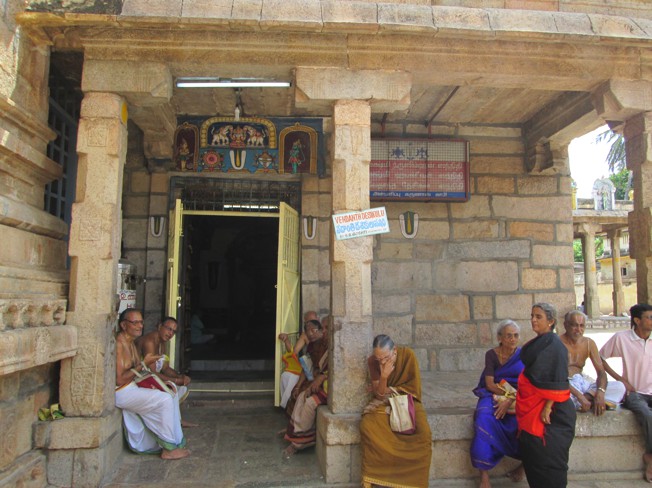
We are to see sloka 25 of Chapter 1. Appropriate to this sloka, we are at a place. We are at Sri Periya Nambi Tirumalikai (house) in East Chittirai Street, Srirangam. Sri Ramanuja was taught by Five Acharyas. Among them the First is Periya Nambi (Mahapoorna). He was born in the star Kettai (Jyeshta), in the Tamil month of Margazhi (December-January). The Deity of Kanchipuram, Sri Devaraja, only instructed Sri Ramanuja to approach Sri Periya Nambi as Acharya. On that order, Sri Periya Nambi became Acharya of Sri Ramanuja. Many Acharyas had lived in Srirangam. Periya Nambi, who lived in Srirangam, was the disciple of Sri Alavandar. Through Sri Periya Nambi, Sri Alavandar had passed on the policy of equality and universality, to impart knowledge of Gita, to Sri Ramanuja. Sri Ramanuja learnt many important topics from Sri Periya Nambi, in Madurantakam. Sri Periya Nambi also performed the pancha samskaram for Sri Ramanuja, in Madurantakam. Sri Ramanuja arranged for a dwelling house for his Acharya, Sri Periya Nambi, in Srirangam. It is also understood that Sri Ramanuja arranged houses for his disciples, Sri Koorattalwan and Sri Mudaliyandan jn the same street but in the opposite row. Sri Periya Nambi had a daughter Athuzhai. Sri Ramanuja got her married. It is our great fortune that we are at this house of Sri Periya Nambi. In Srirangam, every inch is backed by history. East side has the greatness, that the Divine Feet of Sri Ranganatha are in the East direction, only! We will see the sloka from here. An incident in Sri Periya Nambi's life and Gita are closely connected. First the sloka.
In sloka 24, we saw Sri Krishna parked the great chariot in between the two armies. In the 25th sloka, we will see, in front of whom, did Sri Krishna park the vehicle:
bhisma-drona-pramukhatah
sarvesam ca mahi-ksitam
uvaca partha pasyaitan 
samavetan kurun iti
In the presence of Bhisma, Drona and all other chieftains of the world, Hrsikesa, the Lord, said, Just behold, Partha, all the Kurus who are assembled here.
Uvaca = ( Sri Krishna) spoke, bhisma-drona-pramukhatah = (after parking the chariot) in the presence of Bheeshma, Drona, sarvesam ca = and near all, mahi-kshitam =  great heroes Here Two types of interpretations are possible. How can the chariot be parked in front of so many? So, it can be said that Sri Krishna, without caring for all the other heroes watching, parked the chariot in front of Bheeshma and Drona. Or, it is possible He parked the chariot in front of all of them. Arjuna did not ask Sri Krishna to park the chariot in front of them, but Sri Krishna parked in front of these persons, with a purpose. He foresaw that Arjuna would be declining to fight and would drop his bow and arrows. So, to provoke a situation, He deliberately parked in that spot! Sri Krishna could have parked the chariot in front of Duryodana or Dussasana or Karna. If He had done so, perhaps Arjuna would have been aroused to fight! Arjuna would have recalled all the misdoings of these people and Arjuna would have started to fight. But we would have missed Gita! To make Arjuna refuse to fight, the chariot was parked in front of Bheeshma and Arjuna. That way, Arjuna would get confused as to whether it was right to fight grandfather and Acharya, and possibly, kill them. Only when confused, clarity can emerge. That is why Sri Krishna parked the chariot in front of Bheeshma and Drona. 
Another interpretation is that Bheeshma was the Chief Commander, and if Arjuna wanted to speak, he should do to Bheeshma only. Another interpretation is that instead of saying Drona and Bheeshma, it was mentioned Bheeshma and Drona. This may look not an issue for us. But our elders and great scholars, attach importance to every word mentioned. Drona was teacher for Arjuna and taught him archery. That is all. But Bheeshma was a great gyani (wise man). Bheesma was a superior warrior, eldest in the clan and possessed great character. That is why this order of mentioning the names here. It is also possible that Sri Krishna parked the chariot in front of these persons, with a hope, at least then, would they take efforts to halt the war. So far both Bheeshma and Drona had sided with evil. Now, Sri Krishna gave a last opportunity to them to correct their approach.
One more opinion is also there. Bheeshma was a silent spectator. when Dussasana tried to disrobe Draupati, in the royal assembly. He should have then and there punished Duryodana and his brother for the misdeed. None could dare Bheeshma. Why did he remain silent at that time? Bheeshma considered Draupati as an object used in gambling, which was basically wrong. Such a great man slipped in an evil incident. Here, we may get a doubt. Sri Krishna could have appeared there, when Draupati cried 'Hey! Krishna! Dwarakanatha! Achyuta!', for help.  He could have personally consoled Draupati. But, instead, He arranged for the sarees on the spot and prevented any humiliation for her. Sri Pillai Lokacharya says that had Sri Krishna appeared there, He would have chopped the heads of Bheeshma, Drona and others. Not only that, He might have chopped the heads of Yudhishtra, Arjuna and others also. It was wrong to play gambling with humans as stakes, and most condemned for staking women, who are to be honoured. In Vedas or Upanishads, women have never been disgraced. The moment she cried Govinda, He was responsible for her protection. There was no question of she being the stakes held by anyone else. It was wrong for Yudhishtra, Bheema and Arjuna to have remained  mute spectators. When a woman was being disgraced, then there is no question of seeing dharma in gambling. Had he punished that way all including the Pandavas, Draupati would have become a widow, and considering that alone, Sri Krishna did not appear in Person during that incident. So, now Sri Krishna offered the last opportunity to Bheeshma to test his wisdom. 
Partha = O! Arjuna, pasyaitan = look at. That is Arjuna should look at them after knowing who they were and what their strength and weakness were. We will see further in the next lecture.
                                                                 (continued)        


Friday, February 6, 2015

GITA 1.22

GITA 1.22
srivatsa chinna misrEbyO nama ukthima dhImahE:
yadhukthayas thrayi gantE yaanti mangala sUtradhaam:


This is a sloka on one of the great disciples of Sri Ramanuja, Sri Koorattalwan. Sri Ramanuja had many disciples and we can find many noble qualities in everyone of them. We are in the house, where Sri Koorattalwan lived. It is known as Koorattalwan Tirumalikai. It is situated  in East Chittirai Street, Srirangam, near the Chittirai Ther (chariot or rath) shed. What is the relation between Koorattalwan and Gita? Sri Krishna has taught us how to live in many slokas of Gita. Though it may be in slokas, don't we need at least one person who has followed all the tenets of Gita, so that we could follow? Books alone can not impart knowledge. To make our book knowledge blossom, we have to follow our elders, who have practiced them. Sri Koorattalwan practiced every preaching in Gita. Near Arakkonam, Tamilnadu,  Kooram is a small village. Sri Koorattalwan was born in that village, some years before Sri Ramanuja was born. In the year 2010, in the Tamil month of Thai and in the star Hastham, his 1000th birth anniversary would be celebrated. In Gita, Sri Krishna preached that one should face happiness and sorrow, profit and loss with the same feelings. He was well read and very rich. In one moment, he relinquished all his wealth and surrendered at Sri Ramanuja. 
He had so much knowledge that at times he was able to correct Sri Ramanuja. Sri Ramanuja selected this house for Sri Koorattalwan. East Chittirai street is famous as Sri Periya Nambi's house was just in front of this house. All these details are available in Guru Parampara, which also throws insight into how these great persons lived, in spite of many hardships. After paying our respects to this Acharya, we will proceed to the next sloka in Gita. 
We saw in sloka 23, that Arjuna told Sri Krishna that he desired to see all those who had assembled to please the evil minded Duryodana. The next 24 th sloka is what Sanjaya told Dridarashtra. Sloka 24:
sanjaya uvaca 
evam ukto hrsikeso 
gudakesena bharata 
senayor ubhayor madhye 
sthapayitva rathottamam
Sanjaya said: O descendant of Bharata, being thus addressed by Arjuna, Lord Krsna drew up the fine chariot in the midst of the armies of both parties.
This sloka gets completed only with the next sloka. Evam ukto = thus addressed by, gudakesena = Arjuna (gudaka =  sleep, esa = controller). We are used to sleep in our own beds and in particular surroundings. Also, sometimes if we keep awake for long time in night, we will have overhang of sleep. It is very difficult for us to resist sleep. Arjuna had succeeded in controlling sleep. Sleep is a natural property, to give rest to our organs. After sleep, all these organs get refreshed. There are Three stages in sleep. The First is the wake up stage. It is called jagrada dasha in Sanskrit, when all our organs, including mind, are active. The next stage is just when we sleep, when all the external organs are resting, but mind is active and we get dreams. This is called swapa dasha. The Third stage is called sushupti dasha, when the mind also is rested. Arjuna was able to give refreshing to all his organs, even without a formal sleep. Even now, there are yoga taught to give fresh energy to our organs, without sleeping. The 6 to 8 hours sleep no doubt gives fresh energy to our organs. But going to sleep with many worries in our mind, will not give that result. Good sleep is when we are able to sleep within ten minutes after hitting the bed! Arjuna had the power to control sleep by controlling his mind. There is a reason, why Arjuna is named gudakesa here Because he is going to refuse to fight, and Sri Krishna is going to advise Arjuna in about 700 slokas. We may think that Arjuna was dull headed and that is why so much persuasion was needed! But we should know that Arjuna was very intelligent and can not be compared with us. He could resist temptation even when most beautiful women like Urvasi tried to entice him. He had conquered his senses and mind. Bharata = O! King (Dridarashtra), rathottamam = very special chariot, senayor ubhayor madhye = in the middle between the two armies, sthapayitwa = parking, hrisikesa = by Sri Krishna. The sentence continues into the next sloka 25. 
It appears Sri Ramanuja used to sleep for very little time. But Sri Koorattalwan would not sleep even that much! Though we can not avoid sleeping, we should know that controlling sleep will be advantageous for us. Sleep is also the result of our Rajo and Tamo qualities. We will see more in the next lecture. 
                                                                  (continued)   


Thursday, February 5, 2015

GITA 1.21

GITA 1.21
Today we are at Sri Vedanta Desikan Sannidhi in Srirangam Temple. He has presented a beautiful commentary on Gita called Tatparya Chandrika. Using that as basis we are studying Gita. Vedantam is the finale of Vedas. Sri Desikan is an Acharya capable of showing us the right path. The name Desika means a person after studying all vedas and Vedanta, after studying Alwars' prabhandam in full, trying to show us the right path. This sannidhi is situated near North gate, opposite Sri Thayar Sannidhi, near Sri Mettu Azhagiyasingar sannidhi and near the Kambar Arangetra Mantapam (see Gita 1.18). Inside this sannidhi Sri Vedanta Desika is gracing along with Sri Lakshmi Hayagriva. 

He is very closely associated with Srirangam. During the Muslim invasion of Srirangam, Sri Vedanta Desika carried Sruta Prakasika and the children of its author and proceeded Westwards to Melkote, Tirunarayanapuram, near Mysore. Sri Ramanuja made an elaborate commentary on Brahma sutras, called Sri Bhashyam. This was transcribed by Sri Sudarsana Bhatta and it was called Sruta Prakasika. So, to preserve that invaluable document, Sri Vedanta Desika carried it to safety. Thus he had undertaken an important duty to safeguard the sampradhaya (tradition). We are at the entrance to this sannidhi and after paying respects to him, we will proceed further.
Arjuna asked Sri Krishna to station the chariot between the two armies so that he could view who had come to fight with him and who had come to help him in the fight. Now next sloka 23:
yotsyamanan avekse 'ham 
ya ete 'tra samagatah 
dhartarastrasya durbuddher
yuddhe priya-cikirsavah
Let me see those who have come here to fight, wishing to please the evil-minded son of Dhrtarastra.
Aham = I (Arjuna), avekse = see,  yotsyamanan = those come to fight, ya ete 'tra  = here (in Kurukshetra), samagatah = assembled, dhartarastrasya = son of Dridarashtra (Duryodana), durbhuddher = evil minded, yuddhe = to fight, priya-cikirsavah = wanting to please. There are many who have assembled to fight to please Duryodana. Is that wish right? In our house, our child wants to eat dirt. Since, that would spoil the child health, the mother prevents the child. Can a neighbour criticize the mother for not fulfilling the desire of the child? The mother would help the child, in what is good for the child. All priyam (desires) can not be helped; but hitam (doing good) has to be helped.  We see this in our life frequently. What is good for us (hitam) is not liked by us; but what is liked by us (priyam) may not be good for us. Neem and bitterguord  are good for health, but we never like them. Fast foods are liked, but they are harmful. Similarly, speaking always truth is good, but many times we avoid it. But gossip and falsehood are interesting and we resort to them. We should do what is good only. If that is also to our liking, then it is pleasant. So, in every act we should see what is good. 
Our Acharyas and elders will advise us what is good and tell that in ways we like. "Satyam Bruyat Priyam Bruyat Na Bruyat Satyam Apriyam" is a famous sanskrit saying. It says that we should talk only truth, but in a way it is liked; never speak truth, if it is going to be disliked. In this war, his freinds have come to do what is liked by Duryodana and not what is good for him. We also should follow this in our life. We should try to advis what is good for our friends; and, not abandon. When we get the opportunity to advis what is good for anyone, we should not run away, but advise what is good. It does not matter, whether our advise is heeded or not. 
Prahalada was not happy in the way, his father was forcing his citizens not to worship God, but worship his father. So, even as a child, he bravely advised his father to correct his ways. Prahalada tried to tell his father what was good for him. Similarly, Vibheeshana advised his elder bother Ravana. Instaed of thanking Vibheeshana for doing good to him, Ravana despised Vibheeshana and expelled him. Thus, it is our duty to tell what is good. It is also true that such friends will be very few and flatterers will be abundant. 
Arjuna thus sees flatterers assembled to please Duryodana. 
                                                                   (continued)   


Wednesday, February 4, 2015

GITA 1.20

GITA 1.20
gita sugita kartavya, kim anyaih sastra vistaraih
ya svayam padmanabhasya, mukha-padmad vinihsrta
According to this sloka, Sri Krishna preached Gita from His lotus like mouth, and gave it to Arjuna as a medicine. Sri Krishna is Sri Ranganatha and now we are in the 1000 pillars Manatap in His temple. During the Adyayana Utsavam, the Lord graces from here during 'Ira patthu' (Ten nights). During that time, every decade of Nammalwar's Tiruvaimozhi is recited with dancing poses, by Arayars, in front of the Lord. Such is the greatness of Srirangam and everything here is a pleasure to the devotees.
From here, we will see the  sloka 22. Arjuna commands Sri Krishna to park the chariot in between the Two armies. Kauravas had 11 akshauhini army, while Pandavas had 7 akshauhini army. After the chariot is parked, what Arjuna is going to do, is explained in sloka 22. 
yavad etan nirikse 'ham 
yoddhu-kaman avasthitan
kair maya saha yoddhavyam
asmin rana-samudyame
so that I may see who is present here, who is desirous of fighting, and with whom I must contend in this great battle attempt.
Asmin = in this, rana-samudyame = war, maya = by me, kair saha yoddhavyam = with whom  to fight, yavad etan nirikse 'ham = to the extent I can see, yoddhu-kaman avasthitam = those desirous of fighting and present here. In the first half of the sloka, Arjuna tells he wanted to see those who had come to fight, to the extent he could see. In the second half, he is desiring to see with whom he is to associate to fight. Thus Arjuna wants to see who are his foes and who are his supporters. So, he wants Sri Krishna to station the chariot in the middle of the two armies. It may look funny, but once understood we could appreciate the deep meaning. 
This incident is taking place in Dwapara yug. First yug is Krita yug, followed by Treta yug and then Dwapara yug. We are in Kali yug, the last one. It is now 5108 years since the dawn of Kali yug. Kali yug starts at the end of Dwapara yug. Sri Krishna left for Vaikuntam at the end of Dwapara yug. Immediately thereafter, Dwaraka was submerged in ocean. Even today, we visit Dwaraka temple, by travelling in boats to cross ocean. Before Dwapara yug was Treta yug, when Sri Rama was born. During that time, Sri Rama along with His brothers Sri Bharata, Sri Lakshmana and Sri Shatrugna, was learning under Vasishta. At that time Sri Rama's age was 12 years. At that time sage Viswamitra arrives at Dasarata's palace, to request him for assistance to complete the yaga (holy fire ritual), he was performing. Viswamitra entered the Royal assembly. Dasarata was extremely pleased at the arrival of such a great sage. So, he welcomed Viswamitra with due honours. After offering seat, Dasarata, before Viswamitra made any request, offered to grant any request from him! Immediately, Viswamitra grabbed the opportunity, and requested Dasarata to depute his eldest son Sri Rama with him. Viswamitra said that he was to begin one Yaga and Rakshasas were causing disturbance. Though, he could curse them, because he would be performing the Yaga, he had to control his anger. If Sri Rama was deputed, He would guard the Yaga from those Rakshasas. Dasarata then only realised his mistake in volunteering to grant any request from Viswamitra. It is usual for many of us to agree for anything, when we are very happy, without analysing what we should do. But later, we might be repenting for having agreed to do that work. So we should be very careful in promising. Dasarata, then refused to send Sri Rama with Viswamitra, with a plea that Sri Rama was too young to face Rakshasas, and offered himself to defend the Yaga. But Viswamitra would not compromise and he started to depart angrily. Dasarata was embarrassed and at that time Vasishta signalled Dasarata that there must be something more than mere protecting the Yaga and so Dasarata should pacify Viswamitra by agreeing to depute Sri Rama. After the Yaga, Viswamitra would go to Mithila and get Sri Rama married to Sri Sita. Thus, though on the face of it was for Viswamitra to carry out his Yaga, in reality, it was for the good of Sri Rama. Immediately, Dasarata agreed and advised Sri Rama to go with Viswamitra and to carry out his orders. Sri Lakshmana also accompanied Sri Rama. Viswamitra went with Sri Rama and Sri Lakshmana, and entered the forest, where a huge demon, Thataka, was living. She came to kill them, and so, Viswamitra ordered Sri Rama to finish her. Sri Rama accordingly took the bow and when just about to shoot the arrow, got a doubt, whether it was right for Him to kill a woman, that too it was His debut. But Viswamitra told the hesitating Sri Rama, that she should be killed for the benefit of human kind, and then Sri Rama shot the arrow and killed her. So, Sri Rama carried out the order of Viswamitra, as advised by His father, Dasarata. Here also, Sri Rama, the Supreme Being, obeyed the command of an ordinary mortal, Viswamitra. We should always obey our elders like our parents, elder brothers, aged persons, etc. To demonstrate this only Sri Rama practiced in His life. 
In Sri Krishna Avatar also, he obeyed Arjuna and parked the chariot between the armies, without any protest. The Lord thus displays a fine quality in every avatar. He instantly appeared when the Elephant, Gajendra, cried for help. He appeared as Sri Narasimha, to prove the words of child Prahalada, from the same pillar indicated by him. He is bound by the uttering of a child or a devotee. Thus we should obey our seniors. Will that be good or bad? Our parents do not bring us up with any expectation that in future we would take care of them. But the parents might have a small desire that their children are still dependent on them. The children should ensure, therefore, to obey the parents till they live. Paraents' satisfaction ensures the Lord's happiness. By obeying, we will get their blessings and we can lead a care free life. 
We will see further in the next lecture.
                                                                 (continued)   


Tuesday, February 3, 2015

GITA 1.19

GITA 1.19
UllAsa-Pallavitha-Paalitha-SapthalOkee-
nirvAha-kOrakitha-nEma-katAshaleelAm|
Sriranga-harmyatala-MangaLa-dheepa-rEkhAm
SrirangarAja-MahishIm SriyamAsrayAma||
This is a sloka from 'gunaratna kosam' by the great Acharya Sri Parasara Battar. These slokas were composed in praise of Sri Ranga Nachiyar. She is shining like a lamp on the vimanam (canopy) over Sri Ranganatha. With Her grace only, the entire World is living. 
In the name Srirangam, Sri denotes Her and this is Her rangam (dancing stage). Sri Ranga Nachiyar is happily dancing in this place. We are now in the Thousand pillar mantapam ,which is replica of similar one in Vaikuntam. In the Gita we are studying, the greatness of the Lord. The Lord is praised as Sri Hrishikesa. We saw sloka 21 first half. Sanjaya said,"O! King! Arjuna firmly held his bow and looking at Duryodana and others, told these words to Sri Hrishikesa (Sri Krishna)". We will now see what Arjuna told. The second half of sloka 21: 
senayor ubhayor madhye
ratham sthapaya me 'cyuta
O infallible one, please draw my chariot between the two armies
Acyuta = Hey! Achyuta (Sri Krishna), senayor ubhayor madhye = in between the Two armies, me ratham = my chariot, sthapaya = park (it). This is an order from Arjuna to Sri Krishna! Arjuna should have politely requested Sri Krishna, as Sri Krishna was Supreme Being and Arjuna was an ordinary mortal. He should have fallen at Sri Krishna's feet and prayed. But that shows their intimacy as they were cousins! It was Arjuna's great fortune. Such was their intimacy that Arjuna could command Sri Krishna! If a mortal could order the Supreme Being, that itself is enough to foretell victory for the Pandavas! Was there a necessity to fight? There is no doubt about the result of the war, after this talk by Arjuna! Sri Vedanta Desika in his Tatparya Chandrika shows a wonderful interpretation. In the beginning, Dridarashtra asked Sanjaya as to what was happening in the sacred Kurukshetra between his sons and Pandava. We mentioned that Dridarashtra concealed his real intention. Dridarashtra was eager to know the victory of his sons. But afraid of partiality, he concealed his intention in his query to Sanjaya. Sanjaya, understanding the real intention of Dridarashtra, tried to reply in the same vein! Because both Sanjaya and Dridarashtra were classmates! Dridarashtra used to wonder and enquire Sanjaya as to how he was able to grasp knowledge so quickly, even though both of them studied under the same teacher. Sanjaya used to reply that he could answer his query if Dridarashtra would not get offended. That itself should be clear to Dridarashtra that something unpleasant would be told. Sanjaya did not know how to deceive and so he was able to understand everything clearly. Corollary is that Dridarashtra was a deceiver! For the query of Dridarashtra in the beginning, Sanjaya mentioning about the sound from Panchajanya shattering the hearts of Duryodana and others, could be one indirect answer. Now as a Second answer to Dridarashtra's query, Sanjaya is narrating that an ordinary mortal is ordering the Supreme Being to park the chariot in between the armies and it is being carried out! But as usual, Dridarashtra was incapable of understanding the satire in Sanjaya's words. That is why at the end, Sanjaya explicitly tells Dridarashtra that where Sri Krishna and Arjuna were, there victory was confirmed. 
Here, Arjuna addresses Sri Krishna as Achyuta. Achyuta has several meanings. One is that one will not abandon. One who never deserts a person who has surrendered is Achyuta. The Lord never slips from any of His divine qualities.Whatever Avatar He takes, be is Fish or Boar or Hayagriva, He never slips from any of His noble qualities. Also, He never abandons anyone approaching Him. 
In the famous hymn 'pachaima malaipol meni...', of Tirumalai of Tondaradipodi Alwar, he calls Sri Ranganatha as Achyuta. The Alwar describes the beauty of the Lord. In festivals, the Lord is decorated differently to show His beauty, in various forms. Alwar describes the Lord's divine body as a green hill and in that His lips are red like corals. Eyes appear as lotus! In this how does Achyuta fit in? A lotus might lose its blossoms, when Sun sets; or, it may wither away after a few days, but Sri Krishna's eyes will never lose their qualities. 
Arjuna calling Sri Krishna Achyuta also to indicate that He should not abandon Arjuna! So, Arjuna is commanding Sri Krishna with something in his mind. Sri Krishna accordingly parks the chariot so that Arjuna could see all the heroes standing in both armies. Normally, before we venture into something, we should analyse all pros and cons. Here, Sri Ramanuja in his commentary raises a question. How is it justified for Sri Krishna to obey such commands from Arjuna? The Supreme Being, in the eyes of the World, is working as a Charioteer for a mortal! We have seen friends of great persons showing their intimacy in private, but in public, they would show their due respects. But here Arjuna is publicly displaying Sri Krishna as His charioteer! Sri Ramanuja answers that for the sake of His devotee, the Lord will stoop to any level. We will see in the next lecture how Sri Krishna parks the chariot. 
                                                                   (continued)      


Monday, February 2, 2015

GITA 1.18

GITA 1.18
ulagam yavaiyum thamula aakkalum
nilai peruthalum neekalum neengala
alagila vilayattudayar avar thalaivar 
annavarke saran nangale. 
This is the First, prayer song of Kamba Ramayanam, in Tamil. Poet Kambar says that he prostrates to Him, Who is the Creator, Protector and Destroyer, and Who does all these as a Play and Who is Supreme. Kambar lived many centuries earlier and had authored Ramayana in Tamil language. For launching his work debut, he came to Srirangam. He worshiped Sri Ranganatha and prayed for permission for the launch. At that time Sri Ranganatha, through the Archaka (priest) asked whether Kambar sang in praise of Satakopa (Nammalwar). Repenting for that omission, Kambar immediately composed 'satakopar andhadi' in Tamil. He then launched his Ramayana epic in a mantapam in Srirangam temple. 
  
This mantapam is called Kambar Arangetra Mantapam and is situated near the North gate of the temple, opposite Sri Thayar Sannidhi and Sri Mettu Azhagiyasingar Sannidhi. In those days the approval and recognition  for Kambar's Ramayana was not that easily available. In his Ramayana, Kambar, while describing Yudha canto, mentions through Vibheeshana about Hiranyakasipu. Like Sri Narasimha destroyed Hiranyakasipu, Vibheeshana advises his brother Ravana not to indulge in evil acts and displease Sri Rama. While doing so, Kambar described Sri Narasimha Avatar story, in his Ramayana epic. When Kambar started reciting this episode and at the instance where Sri Narasimha emerged from pillar to kill Hiranyakasipu, loud laughter was heard from the Mettu Azhagiyasingar Sannidhi (seen right of the Mantapam in the picture). Thus everyone thought that the Lord Himself had recognized the work of Kambar. Thus, this is a historical place. From here, we will see the next sloka in Gita.
We had seen sloka 19 in the last lecture. In the next sloka 20, Arjuna looks at all those assembled before him. He held his bow Gandipa firmly and addressed Sri Krishna. 
atha vyavasthitan drstva
dhartarastran kapi-dhvajah
pravrtte sastra-sampate
dhanur udyamya pandavah 
O King, at that time Arjuna, the son of Pandu, who was seated in his chariot, his flag marked with Hanuman, took up his bow and prepared to shoot his arrows, looking at the sons of Dhrtarastra.
Pandavah = Arjuna, dhanur udyamya = grabbed his bow (Gandipa), sastra-sampade = fight, pravrutte = at the start, drstva = saw, dhartarastran = sons of Dridarashtra, vyavasthitan = all those determined (to make Duryodana win), kapi-dhvajah = (from the chariot with) monkey (Hanuman) emblem flag. By mentioning the flag with Hanuman as the emblem here, Vyasa assures that  Arjuna had the blessings of Sri Hanuman also and so sure of victory. If we worship Sri Anjaneya before starting a work, we can be sure of success. Because Sri Hanuman is famous for adventurous feats. He crossed the ocean to meet Sri Sita in Lanka and returned to convey his meeting to Sri Rama, which enabled Sri Rama to rescue Sri Sita. So Arjuna is venturing to fight with the blessings of Sri Hanuman. Also, just like the Ravana's army shivered at the sight of Sri Hanuman, Kauravas army would shiver at the sight of Hanuman emblem in the flag. We should remember that Sanjaya is narrating the events in the battlefield to King Dridarashtra. 
Sri Hanuman went with a mission to see Sri Sita and bring message from Her. Normally, when we are on a particular mission, we should try to gather information on all aspects associated with our mission, without spoiling the mission. We should be ready to answer all queries associated with the main purpose of our mission. That is why, Sri Hanuman, after meeting Sri Sita, wanted to know the strength and weakness of Ravana so that Sri Rama would be able to plan the strategy. So, he provoked Ravana by destroying the Ashoka gardens, killed the demons who came to fight with him, killed Ravan's son Akshakumar and pretended as though he was bound by Indrajit and met Ravana. Thus, Sri Hanuman created fear in the Rakshasas in Lanka. It was like twilight before sunrise. That is Sri Hanuman appeared before Sri Rama came to Lanka to destroy Ravana and his army. Similarly, here also Sri Hanuman appears before Sri Krishna and Arjuna enter the battlefield. Sri Hanuman had promised Arjuna that he would indirectly give support in the battle. Also Hanuman is elder brother of Bheema as both of them were blessed by god Vayu. Sri Hanuman is a symbol of enthusiasm. 
Now, we will see the First half of next sloka 21: 
hrsikesam tada vakyam
idam aha mahi-pate
O King, Arjuna then spoke to Hrsikesa [Krsna] these words:
Hrsikesam = (to) Sri Krishna, tada vakyam = these words, idam aha = spoke, mahi-pate = O! King. Already it was explained that Hrishikesa means controller of sense organs. Another meaning is, harsha = happiness, isa = commander, that is one who commands everyone and keeps them happy. What Arjuna told Sri Krishna will be discussed in the next lecture.
                                                                         (continued)      


Sunday, February 1, 2015

GITA 1.17

GITA 1.17
Vaikuntethupareloke sriya sardyamjagatpati:
Astevishnuraachintyatma baktai hibhagavatasa:
This is a purana sloka which says the Lord is gracing in Vaikuntam with all devotees who have reached Vaikuntam. It is not possible for us to view Him with our present body and eyes. That is why, out of mercy, the Lord has come down to earth and graces as Sri Ranganatha here. Sri Utsava Murthy, Sri Namperumal is gracing in standing pose. Sri Moolavar, Sri Ranganatha is gracing in a reclining pose. 
iruL iriya chuDar maNihaL imaikkum neTTri inattutti aNi paNam AyirangaL Arnda
aravu araSa perunSOdi anandan ennum aNi viLangum uyar veLLai aNaiyai mEvi |
tiru aranga peru naharuL teNNeer ponni tirai kaiyAl aDi varuDa paLLi koLLum
karu maNiyai kOmaLattai kaNDu koNDu en kaNNiNaihaL enru kolO kaLikkum nALE|| 
Like this by Kulasekara Alwar, many Alwars have yearned to visit Srirangam and have darshan of the Lord. Sri Ranganatha is no different from Sri Krishna. Tiruppanalwar, in his Amalanadipiran, says in the last hymn:
Kontal vannanaik kovalanay vennai
Untavayan ennullam kavarntanai
Antarkon Aniyarangan ennamutinaik
Kanta kankal marronrinaikkanave. 
Here, he says Sri Krishna is Sri Ranganatha. It is said that  one can carefully notice the smell of dairy products near Sri Ranganatha!
Sri Krishna is, along with Arjuna, seated in the grand chariot, in Kurukshetra battlefield. Bheeshma and others blew their conchs from Kauravas side; and, Sri Krishna, Pandavas and others also blew their conchs. In the next sloka 19, the effect of blowing of Panchajanya by Sri Krishna is described:
sa ghoso dhartarastranam
hrdayani vyadarayat 
nabhas ca prthivim caiva
tumulo 'bhyanunadayan
The blowing of these different conchshells became uproarious, and thus, vibrating both in the sky and on the earth, it shattered the hearts of the sons of Dhrtarastra.
Nabhas ca = the sky and, prthvim = the earth, tumulo 'bhyanumadayan =  echo of collective noise of (all conchs on Pandavas side), dhartarastranam = (heard by) sons of Dridarashtra, hrdayam vyadarayat = shattered their hearts. The collective noise from Panchajanya and others reverberated in the sky and earth and were heard by sons of Dridarashtra. Their hearts were shattered. Commentators have given beautiful explanation here. When Sri Krishna blows His Panchajanya, will it arouse happiness or fear? Normally, one should feel happy. Then why the hearts of Duryodana and others were shattered? The God graces us according to our mind in approaching Him. If we approach Him with love, He responds with love. But if we approach Him with hatred, He also shows His anger. Nammalwar says in his Tiruvaimozhi:
agalil agalum * aNugil aNugum *
pugalum ariyan * poruvallan emmAn **
nigaril avan pugazh * pAdi iLaippilam 
pagalum iravum * padindhu kudaindhE 
                                                                                        (1.7.10)
If we try to be away from Him, He also goes away from us; but if we want to be near Him, He also comes forward to us. Alwar says in another poem, that the Lord tries to be near us and so takes a step forward to meet us. He is so great and superior. Should not we immediately take four steps to approach Him? On the contrary, we go backwards by four steps! Normally, we should try to stick to Him, ourselves. We do not do that and even when He approaches us, we try to go away! Like this we have been behaving over so many lives. We have seen mother cat, transfering her kitten from one place to other. We are kittens and the Lord is Mother Cat. So, when the Mother Cat comes to us, we do not think we are kitten, but we think we are mice and so run away. Here also, the sound of Panchajanya gives happiness to many, but a few are scared. Those who are happy are those liking Sri Krishna. Those who find Panchajanya dreadful, are those hating Sri Krishna.  
Sri Koorattalwan, in his Atimanushya Stavam tells something from Ramayana. Sri Lakshmana is lying on the ground unconscious, after hit by Indrajit. Ravana thought that if Sri Lakshmana was taken away, Sri Rama would not bear that separation and that way Ravana would have won. So, he tried to lift Sri Lakshmana with all his Twenty hands, but could not lift an inch. Ravana then felt that he could lift Humalayas and Mount Kailash, but unable to lift Sri Lakshmana. He then abandons that idea and goes away. Next, Hanuman arrives at the scene. Seeing Sri Lakshmana on the ground lying, Hanuman lifts him like a flower and takes him to Sri Rama!  Valmiki while describing this says that what could not be lifted by Ravana, was simply carried away by a monkey! After all Sri Lakshmana was unconscious and he could not change his weight for different persons, himself. The truth is that Ravana came with evil intention and so he could not lift Sri Lakshmana. While, Hanuman came with love and bhakti, and so he could easily carry him. Similarly, here the sons of Dridarashtra found the sound of Panchajanya dreadful. Like Sri Rama was able to pierce the Seven great trees with one arrow, in Ramayana, the one blow of sound rattled all the Hundred sons of Dridarashtra! 
We know that Sri Rukmini was in love with Sri Krishna. But Her brother Rukmi had arranged for marriage with Sisupala. Sri Rukmini, knowing this wicked design of Her brother, sent an old brahmin to take a message to Sri Krishna in Dwaraka. She sent a message in 7 lyrics requesting Sri Krishna to come to Her place and take away Her and marry Her. She had also written that on the previous day to marriage day, She would be visiting the temple and Sri Krishna should come and give indication about His arrival. Sri Krishna accordingly came on the appointed day and blew His Panchajanya to indicate His arrival. That sound was welcome for Sri Rukmini and She heaved a sigh of relief! Thus the sound of the same Panchajanya created different feelings to different persons. 
The sound of the conchs reverberated in the sky and on the earth! 
                                                                  (continued)