Tuesday, February 3, 2015

GITA 1.19

GITA 1.19
UllAsa-Pallavitha-Paalitha-SapthalOkee-
nirvAha-kOrakitha-nEma-katAshaleelAm|
Sriranga-harmyatala-MangaLa-dheepa-rEkhAm
SrirangarAja-MahishIm SriyamAsrayAma||
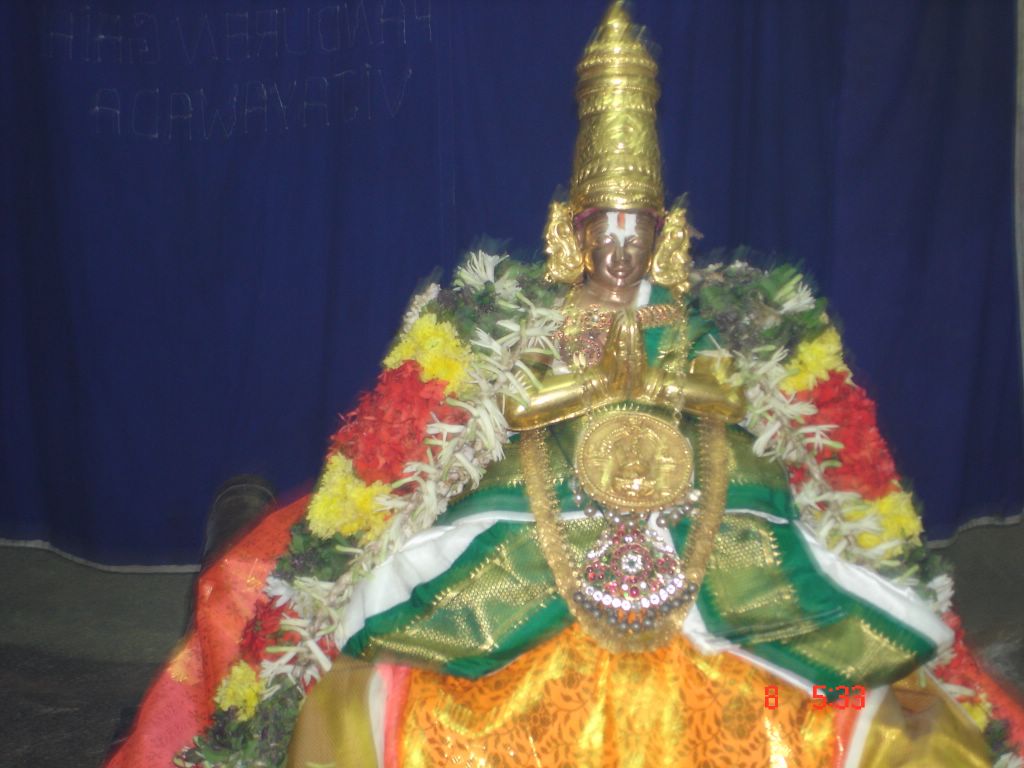
This is a sloka from 'gunaratna kosam' by the great Acharya Sri Parasara Battar. These slokas were composed in praise of Sri Ranga Nachiyar. She is shining like a lamp on the vimanam (canopy) over Sri Ranganatha. With Her grace only, the entire World is living. 
In the name Srirangam, Sri denotes Her and this is Her rangam (dancing stage). Sri Ranga Nachiyar is happily dancing in this place. We are now in the Thousand pillar mantapam ,which is replica of similar one in Vaikuntam. In the Gita we are studying, the greatness of the Lord. The Lord is praised as Sri Hrishikesa. We saw sloka 21 first half. Sanjaya said,"O! King! Arjuna firmly held his bow and looking at Duryodana and others, told these words to Sri Hrishikesa (Sri Krishna)". We will now see what Arjuna told. The second half of sloka 21: 
senayor ubhayor madhye
ratham sthapaya me 'cyuta
O infallible one, please draw my chariot between the two armies
Acyuta = Hey! Achyuta (Sri Krishna), senayor ubhayor madhye = in between the Two armies, me ratham = my chariot, sthapaya = park (it). This is an order from Arjuna to Sri Krishna! Arjuna should have politely requested Sri Krishna, as Sri Krishna was Supreme Being and Arjuna was an ordinary mortal. He should have fallen at Sri Krishna's feet and prayed. But that shows their intimacy as they were cousins! It was Arjuna's great fortune. Such was their intimacy that Arjuna could command Sri Krishna! If a mortal could order the Supreme Being, that itself is enough to foretell victory for the Pandavas! Was there a necessity to fight? There is no doubt about the result of the war, after this talk by Arjuna! Sri Vedanta Desika in his Tatparya Chandrika shows a wonderful interpretation. In the beginning, Dridarashtra asked Sanjaya as to what was happening in the sacred Kurukshetra between his sons and Pandava. We mentioned that Dridarashtra concealed his real intention. Dridarashtra was eager to know the victory of his sons. But afraid of partiality, he concealed his intention in his query to Sanjaya. Sanjaya, understanding the real intention of Dridarashtra, tried to reply in the same vein! Because both Sanjaya and Dridarashtra were classmates! Dridarashtra used to wonder and enquire Sanjaya as to how he was able to grasp knowledge so quickly, even though both of them studied under the same teacher. Sanjaya used to reply that he could answer his query if Dridarashtra would not get offended. That itself should be clear to Dridarashtra that something unpleasant would be told. Sanjaya did not know how to deceive and so he was able to understand everything clearly. Corollary is that Dridarashtra was a deceiver! For the query of Dridarashtra in the beginning, Sanjaya mentioning about the sound from Panchajanya shattering the hearts of Duryodana and others, could be one indirect answer. Now as a Second answer to Dridarashtra's query, Sanjaya is narrating that an ordinary mortal is ordering the Supreme Being to park the chariot in between the armies and it is being carried out! But as usual, Dridarashtra was incapable of understanding the satire in Sanjaya's words. That is why at the end, Sanjaya explicitly tells Dridarashtra that where Sri Krishna and Arjuna were, there victory was confirmed. 
Here, Arjuna addresses Sri Krishna as Achyuta. Achyuta has several meanings. One is that one will not abandon. One who never deserts a person who has surrendered is Achyuta. The Lord never slips from any of His divine qualities.Whatever Avatar He takes, be is Fish or Boar or Hayagriva, He never slips from any of His noble qualities. Also, He never abandons anyone approaching Him. 
In the famous hymn 'pachaima malaipol meni...', of Tirumalai of Tondaradipodi Alwar, he calls Sri Ranganatha as Achyuta. The Alwar describes the beauty of the Lord. In festivals, the Lord is decorated differently to show His beauty, in various forms. Alwar describes the Lord's divine body as a green hill and in that His lips are red like corals. Eyes appear as lotus! In this how does Achyuta fit in? A lotus might lose its blossoms, when Sun sets; or, it may wither away after a few days, but Sri Krishna's eyes will never lose their qualities. 
Arjuna calling Sri Krishna Achyuta also to indicate that He should not abandon Arjuna! So, Arjuna is commanding Sri Krishna with something in his mind. Sri Krishna accordingly parks the chariot so that Arjuna could see all the heroes standing in both armies. Normally, before we venture into something, we should analyse all pros and cons. Here, Sri Ramanuja in his commentary raises a question. How is it justified for Sri Krishna to obey such commands from Arjuna? The Supreme Being, in the eyes of the World, is working as a Charioteer for a mortal! We have seen friends of great persons showing their intimacy in private, but in public, they would show their due respects. But here Arjuna is publicly displaying Sri Krishna as His charioteer! Sri Ramanuja answers that for the sake of His devotee, the Lord will stoop to any level. We will see in the next lecture how Sri Krishna parks the chariot. 
                                                                   (continued)      


Monday, February 2, 2015

GITA 1.18

GITA 1.18
ulagam yavaiyum thamula aakkalum
nilai peruthalum neekalum neengala
alagila vilayattudayar avar thalaivar 
annavarke saran nangale. 
This is the First, prayer song of Kamba Ramayanam, in Tamil. Poet Kambar says that he prostrates to Him, Who is the Creator, Protector and Destroyer, and Who does all these as a Play and Who is Supreme. Kambar lived many centuries earlier and had authored Ramayana in Tamil language. For launching his work debut, he came to Srirangam. He worshiped Sri Ranganatha and prayed for permission for the launch. At that time Sri Ranganatha, through the Archaka (priest) asked whether Kambar sang in praise of Satakopa (Nammalwar). Repenting for that omission, Kambar immediately composed 'satakopar andhadi' in Tamil. He then launched his Ramayana epic in a mantapam in Srirangam temple. 
  
This mantapam is called Kambar Arangetra Mantapam and is situated near the North gate of the temple, opposite Sri Thayar Sannidhi and Sri Mettu Azhagiyasingar Sannidhi. In those days the approval and recognition  for Kambar's Ramayana was not that easily available. In his Ramayana, Kambar, while describing Yudha canto, mentions through Vibheeshana about Hiranyakasipu. Like Sri Narasimha destroyed Hiranyakasipu, Vibheeshana advises his brother Ravana not to indulge in evil acts and displease Sri Rama. While doing so, Kambar described Sri Narasimha Avatar story, in his Ramayana epic. When Kambar started reciting this episode and at the instance where Sri Narasimha emerged from pillar to kill Hiranyakasipu, loud laughter was heard from the Mettu Azhagiyasingar Sannidhi (seen right of the Mantapam in the picture). Thus everyone thought that the Lord Himself had recognized the work of Kambar. Thus, this is a historical place. From here, we will see the next sloka in Gita.
We had seen sloka 19 in the last lecture. In the next sloka 20, Arjuna looks at all those assembled before him. He held his bow Gandipa firmly and addressed Sri Krishna. 
atha vyavasthitan drstva
dhartarastran kapi-dhvajah
pravrtte sastra-sampate
dhanur udyamya pandavah 
O King, at that time Arjuna, the son of Pandu, who was seated in his chariot, his flag marked with Hanuman, took up his bow and prepared to shoot his arrows, looking at the sons of Dhrtarastra.
Pandavah = Arjuna, dhanur udyamya = grabbed his bow (Gandipa), sastra-sampade = fight, pravrutte = at the start, drstva = saw, dhartarastran = sons of Dridarashtra, vyavasthitan = all those determined (to make Duryodana win), kapi-dhvajah = (from the chariot with) monkey (Hanuman) emblem flag. By mentioning the flag with Hanuman as the emblem here, Vyasa assures that  Arjuna had the blessings of Sri Hanuman also and so sure of victory. If we worship Sri Anjaneya before starting a work, we can be sure of success. Because Sri Hanuman is famous for adventurous feats. He crossed the ocean to meet Sri Sita in Lanka and returned to convey his meeting to Sri Rama, which enabled Sri Rama to rescue Sri Sita. So Arjuna is venturing to fight with the blessings of Sri Hanuman. Also, just like the Ravana's army shivered at the sight of Sri Hanuman, Kauravas army would shiver at the sight of Hanuman emblem in the flag. We should remember that Sanjaya is narrating the events in the battlefield to King Dridarashtra. 
Sri Hanuman went with a mission to see Sri Sita and bring message from Her. Normally, when we are on a particular mission, we should try to gather information on all aspects associated with our mission, without spoiling the mission. We should be ready to answer all queries associated with the main purpose of our mission. That is why, Sri Hanuman, after meeting Sri Sita, wanted to know the strength and weakness of Ravana so that Sri Rama would be able to plan the strategy. So, he provoked Ravana by destroying the Ashoka gardens, killed the demons who came to fight with him, killed Ravan's son Akshakumar and pretended as though he was bound by Indrajit and met Ravana. Thus, Sri Hanuman created fear in the Rakshasas in Lanka. It was like twilight before sunrise. That is Sri Hanuman appeared before Sri Rama came to Lanka to destroy Ravana and his army. Similarly, here also Sri Hanuman appears before Sri Krishna and Arjuna enter the battlefield. Sri Hanuman had promised Arjuna that he would indirectly give support in the battle. Also Hanuman is elder brother of Bheema as both of them were blessed by god Vayu. Sri Hanuman is a symbol of enthusiasm. 
Now, we will see the First half of next sloka 21: 
hrsikesam tada vakyam
idam aha mahi-pate
O King, Arjuna then spoke to Hrsikesa [Krsna] these words:
Hrsikesam = (to) Sri Krishna, tada vakyam = these words, idam aha = spoke, mahi-pate = O! King. Already it was explained that Hrishikesa means controller of sense organs. Another meaning is, harsha = happiness, isa = commander, that is one who commands everyone and keeps them happy. What Arjuna told Sri Krishna will be discussed in the next lecture.
                                                                         (continued)      


Sunday, February 1, 2015

GITA 1.17

GITA 1.17
Vaikuntethupareloke sriya sardyamjagatpati:
Astevishnuraachintyatma baktai hibhagavatasa:
This is a purana sloka which says the Lord is gracing in Vaikuntam with all devotees who have reached Vaikuntam. It is not possible for us to view Him with our present body and eyes. That is why, out of mercy, the Lord has come down to earth and graces as Sri Ranganatha here. Sri Utsava Murthy, Sri Namperumal is gracing in standing pose. Sri Moolavar, Sri Ranganatha is gracing in a reclining pose. 
iruL iriya chuDar maNihaL imaikkum neTTri inattutti aNi paNam AyirangaL Arnda
aravu araSa perunSOdi anandan ennum aNi viLangum uyar veLLai aNaiyai mEvi |
tiru aranga peru naharuL teNNeer ponni tirai kaiyAl aDi varuDa paLLi koLLum
karu maNiyai kOmaLattai kaNDu koNDu en kaNNiNaihaL enru kolO kaLikkum nALE|| 
Like this by Kulasekara Alwar, many Alwars have yearned to visit Srirangam and have darshan of the Lord. Sri Ranganatha is no different from Sri Krishna. Tiruppanalwar, in his Amalanadipiran, says in the last hymn:
Kontal vannanaik kovalanay vennai
Untavayan ennullam kavarntanai
Antarkon Aniyarangan ennamutinaik
Kanta kankal marronrinaikkanave. 
Here, he says Sri Krishna is Sri Ranganatha. It is said that  one can carefully notice the smell of dairy products near Sri Ranganatha!
Sri Krishna is, along with Arjuna, seated in the grand chariot, in Kurukshetra battlefield. Bheeshma and others blew their conchs from Kauravas side; and, Sri Krishna, Pandavas and others also blew their conchs. In the next sloka 19, the effect of blowing of Panchajanya by Sri Krishna is described:
sa ghoso dhartarastranam
hrdayani vyadarayat 
nabhas ca prthivim caiva
tumulo 'bhyanunadayan
The blowing of these different conchshells became uproarious, and thus, vibrating both in the sky and on the earth, it shattered the hearts of the sons of Dhrtarastra.
Nabhas ca = the sky and, prthvim = the earth, tumulo 'bhyanumadayan =  echo of collective noise of (all conchs on Pandavas side), dhartarastranam = (heard by) sons of Dridarashtra, hrdayam vyadarayat = shattered their hearts. The collective noise from Panchajanya and others reverberated in the sky and earth and were heard by sons of Dridarashtra. Their hearts were shattered. Commentators have given beautiful explanation here. When Sri Krishna blows His Panchajanya, will it arouse happiness or fear? Normally, one should feel happy. Then why the hearts of Duryodana and others were shattered? The God graces us according to our mind in approaching Him. If we approach Him with love, He responds with love. But if we approach Him with hatred, He also shows His anger. Nammalwar says in his Tiruvaimozhi:
agalil agalum * aNugil aNugum *
pugalum ariyan * poruvallan emmAn **
nigaril avan pugazh * pAdi iLaippilam 
pagalum iravum * padindhu kudaindhE 
                                                                                        (1.7.10)
If we try to be away from Him, He also goes away from us; but if we want to be near Him, He also comes forward to us. Alwar says in another poem, that the Lord tries to be near us and so takes a step forward to meet us. He is so great and superior. Should not we immediately take four steps to approach Him? On the contrary, we go backwards by four steps! Normally, we should try to stick to Him, ourselves. We do not do that and even when He approaches us, we try to go away! Like this we have been behaving over so many lives. We have seen mother cat, transfering her kitten from one place to other. We are kittens and the Lord is Mother Cat. So, when the Mother Cat comes to us, we do not think we are kitten, but we think we are mice and so run away. Here also, the sound of Panchajanya gives happiness to many, but a few are scared. Those who are happy are those liking Sri Krishna. Those who find Panchajanya dreadful, are those hating Sri Krishna.  
Sri Koorattalwan, in his Atimanushya Stavam tells something from Ramayana. Sri Lakshmana is lying on the ground unconscious, after hit by Indrajit. Ravana thought that if Sri Lakshmana was taken away, Sri Rama would not bear that separation and that way Ravana would have won. So, he tried to lift Sri Lakshmana with all his Twenty hands, but could not lift an inch. Ravana then felt that he could lift Humalayas and Mount Kailash, but unable to lift Sri Lakshmana. He then abandons that idea and goes away. Next, Hanuman arrives at the scene. Seeing Sri Lakshmana on the ground lying, Hanuman lifts him like a flower and takes him to Sri Rama!  Valmiki while describing this says that what could not be lifted by Ravana, was simply carried away by a monkey! After all Sri Lakshmana was unconscious and he could not change his weight for different persons, himself. The truth is that Ravana came with evil intention and so he could not lift Sri Lakshmana. While, Hanuman came with love and bhakti, and so he could easily carry him. Similarly, here the sons of Dridarashtra found the sound of Panchajanya dreadful. Like Sri Rama was able to pierce the Seven great trees with one arrow, in Ramayana, the one blow of sound rattled all the Hundred sons of Dridarashtra! 
We know that Sri Rukmini was in love with Sri Krishna. But Her brother Rukmi had arranged for marriage with Sisupala. Sri Rukmini, knowing this wicked design of Her brother, sent an old brahmin to take a message to Sri Krishna in Dwaraka. She sent a message in 7 lyrics requesting Sri Krishna to come to Her place and take away Her and marry Her. She had also written that on the previous day to marriage day, She would be visiting the temple and Sri Krishna should come and give indication about His arrival. Sri Krishna accordingly came on the appointed day and blew His Panchajanya to indicate His arrival. That sound was welcome for Sri Rukmini and She heaved a sigh of relief! Thus the sound of the same Panchajanya created different feelings to different persons. 
The sound of the conchs reverberated in the sky and on the earth! 
                                                                  (continued)  


Saturday, January 31, 2015

GITA 1.16

GITA 1.16
We are at the Vaikunta vasal (Paramapada vasal) in Srirangam temple. On the Vaikunta Ekadasi day ( a day in December- January), through this gate only the procession of Sri Namperumal is taken. For ten days from that day, Tiruvaimozhi is recited and the festival is celebrated with fervour. This is called the Great Festival (Periya Tirunaal). Every atman always desires to reach Vaikuntam. All devotees consider it as a great privilege to pass through and touch this gate. On one side is the Chandra Pushkarini (temple tank) and opposite is the sannidhi of Sri Ranganachiyar (Thayar). On another side is the sannidhi of Mudalazhvars (Poigai, Bhootham and Pei Alwars). Thus all these surround this place. Near this place is the sannidhi of Sri Danvantari, Who is considered as an Avatar of Sriman Narayana and who cures all, from diseases. Standing between (Sri Dhanvantari sannidhi and Vaikunta vasal) we have to realize that when we live in this World, we should live healthy. After this life in this World, we should enter Vaikuntam. Now we will see the slokas of Gita.
Yesterday we saw sloka 16. Now slokas 17 and 18:
kasyas ca paramesv-asah
sikhandi ca maha-rathah
dhrstadyumno viratas ca
satyakis caparajitah
That great archer the King of Kasi, the great fighter Sikhandi, Dhrstadyumna, Virata and the unconquerable Satyaki, 
drupado draupadeyas ca
sarvasah prthivi-pate 
saubhadras ca maha-bahuh
sankhan dadhmuh prthak prthak
Drupada, the sons of Draupadi, and the others, O King, such as the son of Subhadra, greatly armed, all blew their respective conchshells.
By these two slokas, we notice who else blew conchs. All these persons are on the Pandavas side. Already we saw the persons on the Kauravas side, starting from Bheeshma, blew their conchs and made noise. Sri Krishna started blowing His conch Panchjanya and then all followed one by one. Kasyas ca paramesv-asah = the great archer, King of Kasi, sikandi ca maha-ratah = maharatha Sikhandi.
 As alraedy mentioned he who can fight with 11,000 persons, is called maharatha. Sri Krishna is going to use Sikhandi to kill Bheeshma on the 10th day of the war. Bheeshma has got a boon that he could remain alive as long as he desired. We may be feeling that if we also could get similar boon, how wonderful would it be! But actually, it is very dangerous and painful. In fact the unforeseeable nature of death makes us live happily. If we could know our death timing, we could never feel happy. Bheeshma wanted to die after ascertaining that Hastinapur was in the hands of a good and stable ruler. So, Sri Krishna had planned to defeat Bheeshma by Sikhandi. Bheeshma was the son of Ganga and had a step brother Vichitraveerya. Bheeshma was on the look out for a bride for Vichitraveerya. King of Kasi had Three daughters - Ambai, Ambika and Ambalika. Bheeshma abducted these girls in a swayamvaram and none dared to fight Bheeshma. Though Ambika and Ambalika were married to Vichitraveerya, Ambai wanted to marry her lover King of Salva. Bheeshma also felt it was not correct to get married her to a person different from his lover. So, Bheeshma let her go. But King of Salwa refused to marry her, as she was already abducted by Bheeshma. In spite of many attempts, both Bheeshma and King of Salwa abandoned Ambai. Then she asked Bheeshma to marry her. He told of his pledge to remain unmarried and so he also could not help her. Getting dejected, Ambai wanted to take revenge on Bheeshma and so did severe penance in the Himalayas. Sri Subramanya appeared before her and gave her a garland and said whoever wore that garland would be able to kill Bheeshma. She pleaded with many kings to wear the garland and vanquish Bheeshma, but none were ready for that. Finally, she came to Drupada, King of Panchala. But he also refused and getting dejected, she left the garland hanging in the palace gate and went away. She then penanced and prayed for Sri Paramasiva. He appeared before her and said that in the present birth of Ambai, she would not be able to kill Bheeshma; but in her next birth as a transsexual could fulfill her revenge. That is how she was born as Sikhandi. She was growing up in the palace of Drupada and one day she wore the garland she had left on the gates of the palace, in her last birth as Ambai. Since in her current birth also she was a girl, it was difficult for her to fight Bheeshma. Once, she went for a festival, where she met a gandarva lad, Tumburu. With his help, she changed her sex to a male. Now Sikhandi was a man! Sikhandi was brought in to fight Bheeshma in the Mahabharata war, bur Bheeshma refused to fight Sikhandi, as he was a woman earlier. When Bheeshma dropped his bow and declined to fight Sikhandi, Sri Krishna used that opportunity to fell Bheeshma. Can Sri Krishna play such foul game to destroy Bheeshma? The Lord has said that He was partial to His devotees. Therefore, there is no use in trying to find fault with Sri Krishna. So, it will be prudent on our part to be His devotee and live happily with whatever He blesses us! There is no use in trying to judge the deeds of the Lord. 
Parajitah = unconquerable, drstadyumna - Drashtadyumna, viratas ca satyaki = Virata and Satyaki. Drashtadyumna was the son of Drupada who begot him in a special yagna to kill Drona! Now Drashtadyumna was the Chief Commander of Pandavas army. Drashtadyumna and Draupati were siblings. 
Drupado = (King) Drupada, draupadeyas ca = and sons of Draupati, sarvasa = all others, maha bahu = great armed, saubhadras ca = son of Subhadra (Abhimanyu), sankham = conchs, dadhmuh = blew, prthak prthak = separately, pritvi-pate = O! King ( addressing Dradarashtra by Sanjaya). We should keep in mind that all these slokas are the narratives of the happenings in Kurukshetra battlefield, by Sanjaya to Dridarashtra. Abhimanyu, son of Arjuna and Subhadra, married Uttara, daughter of Virata and their child was Parikshit, who was told by the sage Sukha, the story of Sriman Narayana, which is the famous Srimad Bhagavatam puranam
We will see in the next lecture what was the effect of the sound from Panchajanya.
                                                                           (continued)          


Friday, January 30, 2015

GITA 1.15

GITA 1.15
lokaachaaryaaya gurave kRshNapaadasya sUnave 
samsaara bhogasandashTa jIvajIvaatave namaH |
This sloka is in praise of Sri Pillai Lokacharya. Today we are going to see Gita from the sannidhi of Sri Pillai Lokacharya in Srirangam.
We are seeing the happenings in Kurukshetra battlefield. About 700 years back there was an invasion by army, on Srirangam. In the year 1323 A.D. Muslims from North invaded Srirangam. Therefore, the Idols of Sri Namperumal  and Sri Ranganachiyar (Thayar) were threatened. Sri Pillai Lokacharta was living at that time. He was the son of Sri Vadakku Tiruveedhipillai, who was the disciple of Acharya Nampillai. Sri Pillai Lokacharya was born in 1205 A.D. So, when he was in his ripe old age the invasion took place. The looters entered Srirangam. Many people had to sacrifice their lives to save Srirangam. History records that about 12,000 people died. The idols of Sri Namperumal and Sri Ranganachiyar were carried in a closed palanquin, by Pillai Lokacharya, who proceeded South, secretly. Placing the idols in a cave in Jyotishkudi (presently Kodikulam) at the foothills of present day Aanaimalai near Tirumaliruncholai (Azhagar Koil), Sri Pillai Lokacharya lived there itself, guarding the idols. After sometime, he passed away there itself. Thereafter, Sri Namperumal travelled many places including Tirumalai (Tirupati) and then reached Srirangam in the year 1371. Like Sri Rama went on exile, Sri Namperumal also left Srirangam and returned after 48 years. It was because of the great service of this Acharya, today we are able to worship and enjoy, in great numbers. Therefore, all of us owe a lot to Sri Pillai Lokacharya. 
Now we will see the battle in Kurukshetra. 
Sloka 16:
anantavijayam raja
kunti-putro yudhisthirah
nakulah sahadevas ca
sughosa-manipuspakau
King Yudhisthira, the son of Kunti, blew his conchshell, the Ananta-vijaya, and Nakula and Sahadeva blew the Sughosa and Manipuspaka. 
Then the blowing of conchs by others is mentioned. Anantavijayam is the name of the conch of Yudhishtra. Raja = king, yudhisthiram = staying firmly in battle, kunti-putrah = son of Kunti. Here Yudhishtra is described with three attributes - King, son of Kunti and person standing firmly in battle. Though he had lost the kingdom (in gamble), he is considered King as he always stood by righteousness or dharma. Kunti was blessed by Yama and thus Yudhishtra was born. Since Sri Krishna was on Yudhishtra's side, victory was evident and so would become King soon. Knowing this only, Sanjaya mentions to Dridarashtra about Yudhishtra as King. 
Vasudeva was the father of Sri Krishna. He had a lot of sisters. Kunti was one of the sisters. The neighbouring kingdom was Kunti kingdom. That King did not have any child for a longtime. Vasudeva and the King were very close friends. The King requested Vasudeva's father to give in adoption on of his daughters. Agreeing Vasudeva gave in adoption his daughter Pritha. After adoption, she was known as Kunti Devi. That is why we see many times Arjuna is addressed by Sri Krishna as Partha, that is son of Pritha. Kuntis son is called Kaunteya. Since Sri Krishna drove Partha's chariot, He is Parthasarathy! He was also called Vijayasarathy. Yudhishtra was the eldest son of Kunti. Once she requested Sri Krishna, to bless them with problems, always. Sri Krishna was surprised at the request of His aunt! (Arjuna, His aunt's son was very intimate with Him. On the other hand, Sisupala, son of another aunt of Sri Krishna, was sworn enemy of Sri Krishna! So mere relationship will not do good. It is the mind.) When Sri Krishna asks her why she made that type of request, Kunti replied that only in distress, they remembered Sri Krishna! This is our case also. If we are happy, we tend to think all achievements are because of our efforts only. But when we are in problems, we blame the God for our failures. This is totally wrong! Either we accept success and failure as result of our actions or, attribute both to Him. That is why Kunti prayed that lest they forgot Him, they should frequently face problems. She was very righteous and sincere. She lived as an example to all women. 
Yudhishtra is yudhi (in battles) + thishtati (steadfast). When and where he had fought battles? We have heard of Arjuna and Bheema as strong fighters. But when a fight started it was Arjuna who became despondent and that is how Gita came up! But Yudhishtra never backtracked, once battle started. Such was his bravery. Pandavas, obeying the conditions, went to forest for 12 years and thereafter to remain incognito for one year. But just after 13 months after their exile started, Bheema came to Yudhishtra and said they should return to Hastinapur. Yudhishtra asked why he wanted to return so early. Bheema replied that as per one logic, one year could be represented by one month and so using that logic they could return to the Kingdom. Bheema made this proposal, because in forest he could not get enough food and had to starve! Yudhishtra never agreed and was firm that they should complete 13 years as per the agreement. He said they could then rightfully claim for the Kingdom and if the Kauravas denied, even if all his brothers did not come, Yudhishtra would lead a battle and fight to get back the kingdom. This shows how steadfast he was in battles. He was not for mere words but for real action. He was also very righteous. At the end, after the war was over and after Pandavas ruled the Kingdom, Pandavas left for the Heavens. It was an arduous climb uphill, beyond Badarikashram (Badrinath). On the way, one by one, Draupati, Sahadeva, Nakula, Arjuna and Bheema fell away. But a dog was following Yudhishtra right from the beginning. When finally, Yudhishtra was about to pass on to Heavens, the dog made a request to Yudhishtra. The dog was suffering from infection by many worms and so it wanted Yudhishtra to remove the worms before he left for the Heavens. When he tried to take away the worms, the worms pleaded to Yudhishtra that they were living on the blood of the dog and they would starve to death if separated, The righteous Yudhishtra after weighing all requests decided to take the worms on his body. This way, he helped the dog from its agony and worms from starvation. Later Indra, who was in the form of worms and Yama, in the form of dog, appeared before Yudhishtra and appreciated his righteousness. 
Nakula blew his conch Sughosha and Sahadeva blew his conch Manipushpakam.
After Sri Krishna and all the Pandavas blew their respective conchs, we will see what others did. 
                                                                            (continued)      


Thursday, January 29, 2015

GITA 1.14

GITA 1.14
We are at Sri Udaiyavar (Ramanuja) sannidhi in Srirangam. Sri Ramanuja was born in 1017 A.D. in Sriperumbutur, near Madras (Chennai). He travelled all over Tamilnadu to propagate Sri Vaishnava philosophy and died in Srirangam. His mortal body is buried here, as ordained by Sri Ranganatha. Earlier this was the Vasantha Mandapam of Sri Ranganatha. Today we are going to see Gita slokas from here. If we are able to enjoy Gita, credit goes to Sri Ramanuja, who propagated its significance. In Gita, the First Chapter is called Arjuna Vishada Yogam. In this Chapter Arjuna expresses his profound grief. 
Yesterday we saw sloka 14, in which it was described that Sri Krishna and Arjuna were seated in the great chariot drawn by white horses. It was a captivating sight to see them both. It shook Duryodana's heart. From that chariot both of them blew their conchs. Sound of conch resembles the pranava sound 'Aum'. It is the foundation for mankind. The sound from Sri Krishna's conch, Panchajanya, reverberated like the 'Aum' sound. This is what we are going to see in today's 15th sloka:
pancajanyam hrsikeso
devadattam dhananjayah
paundram dadhmau maha-sankham
bhima-karma vrkodarah
Then, Lord Krsna blew His conchshell, called Pancajanya; Arjuna blew his, the Devadatta; and Bhima, the voracious eater and performer of Herculean tasks, blew his terrific conchshell called Paundram.
Here, the blowing of their respective conchs by Three persons is described. Sri Hrishikesa, that is Sri Krishna blew His conch Panchajanya. Arjuna blew his conch Devadatta. Bheema blew his conch Paundram. Hrishikesa means one who had conquered all sense organs. Hrishi means sense organs like eyes, ears, etc. Easa means controller. That is Sri Krishna controlled his sense organs. But that is a superficial meaning. It is not a wonder that Sri Krishna controlled His senses. Even some of us are able to control senses. Then is it a wonder that the Supreme Being is able to control senses? He, not merely controls His senses, but even the sense organs of His devotees. We go to worship Sri Ranganatha, When we look at His divine feet, we are so captivated that our eyes refuse to shift. When we look at His divine eyes, our sight gets nailed. Tondaradipodi Alwar says that when he went to worship Sri Ranganatha, his body started melting away. He developed goose-bumps. Sri Ranganatha is reclining with His head in East direction, feet in the West, back to the North and looks at South. We see His divine image, we eat His prasadam and we smell the Tulasi (basil) leaves that adorned Him. All our organs are involved in Him. In Ramayana, Valmiki while describing the beauty of Sri Rama, says that with His charm, Sri Rama attracts simultaneously,  the eyes and minds of all the viewers! Similarly, Tirumangai Alwar says while worshiping Sri Sauriraja Perumal in Tirukkannapuram. He says that after seeing Him, he prefered  to leave the eyes there itself as after seeing Him, the eyes should not see others, as they are all worthless! 
Thus all our organs are controlled by Him and so He is Sri Hrishikesa. The advantage is that our senses will not drift away on mean things, and would be immersed in Him! 
So Sri Krishna blew His conch Panchajanya. Here in this Udayavar sannidhi, we can worship the large and beautiful  Conch of the Lord. Exactly opposite this sannidhi is the Chakkarattalwar Sannidhi.
There we can worship the Chakra (Sudarsana) and here the Conch (Panchajanya).
Why the Conch emblem on Sri Udayavar sannidhi? Because Sri Ramanuja, like the conch, broadcasted the principles of Vedas and the Gita. Panchajanya has some specialities. Sri Andal in Her Nacchiyar Tirumozhi, has sung 10 hymns only for the Panchajanya. She asks the Conch as to how sweet would be the divine mouth of the Lord! Whenever Sri Krishna wanted to make sound, He would take the Panchajanya to His mouth and while blowing His divine saliva would fall into the Conch. What an experience! Whenever Panchajanya felt hungry, he would go near the mouth of the Lord; and, when he felt asleep, he would rest on the left palm of the Lord! It is like some persons who take food in the inn (dharmasala) and sleep in the patio of the inn! They have no work to do! Similarly is the Panchajanya.
The Discus, Sudarsana, on the other hand, can not dream of kissing the Lord! That is why Sri Andal glorifies Panchajanya. She says none can equal Panchajanya for its intimacy with the Lord and so is the most fortunate! Discus has to leave the Lord sometimes on missions. But the Conch does not ever leave the hands of the Lord. That is why in all hymns where both the Conch and the Discus are mentioned, Sri Andal first mentions the Conch, as it is special! 
Sri Nammalwar sings in Tiruvaimozhi about Srirangam:
 kangkulum pagalum kaN thuyil aRiyAL *kaNNanIr kaigaLAl iRaikkum  
sangku chakkarangkaL enRu kai kUppum *thAmaraik kaN enRE thaLarum   
engnganE tharikkEn unnai vittu? ennum *irunilam kaithuzhA irukkum 
sengkayal pAy nIrth thiruvarangkaththAy! *ivaL thiRaththu en seyginRAyE?     (7.2.1)

This song is composed by Sri Nammalwar imagining himself to be a woman (Nayika bhava). Here also he mentions the Conch first and then Discus, in the Second line! While praising the Lord of Thentiruperai, one of the Nava Tirupati Kshetrams,Sri Makara Nedunkuzhaikadar, Sri Nammalwar mentions 'vellaichuri sangodu aazhiyendi..'. Again Conch first and then Discus! Thus everywhere Panchajanya gets preference! It got the name as it grew in the  body of demon Panchajanya. Dhananjaya (Arjuna) blew his conch Devadatta. Bheema is called Vrikothara, wolf bellied. He blew his conch Paundram. Bhima- karma = capable of doing gigantic deeds. We will see in the next lecture what others did after these Three blew their conchs.
                                                                        (continued) 


Wednesday, January 28, 2015

GITA 1.13

GITA 1.13
According to a sloka, it is said that Sri Krishna gave the essence of Vedas and Upanishads, in Gita. That makes Gita special. Even though is is set in Sanskrit, there are many scholars who have made it in Tamil for the Tamil knowing learners. Sri Ramanuja made bhashyam (commentary) in Sanskrit. Sri Vedanta Desika wrote Tatparya Chandrika in Sanskrit. All these have been rendered in Tamil for enjoyment of Tamil knowing people. On the basis of these we are looking at the slokas in Gita. Today we will have to see sloka 14. There are numerous, supreme opinions found in Vedas, Puranas and Itihasas. How do we obtain them? Sri Krishns appeared in this World and gave these supreme notions through Gita. As an Acharya, He preaches these to His disciple Arjuna. We have seen many teachers in this World. But here only we see the Supreme Deity preaching as Acharya. In that sloka 14:
tatah svetair hayair yukte
mahati syandane sthitau
madhavah pandavas caiva
divyau sankhau pradadhmatuh
On the other side, both Lord Krsna and Arjuna, stationed on a great chariot drawn by white horses, sounded their transcendental conchshells.
This sloka tells that Pandava (here it is Arjuna) and Madhava (Sri Krishna) sitting in their great chariot, blew conchs. Tatah= thereafter, that is after Duryodana spoke to Drona and after Bheeshma blew his conch to encourage Duryodana and after all others raised noises from various instruments like conchs, drums, trumpets and horns, Sri Krishna and Arjuna blew their conchs. By mentioning there after, it is inferred that both Arjuna and Sri Krishna remained silent like a full pot. The enemy had proclaimed that they were ready for the fight. Thereafter, if they remained silent it would mean cowardice and so they made sounds. Svetair hayair yukte = drawn by white horses, mahati syandane = in great chariot, sthitau = both stationed. White horses drawn chariot. It seems Arjuna also liked to dress in white robes. Imagine the battlefield of Kurukshetra, with infantry, horses, elephants, chariots, etc., lined up and amidst them a white chariot pulled by white horses. In that, sky blue hued Sri Krishna is seated as Charioteer. With Arjuna also in white dress, the scene is exciting! The enemy will be defeated by this sight alone! 
We should compare our body as the chariot. Here also the God drives the chariot. He drives it to victory. Like Arjuna in that chariot, here our atman is in the body. So, this atman sitting in this body as chariot, is driven by Paramatman as Charioteer, and should reach Vaikuntam. 
The greatness of this chariot is that even if an amateur sits in it and enters battlefield, he would win! There are some weapons which will destroy enemies, even if one did not know how to wield them. Likewise, Sri Krishna and Arjuna are seated in a famous chariot. Madhavah pandavas caiva = Madhava (Sri Krishna) and Pandava (Arjuna), divyau shankhau = glorious conchs, Their conchs were not just earthly but deific. Both the conchs were without equals. Pradadhmatuh = made sounds or blew. 
There are two persons in the chariot. Similarly, in our body there are atman and Paramatman. In this sloka why name Madhava is mentioned first and then only Pandava? Why not the other way? Because all atman are followers or servants of Paramatman and so this order. Another reason is also there. What is the meaning of Madhava? "Ma" means the Mother, Sri Lakshmi. "Dhava" means Her husband or associate or lover. We call Her, 'Tiru' in Tamil. Why should the name Madhava be used here? Why not Kesava or any other name? Because when once She has envisioned them, was there any doubt about their victory? There was no need to fight to decide victory. When Sri Madhava is seated, the Divine Vision of Sri Lakshmi had graced the chariot and Pandava. So there could be no doubt about victory. In fact towards end of Gita it is going to be told that wherever Sri Krishna is and wherever Arjuna is, there is Sri Lakshmi and so victory is assured. Therefore, if we can get Her grace, we can be sure of victory everywhere. 
In this chariot both Arjuna and Sri Krishna are there. Of these two, who has greatness? Sri Krishna as Charioteer is seated in the front. Bur Arjuna as the owner of the chariot is at the back. Thus from different angles, greatness belongs to both. Sri Krishna used to play rasakreeta. Sri Krishna and a gopika alternate in a circle. That is, between Two Sri Krishnas one gopika and between two gopikas, one Sri Krishna stand and dance together in a circle, putting each others hands on shoulders of the other. This is called rasakreeta. Sri Krishna is interested in dancing. We may think that there were many gopikas and only one Sri Krishna. But Sri Krishna manifested Himself in many forms and danced. In this dance who was important? Gopika or Sri Krishna? If we consider Two Sri Krishnas with one Gopika, Gopika is important. But if we consider two gopikas with one Sri Krishna, Sri Krishna was important. Likewise, here also if we see the seating priority, Sri Krishna was in the front and so great. But if we consider ownership, Arjuna was great! 
Alwar Tirunagari is one of the Nava Tirupatis in Tirunrlveli district of Tamilnadu state. There the temple administration is called Alwar Adinathan Devastanam. Thus both Alwar and the Lord Sri Adinathan are important. Similarly, here also both Arjuna and Sri Krishna are important. Though, Sri Krishna is the Supreme Being, He had given Arjuna a position to make him also look important. If we go to Him as His servant, He does not treat us as servant but equal to Him. No, He puts His devotees on a higher pedestal!
                                                                            (continued)